By Sir Hannibal

A Roth IRA is one of the most powerful wealth-building accounts available to everyday Americans.
But here’s the wealth tip many people miss:
Opening a Roth IRA doesn’t build wealth by itself.
A Roth IRA is an account. You still have to put money into it—and, crucially, you generally need to invest the money inside the account if you want it working toward long-term growth.
Someone can proudly say, “I opened my Roth IRA,” transfer money into it, and then leave that money sitting in cash for years.
They opened the right account.
They just never completed the job.
Think of the Roth IRA as the container
Imagine buying an empty safe.
The safe protects what you put inside it, but buying the safe doesn’t automatically fill it with valuable assets.
A Roth IRA works similarly.
You open the account through a brokerage or other eligible financial institution. Then, depending on what’s available through that provider, you can choose investments for the money inside it.
That might include diversified mutual funds, ETFs, stocks, bonds or other permitted investments.
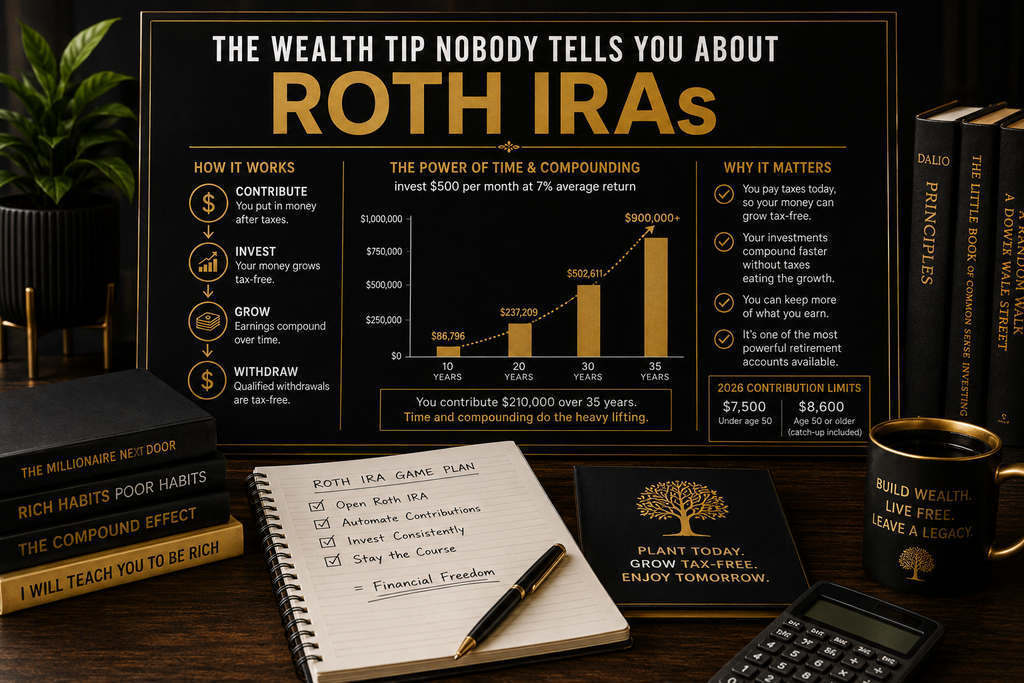
Investor.gov describes IRAs as tax-advantaged investment accounts and notes that Roth IRA contributions are made with after-tax dollars. Investment earnings and withdrawals are generally tax-free when applicable requirements are satisfied.
That’s the advantage you’re trying to put to work.
You’re paying the tax bill on the front end
One of the easiest ways to understand a Roth IRA is to compare it with a traditional IRA.
With a Roth IRA, you don’t generally receive an income-tax deduction for making the contribution.
You’ve already paid taxes on that income.
The potential reward comes later.
Under Roth rules, qualified distributions aren’t included in taxable income. The IRS generally requires the Roth IRA’s five-year requirement to be satisfied and the distribution to meet a qualifying condition, such as being made after age 59½.
Think about what that could mean after decades of investing.
You aren’t just concerned about the taxes on the money you originally contributed.
You’re thinking about the potential growth that money could generate over 20, 30 or even 40 years.
The real power shows up when you give the account decades
Let’s use a hypothetical example.
Imagine someone invests $500 per month from age 30 until age 65.
That’s 35 years.
If those investments hypothetically averaged 7% annually, that person could accumulate approximately:
$900,000.
They personally contributed only:
$210,000.
The rest would come from hypothetical investment growth.
That doesn’t mean a Roth IRA will produce 7%. Investment returns aren’t guaranteed, markets decline, and actual results depend on the investments selected, fees and other factors.
The example illustrates the bigger lesson:
Time can potentially contribute more to your wealth than you do.
That’s why waiting until you’re “making more money” to begin investing can be expensive.
You’re not only losing contributions.
You’re losing years.
Don’t confuse the contribution limit with a savings goal
For 2026, the combined annual contribution limit across your traditional and Roth IRAs is $7,500, or $8,600 if you’re age 50 or older because the 2026 IRA catch-up contribution is $1,100. Eligibility and the amount you can contribute can also depend on factors including taxable compensation and income.
If $7,500 sounds impossible, don’t let the maximum stop you from starting.
Suppose you can invest:
$50 per month.
Start there.
If your finances improve, perhaps $50 becomes $100.
Then $200.
Then $300.
Eventually you may be able to contribute much more.
The habit matters.
There’s another Roth IRA advantage people overlook
People sometimes hesitate to put money into retirement accounts because they think every dollar becomes completely inaccessible until retirement.
Roth IRAs are more nuanced.
IRS rules generally treat a return of your regular Roth IRA contributions as not taxable, and Roth distributions follow specific ordering rules. Earnings, conversions and other distributions can have different tax and penalty consequences.
That doesn’t mean you should treat your Roth IRA like an emergency checking account.
Quite the opposite.
Constantly pulling money out destroys the very thing you’re trying to build: long-term compounding.
But understanding the actual rules is better than assuming all Roth IRA money is locked away under every circumstance.
Higher earners need to pay attention to the income rules
Not everyone can make the full direct Roth IRA contribution.
For 2026, the Roth IRA contribution phase-out range is $153,000–$168,000 of modified adjusted gross income for single filers and heads of household.
For married couples filing jointly, it’s $242,000–$252,000.
Different rules apply to married people filing separately.
This is an area where understanding your tax situation—and potentially working with a qualified tax professional—becomes important.
Don’t assume eligibility simply because you have a Roth IRA account.
The biggest mistake may be waiting for the perfect time
People wait for the market to crash.
They wait for their next raise.
They wait until the debt disappears.
They wait until they understand every investment.
Then five years disappear.
You don’t need to know everything about investing before learning the basics and developing a plan appropriate for your finances.
The Roth IRA’s biggest advantage isn’t some secret investment.
It’s the combination of time, consistent contributions, investing and favorable tax treatment.
A 25-year-old contributing a modest amount has something a 55-year-old millionaire cannot purchase:
30 additional years.
Money can be earned again.
Time can’t.
Your Roth IRA should be part of a bigger wealth system
A Roth IRA isn’t your entire financial plan.
You may also need emergency savings, workplace retirement accounts, debt reduction, insurance, taxable investments, real estate, business ownership and eventually estate planning.
But a Roth IRA can occupy an important place in that system.
And here’s the wealth tip worth remembering:
Don’t simply open a Roth IRA. Fund it. Invest the money appropriately. Keep contributing. Give it time.
The account isn’t the wealth.
What you consistently build inside it is.
Build Beyond Retirement
As your investments and other assets grow, think beyond individual wealth and consider how your family can organize, protect and eventually transfer what you’re building.
Family Bank Starter System
Get the Family Bank Starter System
Family Wealth Trust Blueprint / ILIT Guide
Get the Family Wealth Trust Blueprint
SEO BLOCK
SEO TITLE: The Wealth Tip Nobody Tells You About Roth IRAs
META DESCRIPTION: The biggest Roth IRA mistake may happen after you open the account. Learn how Roth IRAs work and how to use one for long-term wealth.
URL SLUG: wealth-tip-roth-ira
FOCUS KEYPHRASE: Roth IRA wealth building
CATEGORY: Money Tips
ESTIMATED READING TIME: 5–6 minutes
FEATURED IMAGE ALT TEXT: Investor learning how a Roth IRA can be used for long-term wealth building and retirement investing.