BLACK DOLLAR & CULTURE | PERSONAL FINANCE & WEALTH BUILDING
By Sir Hannibal

A job can disappear in a single afternoon. But the financial consequences can follow a family for years.
When a paycheck stops, the bills don’t. The mortgage is still due. Groceries still need to be purchased. Insurance premiums keep coming, and credit-card interest continues accumulating.
For families already struggling to build wealth, even a temporary interruption in employment can undo years of financial progress.
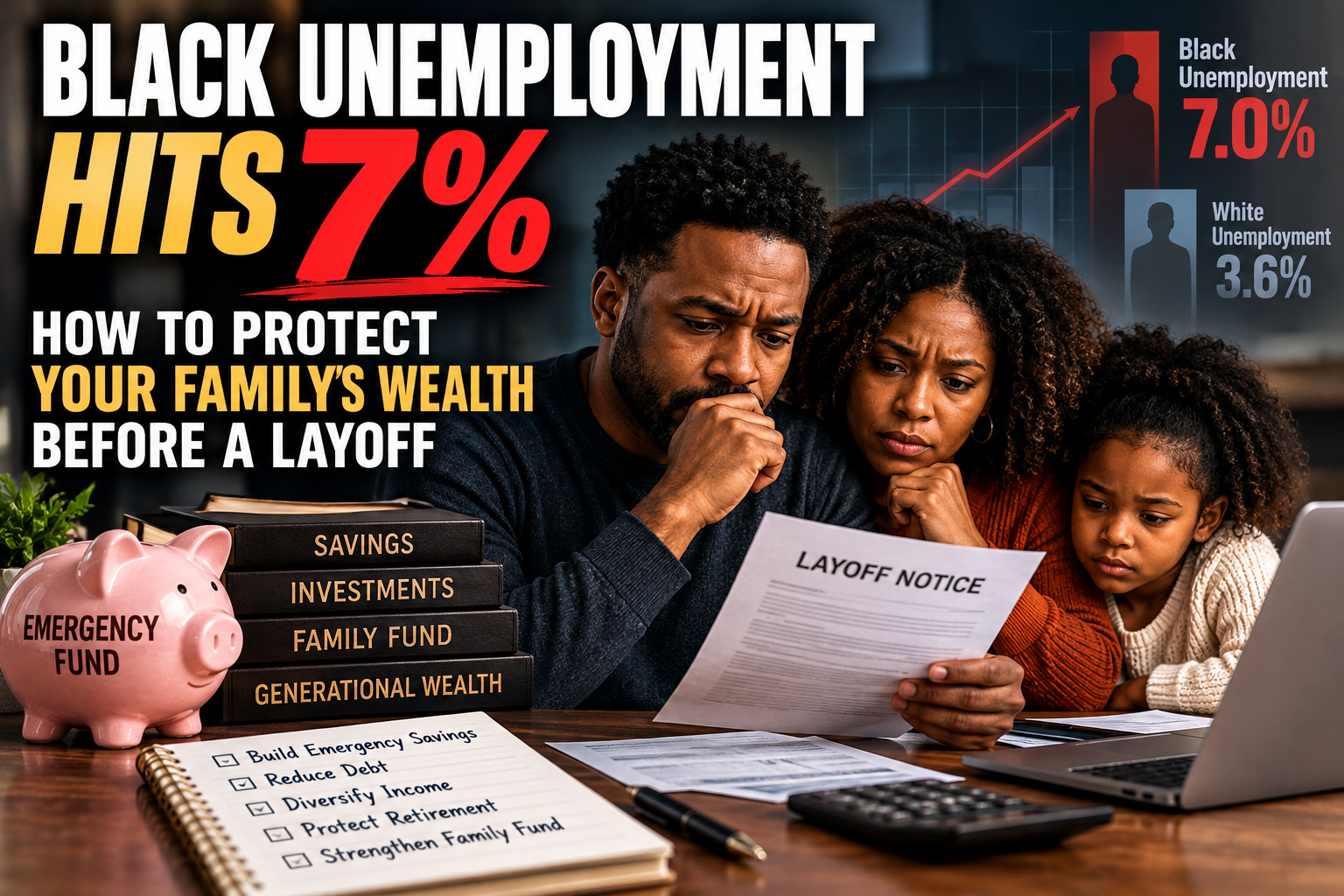
The September 2026 employment report, released October 2, raised fresh concerns about the financial vulnerability of Black households. According to the reported figures, Black unemployment climbed from 6.0% to 7.0%, while White unemployment stood at 3.6%.
That gap deserves attention, but the bigger question for Black Dollar & Culture readers is this:
How do we build a financial system that protects our families when employment is no longer guaranteed?
The answer begins with emergency savings, manageable debt, income diversification, and a more organized approach to family wealth.
What Rising Black Unemployment Means for Household Wealth
Unemployment statistics measure more than the number of people searching for work. Behind those percentages are households making difficult financial decisions.
A parent who loses employment may have to suspend retirement contributions. A homeowner may begin using credit cards to cover utilities. A family that recently started investing may sell its holdings to make the next mortgage payment.
These decisions can have consequences long after employment resumes.
Consider a household earning $65,000 annually. If its primary earner loses a job for three months, the household could lose approximately $16,250 in gross wages before accounting for unemployment benefits, severance, or replacement income.
The damage isn’t limited to those missing wages. If the family borrows money to survive, it may spend the following year repaying debt rather than rebuilding investments.
This is one reason employment instability can become a long-term wealth-building obstacle.
A single layoff doesn’t necessarily destroy wealth. But repeated financial emergencies, especially without sufficient reserves, can prevent a family from accumulating assets.
Why Black Families May Face Greater Financial Exposure
Black households are not financially identical. Some have substantial savings, investments, businesses, and property. Others are still working toward their first emergency fund.
However, historical differences in inherited wealth, homeownership, and access to financial resources can make unemployment particularly difficult for households without a financial cushion.
A family with six months of expenses in savings can approach a layoff differently from one that must immediately borrow money.
The difference isn’t simply income. It’s the amount of financial protection already in place.
This is why wealth-building conversations must extend beyond salaries and investment returns.
We need to discuss financial resilience: the ability to survive an interruption without sacrificing the assets we’re trying to build.
Your Emergency Fund Is the First Line of Defense
Before a household begins pursuing aggressive investments, it should establish accessible emergency savings.
For many households, a reasonable target is three to six months of essential living expenses. Families with variable incomes, single earners, or less stable employment may benefit from larger reserves.
Suppose your essential monthly expenses are $3,500.
| Emergency reserve | Savings target |
|---|---|
| 1 month | $3,500 |
| 3 months | $10,500 |
| 6 months | $21,000 |
| 9 months | $31,500 |
A $21,000 emergency fund might initially seem unrealistic. But it doesn’t have to be built overnight.
Start with $500. Then aim for $1,000, one month of expenses, and eventually three months.
Even setting aside $50 or $100 per week can establish a meaningful financial cushion over time.
Keep emergency money in an accessible, federally insured savings account rather than exposing it to stock-market volatility.
The purpose of this money isn’t to generate the highest possible return. Its purpose is to be available when life becomes unpredictable.
Why a Layoff Shouldn’t Automatically Destroy Your Retirement Plan
One of the most damaging consequences of unemployment is the interruption of long-term investing.
When workers leave their jobs, they may be tempted to cash out a 401(k) to cover immediate expenses.
Although retirement withdrawals may provide temporary relief, they can also trigger income taxes, possible early-withdrawal penalties, and the loss of future investment growth.
For example, $20,000 left invested for 20 years at an assumed annual return of 7% could grow to approximately $77,400.
That return isn’t guaranteed, but the illustration demonstrates the potential opportunity cost of withdrawing retirement assets early.
Before taking money from retirement accounts, households should explore available unemployment benefits, expense reductions, emergency savings, and other assistance.
Protecting retirement assets whenever reasonably possible helps prevent a temporary employment setback from becoming a permanent retirement setback.
How to Build a Family Unemployment Fund
Individual emergency savings protect one household. A properly organized family unemployment fund can provide an additional layer of protection across several households.
Imagine five working adults in an extended family who agree to contribute $100 per month to a shared reserve.
ILLUSTRATIVE FAMILY FUND
Monthly contributions
$500
After 12 months
$6,000
$0$2K$4K$6K$8KMonth 1Month 3Month 6Month 9Month 12
Assumes five members contribute $100 monthly, with no withdrawals or interest.
That $6,000 won’t replace everyone’s income, but it could help a member cover essential bills while searching for new employment.
The key is establishing rules before anyone needs assistance.
A family unemployment reserve should have a written agreement covering eligibility, maximum assistance, repayment expectations if assistance is structured as a loan, approval authority, and how funds are replenished.
It should also remain separate from money intended for business investments, real estate purchases, and long-term family wealth creation.
Family members should consider the legal, tax, and administrative implications of shared funds before pooling money. Depending on the arrangement, a formal entity or professional guidance may be appropriate.
Five Financial Moves to Make Before Your Job Is at Risk
- Calculate your survival number. Determine the minimum monthly amount required for housing, utilities, food, transportation, insurance, and essential debt payments.
- Reduce high-interest debt. Lowering required monthly payments can make unemployment easier to manage.
- Develop another income source. Freelancing, consulting, a small service business, or monetizing an existing skill may provide supplementary income, although none guarantees immediate earnings.
- Review your insurance and benefits. Understand how losing employer-sponsored coverage could affect your household and what continuation or replacement options may be available.
- Have a family financial conversation. Discuss emergency assistance, shared expectations, and whether a structured family reserve makes sense.
The Bigger Lesson: A Paycheck Is Income, Not Financial Security
The September jobs report provides an important warning.
Black unemployment rose to 7.0%, nearly twice the White unemployment rate of 3.6%. Employers added only 29,000 jobs, and previous employment estimates were revised downward.
2026 M09 Results
These figures do not establish that every Black worker faces an imminent layoff, and monthly demographic estimates can fluctuate.
But they reinforce an important principle: building wealth requires preparing for periods when income may be interrupted.
Financial security is not simply having a good job.
It means having savings, manageable obligations, productive assets, transferable skills, and a plan for financial emergencies.
At Black Dollar & Culture, the goal isn’t just to help families earn more money. It’s to help families build systems that allow their wealth to survive difficult economic conditions.
Because the real measure of financial strength isn’t only how much money a family makes. It’s how much of its future it can protect when that money temporarily stops coming in.
Start Building Your Family’s Financial System
A family bank can be one component of a broader financial protection strategy. It is not a substitute for personal emergency savings, insurance, or responsible financial planning.
If you’re ready to organize family contributions, establish financial rules, and begin building a more structured approach to generational wealth, explore these resources:
The Family Bank Starter System — Learn how to begin organizing a family financial system with rules, contributions, and accountability.
Family Wealth Trust Blueprint — Explore trust planning and strategies for protecting family assets.
SEO publishing details
Focus keyphrase
Black unemployment rate 2026 CopySEO title
Black Unemployment Hits 7%: How to Protect Your Wealth
CopyMeta description
Black unemployment reached 7% in September 2026. Learn how emergency savings, family banking, and smart financial planning can protect your wealth.
CopyURL slug
black-unemployment-rate-2026-protect-family-wealth