The 457 Plan: The Retirement Secret Government Workers Need to Know

Most people spend decades working toward retirement, only to discover that accessing their own money comes with restrictions, penalties, and limitations. But what if there was a retirement account that allowed certain workers to access their savings earlier than most Americans without the dreaded 10% early withdrawal penalty? For many government employees, that tool already exists. It’s called the 457 Deferred Compensation Plan. And it may be one of the most overlooked wealth-building tools in America. The Problem Most Workers Face Imagine spending 30 years saving money. You contribute faithfully to your retirement account. You sacrifice vacations. You skip luxuries. You invest consistently. Then one day, you decide you’re ready to leave your job. Maybe you want to start a business. Maybe you want to spend more time with family. Maybe you’re simply burned out. Then you discover that touching your retirement savings before age 59½ could trigger a 10% penalty on top of ordinary income taxes. Many Americans don’t realize this until it’s too late. The system encourages people to save, but often punishes them for wanting flexibility. This is where the 457 plan stands apart. What Is a 457 Deferred Compensation Plan? A 457 plan is a retirement savings account offered primarily to state and local government employees. This includes: Like a traditional 401(k), contributions are made before taxes. That means the money comes directly from your paycheck before Uncle Sam takes his share. Your investments grow tax-deferred until withdrawal. On the surface, it sounds very similar to a 401(k). But beneath the surface lies a major difference. The Hidden Advantage Let’s compare two workers. Worker #1 has a 401(k). Worker #2 has a 457 plan. Both are 52 years old. Both decide to leave their jobs. The 401(k) owner generally faces a 10% early withdrawal penalty if they access their retirement funds before age 59½. The 457 owner does not. Once they separate from their employer, they can generally withdraw funds without the additional penalty. Think about how powerful that is. This means the 457 isn’t simply a retirement account. It’s a flexibility account. It gives workers options. And options create freedom. Why Freedom Matters More Than Money Many people chase higher incomes their entire lives. But wealth isn’t just about money. Wealth is about control. Control over your schedule. Control over your opportunities. Control over how you spend your time. The ability to walk away from a job you no longer enjoy. The ability to pursue a business idea. The ability to care for loved ones when they need you. The ability to design your life instead of simply surviving it. That’s what makes the 457 so powerful. It gives people another path toward financial independence. Government Workers Have an Advantage Many government employees possess something that millions of Americans wish they had. Multiple retirement systems. A typical government worker may have: When used together, these tools can create a powerful financial foundation. The pension provides predictable income. The 457 provides flexibility. Additional investments create growth. The result is a retirement strategy that can provide both security and freedom. Not All 457 Plans Are Equal This is an important detail. There are two primary types of 457 plans: Governmental 457 Plans These are generally considered the safest option. Assets are held in trust for participants and remain protected. Non-Governmental 457 Plans These plans are commonly offered by certain nonprofit organizations. The assets may remain tied to the employer, creating additional risk. This is why every participant should ask: “Is my plan a governmental 457 plan?” That simple question could protect years of savings. The Power of Consistency Many people search for shortcuts. But wealth rarely comes from shortcuts. It usually comes from systems. Imagine contributing just a portion of every paycheck over decades. Those contributions grow. The growth compounds. The compounding creates momentum. Eventually, the account begins working harder than you do. That’s the real power behind retirement accounts. Not excitement. Not speculation. Not chasing trends. Consistency. As Sir Wealthington often says: Discipline looks boring until it creates freedom. Lessons for Everyone Even if you don’t have access to a 457 plan, there is still an important lesson here. The wealthy learn the rules. Most people simply work. Understanding financial systems often matters more than earning a higher income. The people who build lasting wealth usually know: Knowledge creates options. Options create freedom. Freedom creates wealth. Final Thoughts The 457 Deferred Compensation Plan isn’t flashy. It won’t go viral on social media. It won’t make headlines. But for millions of government workers, it may be one of the most valuable financial tools available. If you have access to one, learn the rules. Understand the benefits. Know the differences. And use it strategically. Because the goal isn’t simply retirement. The goal is having the freedom to choose your next chapter on your own terms. ❤️ Support Independent Black Media Black Dollar & Culture is 100% reader-powered — no corporate sponsors, just truth, history, and the pursuit of generational wealth. Every article you read helps keep these stories alive — stories they tried to erase and lessons they never wanted us to learn. Build Your Family Bank Get The Family Bank Starter System:https://stan.store/blackdollarandculture/p/the-family-bank-starter-system Protect Generational Wealth Get Your Family Wealth Trust Blueprint Now – ILIT:https://stan.store/blackdollarandculture/p/get-your-family-wealth-trust-blueprint-now Hashtags 457 Plan Government Employees Retirement Planning Financial Freedom Wealth Building Personal Finance Early Retirement Family Bank Financial Literacy Investing Tax Strategy Pension Wealth Ownership Legacy Building Black Dollar And Culture Focus Keyphrase 457 Deferred Compensation Plan Slug 457-deferred-compensation-plan-explained Meta Description Learn how a 457 Deferred Compensation Plan works, why government workers have a unique retirement advantage, and how this powerful account can help create financial freedom and early retirement flexibility.

War, Inflation, and Survival: What Families Must Do Before Prices Rise Again

A war can begin thousands of miles away, but its effects often show up right in your neighborhood. Higher gas prices. More expensive groceries. Rising utility bills. Empty shelves. Economic uncertainty. Every time global conflict erupts, ordinary families end up paying the price. Not on the battlefield—but at the gas pump, in the grocery aisle, and through higher living costs. The families that survive economic storms aren’t always the richest. They’re often the most prepared. The question isn’t whether prices will rise again. History shows they will. The real question is: What are you doing today to protect your family tomorrow? Build A Family Emergency Fund Every family should have a financial cushion for unexpected events. Aim to save three to six months of essential expenses. This fund can help cover emergencies without relying on high-interest debt or credit cards. Economic uncertainty becomes easier to navigate when cash reserves are available. A family with savings has options. A family without savings has stress. Lesson: Cash creates options when times get tough. Create A Family Bank Strong families don’t just earn money—they organize it. A Family Bank allows relatives to pool resources, support one another during emergencies, fund business opportunities, and build wealth across generations. Instead of every household struggling alone, families can work together toward shared financial goals. The wealthy have used family financial systems for generations. There is no reason everyday families cannot do the same. Lesson: Unity creates economic strength. Reduce High-Interest Debt Inflation makes everything more expensive, including debt. Every dollar going toward credit card interest is a dollar that cannot be invested into your family’s future. Focus on eliminating high-interest balances and redirect those savings toward emergency funds, assets, and investments. Lesson: Debt limits flexibility during uncertain times. Grow Your Own Food You don’t need acres of land to begin producing food. A backyard, patio, balcony, or community garden can provide fresh vegetables and herbs while reducing grocery expenses. Consider growing: Many previous generations maintained gardens because they understood a simple truth: producing even a portion of your own food increases independence. Every tomato grown is one less tomato purchased. Lesson: Food security is financial security. Buy Essential Items Before Prices Rise When inflation accelerates, necessities often become more expensive. Gradually stock essentials such as: The goal isn’t panic buying. The goal is preparation. Lesson: Prepared families are less vulnerable to sudden price shocks. Carpool And Share Transportation Costs Fuel prices are often among the first expenses affected by global instability. Families, coworkers, church members, and neighbors can reduce costs through: Money saved on transportation can be redirected into savings, investments, or your Family Bank. Lesson: Cooperation lowers costs. Buy In Bulk As A Family One household has limited buying power. Several family members working together can purchase larger quantities of food and household essentials at lower prices. Bulk purchasing also creates a buffer against future shortages and inflation. This is group economics in action. Lesson: Group economics works. Learn To Repair Instead Of Replace When prices rise, replacing everything becomes expensive. Learning basic skills can save thousands over time: Every repair is money that stays in your family’s pocket. Lesson: Skills are assets. Invest In Skills That Produce Income Economic conditions may change, but valuable skills remain valuable. Consider learning: Skills create opportunities that inflation cannot easily destroy. Lesson: Your greatest asset is your ability to produce value. Diversify Your Income Depending on one paycheck can be risky during uncertain times. Look for additional income streams through: Multiple streams of income provide stability when one source is disrupted. Lesson: Wealthy families rarely rely on a single source of income. Buy Assets, Not Just Stuff Many people spend money on liabilities while neglecting assets. Consider acquiring assets that can generate income or appreciate over time: Assets help families fight inflation rather than merely survive it. Lesson: Assets create financial resilience. Protect Wealth With Proper Planning Building wealth is important. Keeping it is even more important. Many families lose assets through probate, taxes, poor planning, and lack of financial structure. Tools such as trusts and life insurance can help protect what you’ve built for future generations. Final Thoughts As prices rise and uncertainty grows, the answer isn’t panic. The answer is preparation. Build a Family Bank. Grow food. Reduce debt. Carpool. Buy in bulk. Learn useful skills. Create multiple streams of income. Strengthen family relationships. The families that thrive during difficult times are often the ones that depend less on outside systems and more on each other. While others complain about rising prices, your family can be building a foundation strong enough to weather any economic storm. ❤️ Support Independent Black Media Black Dollar & Culture is 100% reader-powered — no corporate sponsors, just truth, history, and the pursuit of generational wealth. Every article you read helps keep these stories alive — stories they tried to erase and lessons they never wanted us to learn. FAQ Will war always cause inflation? Not always, but wars often disrupt energy supplies, transportation, trade routes, and production, which can contribute to higher prices. How much emergency savings should I have? Most financial experts recommend three to six months of essential living expenses. Can I start a Family Bank with very little money? Yes. The habit and structure matter more than the starting amount. Many successful family systems begin with small weekly contributions. What is the easiest food to grow for beginners? Tomatoes, peppers, herbs, lettuce, and collard greens are popular beginner-friendly options. Hashtags #BlackDollarAndCulture #FamilyBank #Inflation #EconomicPreparedness #GenerationalWealth #FinancialLiteracy #GroupEconomics #BlackWealth #WealthBuilding #EmergencyFund #FoodSecurity #FinancialFreedom #AssetBuilding #CommunityEconomics #FamilyLegacy Focus Keyphrase War and Rising Prices Slug war-inflation-and-survival-family-preparation-guide Meta Description Learn how to protect your family from rising prices, inflation, and economic uncertainty through Family Banks, emergency savings, gardening, bulk buying, carpooling, asset ownership, and wealth-building strategies.

What If 20 Families Started a Bank? The Community Wealth Blueprint That Could Change Everything

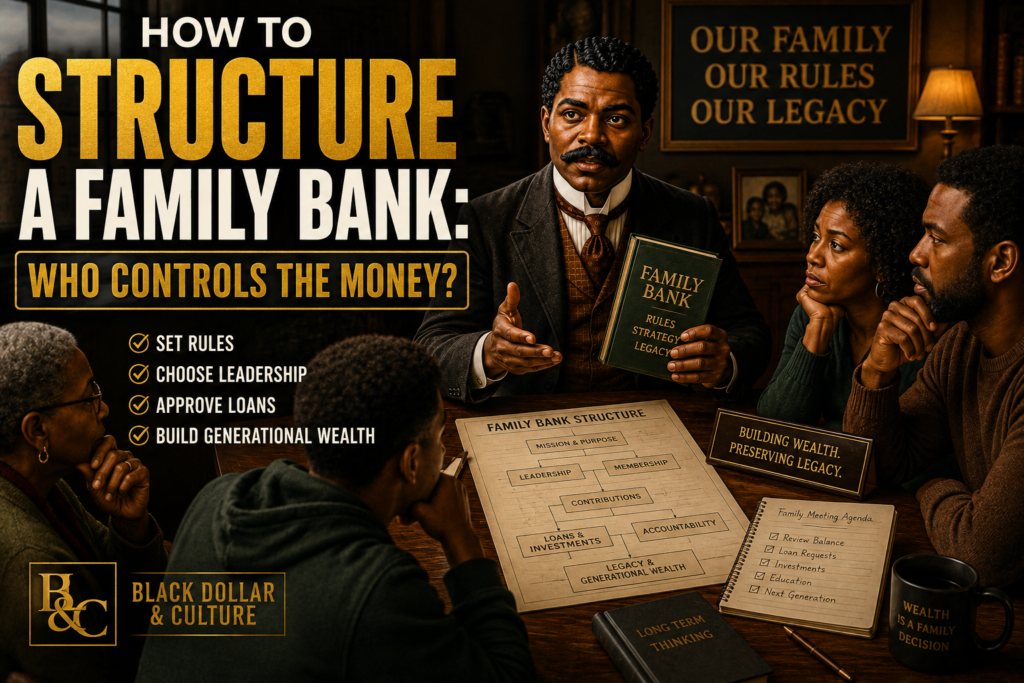
Most families are taught to survive individually. Work harder.Save what you can.Handle emergencies alone.Take on debt when life gets difficult. But wealthy communities have often understood something different: Group economics multiplies power. So what would happen if twenty families stopped building separately… and started building together? Not a literal licensed bank. But a structured community wealth system designed around ownership, circulation, discipline, and long-term legacy. Think about it. If twenty families contributed just $500 per month into a structured economic system, that would create: Now imagine what that capital could potentially support: Suddenly, families are no longer depending entirely on outside institutions for every opportunity. That changes the mindset completely. Why Group Economics Matters One of the biggest problems in struggling communities is not always the absence of money. It is often the absence of systems. Money enters the community…and immediately leaves the community. No circulation.No ownership.No infrastructure.No long-term strategy. That is why concepts like: have historically been so powerful. Black Wall Street understood this. Mutual aid societies understood this. Church communities once understood this deeply. The goal was never simply making money. The goal was creating systems capable of sustaining future generations. This is exactly why the Family Bank concept matters. A Family Bank is not a physical bank building. It is a structured system where families organize money intentionally instead of emotionally. The Family Bank teaches: Instead of constantly financing everything through outside lenders, families begin creating internal systems of support and capital. That mindset shift is powerful. 📘 Build Your Own Family Wealth Structure Here:The Family Bank Starter System Why Structure Matters Now let’s be clear. Any community wealth system requires: Without structure, money becomes chaos. That is why wealthy institutions operate through systems and policies. Not emotions. The same principle applies to families and communities. The ILIT and Legacy Protection Building wealth is one thing. Protecting wealth is another. That’s why wealthy families often use trusts and structured estate planning strategies to help preserve assets across generations. One powerful concept is the ILIT:Irrevocable Life Insurance Trust. An ILIT can help structure how life insurance wealth is transferred, protected, and distributed to heirs. Because many families receive money with no instructions, no protections, and no long-term strategy. That is one reason wealth disappears quickly. 🏦 Learn More About ILIT Wealth Protection Here:Get Your Family Wealth Trust Blueprint Now – ILIT The Bigger Question What would happen if families stopped building alone? What would happen if communities focused on: instead of only survival? That question could change entire communities. Because the goal is not just making money. The goal is building systems strong enough to outlive us. #GroupEconomics #FamilyBank #BlackDollarAndCulture #GenerationalWealth #CommunityWealth #BlackWallStreet #CooperativeEconomics #Ownership #EconomicPower #ILIT #WealthBuilding #FamilyLegacy #BuildTogether #CommunityBank #FinancialFreedom Focus Keyphrase: What If 20 Families Started a BankSlug: what-if-20-families-started-a-bankMeta Description: Discover how 20 families pooling resources could create a powerful community wealth system through group economics, ownership, Family Banking, and ILIT wealth protection strategies.

If You Don’t Control the Flow of Money… You Don’t Control Your Future (PowerNomics)

There are moments in history when the answers are already written… but ignored. In 1995, Dr. Claud Anderson released PowerNomics — not as motivation, not as theory, but as a blueprint. A structured plan to build economic power through one principle most people still overlook: group economics. And decades later, the question isn’t whether it works… it’s whether we’re finally ready to apply it. Because the issue was never a lack of talent, creativity, or ambition. The issue has always been structure. Money flows in… and flows right back out. Paychecks are earned, spent, and gone before they ever have the chance to circulate, multiply, or build anything lasting. That’s not an economy — that’s a pass-through system. And as long as money behaves that way, wealth will never take root. Group economics starts with a simple but uncomfortable truth: you cannot build wealth alone in a system designed around collective power. Every successful community understands this. Their money doesn’t just move — it moves with intention. It circulates internally. It supports businesses within the group. It hires within the group. It builds systems that reinforce itself before reaching outward. That’s not accidental. That’s design. When Dr. Claud Anderson laid out this framework, he wasn’t asking for support out of sympathy — he was outlining a strategy of survival and control. Because whoever controls the flow of money… controls the outcome. And when money leaves immediately, so does opportunity, ownership, and influence. Think about it in real terms. A dollar earned today can either disappear by tomorrow… or circulate five, six, seven times — creating jobs, sustaining businesses, and funding growth along the way. That’s the difference between spending and building. One is temporary. The other is intentional. But group economics requires a shift in thinking — from individual success to collective progress. It means asking different questions before every transaction: Who am I supporting? Where is this money going? What is this building? Because every dollar is a vote. And too often, those votes are cast without strategy. The blueprint is clear. First, money must circulate. Then, ownership must follow. Then institutions are built. And finally, legacy is secured. But without that first step — without group economics — everything else collapses before it ever begins. This is why so many efforts fail. People jump straight to ownership without circulation. They try to build institutions without a base. They aim for wealth without a system to sustain it. And when the foundation isn’t there, nothing holds. That’s what makes this conversation different. This isn’t about doing more. It’s about doing differently. Because once money begins to circulate, something powerful happens. Businesses stabilize. Networks form. Opportunities increase. And slowly, control begins to shift. Not overnight — but consistently. That’s how real economic power is built: quietly, strategically, and collectively. And that’s exactly why this message still matters today. Because the blueprint was never lost. It was just never fully applied. So the real question isn’t whether group economics works… It’s whether we’re finally ready to stop letting money pass through our hands — and start making it work for us. Start Building the System (Don’t Just Learn It) If this message resonates, the next step is structure — not just understanding. 👉 Build Your Internal Economy (Family Bank Starter System)https://stan.store/blackdollarandculture/p/the-family-bank-starter-system 👉 Protect & Pass Down Wealth (ILIT Trust Blueprint)https://stan.store/blackdollarandculture/p/get-your-family-wealth-trust-blueprint-now Because building wealth is one thing… Keeping it — and passing it down — is everything. 🔁 Support the Movement 👉 Discover and support businesses that keep money circulating:https://blkcirculation.com 📊 FAQ: Group Economics & PowerNomics What is group economics?It’s the practice of circulating money within a community to build collective wealth, reduce dependency, and increase economic control. Why is group economics important?Because money that leaves immediately cannot multiply. Circulation is what turns income into wealth. What did Dr. Claud Anderson teach in PowerNomics?That economic power comes from structure — group economics, ownership, institutions, and long-term planning. Why hasn’t this been widely applied?Because most systems condition individuals to operate independently rather than collectively, weakening economic impact. 🔑 Final Thought They knew this in 1995. The blueprint didn’t change. The system didn’t change. The only thing left… is whether we will. #GroupEconomics #PowerNomics #ClaudAnderson #BlackWealth #GenerationalWealth #EconomicEmpowerment #Ownership #WealthBuilding #FinancialLiteracy #BlackBusiness #CommunityWealth #MoneyCirculation #FamilyBank #ILIT #WealthStrategy Group Economics PowerNomics group-economics-powernomics-1995-blueprint Discover Dr. Claud Anderson’s Group Economics blueprint from PowerNomics and learn how to build, circulate, and protect generational wealth today.

PowerNomics Explained: The 1995 Blueprint for Black Wealth We Still Haven’t Used

In 1995, a blueprint was laid out that most people never truly studied. Not because it was hidden.Not because it was complicated. But because it required something most people weren’t ready for: Discipline, structure, and long-term thinking. Dr. Claude Anderson didn’t speak in vague ideas. He didn’t deal in motivation. He laid out a system — one that explained exactly why wealth wasn’t sticking, and what it would take to change that. And if we’re being honest… The problem was never a lack of information. It was a lack of application. The Real Issue Was Never Just Money Most people think the problem is income. “If we just made more, everything would change.” But that’s not how wealth works. Dr. Anderson pointed to something deeper — something most people overlook: Control. You can make money and still be broke in the long run if you don’t control: If money comes in and immediately leaves, it doesn’t matter how much you earn. You’re not building wealth. You’re financing someone else’s. How Money Actually Builds Power Let’s slow this down and make it real. Imagine two different communities. Community A The money is gone within days. No ownership. No return. No growth. Community B Now that same dollar: It doesn’t just move. It multiplies. That’s the difference between spending and circulation. And that difference determines everything. Why Ownership Is the Foundation One of the clearest messages from PowerNomics is this: If you don’t own it, you don’t control it. That applies to: When you don’t own these, you are always operating inside someone else’s system. That means: You participate… but you don’t direct. And participation without ownership doesn’t build lasting wealth. The Hidden Trap: High Income, No Structure This is where a lot of people today get caught. There are more people making money now than ever before. But ask yourself: Because here’s the reality: You can have a high income and still leave nothing behind. Why? Because income without structure turns into: But not long-term power. Why Wealth Keeps Resetting Every Generation This is one of the most important parts of the conversation. A generation works hard. They buy a house.They save some money.They build something. Then life happens: And because there’s no structure: So the next generation… Starts over. That’s not bad luck. That’s a missing system. The Part PowerNomics Tried to Fix Dr. Anderson wasn’t just pointing out problems. He was trying to install a mindset shift: From: To: From: To: From: To: Because wealth isn’t about one person getting ahead. It’s about building something that continues after you’re gone. What This Looks Like in Real Life Let’s bring this down to something practical. Instead of thinking:“I made money this year.” The question becomes:“What system did I build this year?” That could mean: Because once systems are in place… Money starts working differently. This Is Where Most People Need to Get Serious A lot of people agree with these ideas. But agreement doesn’t change anything. Execution does. And execution requires: Because the default system is designed for money to leave your hands. You have to intentionally build something that keeps it. If You’re Ready to Move From Ideas to Structure This is where most people stop. They understand the concept… but don’t build the system. If you’re serious about applying what you just read, you need tools that actually help you implement it. 👉 Start building your internal system here:The Family Bank Starter Systemhttps://stan.store/blackdollarandculture/p/the-family-bank-starter-system 👉 Make sure what you build actually lasts:Get Your Family Wealth Trust Blueprint (ILIT)https://stan.store/blackdollarandculture/p/get-your-family-wealth-trust-blueprint-now 👉 Understand the deeper historical context behind all of this:The First World Before Erasurehttps://stan.store/blackdollarandculture/p/the-first-world-before-erasure The Truth Most People Don’t Want to Say Out Loud The blueprint wasn’t missing. It wasn’t hidden. It was there. Since 1995. Clear. Direct. Actionable. So the real question now isn’t about awareness. It’s about accountability. What are you going to build with the information you already have? FAQ What is PowerNomics?A framework created by Dr. Claude Anderson focused on building wealth through ownership, group economics, and strategic control of resources. Why is ownership more important than income?Because ownership gives you control over assets, opportunities, and long-term wealth, while income alone is temporary. What is a Family Bank?A structured system where families pool and circulate money internally to fund opportunities and build wealth collectively. What is an ILIT and why does it matter?An Irrevocable Life Insurance Trust helps protect and transfer wealth efficiently, preventing assets from being lost through taxes or poor planning. #PowerNomics #BlackWealth #GroupEconomics #OwnershipMatters #GenerationalWealth #FamilyBank #FinancialStrategy #WealthBuilding #EconomicPower #BlackDollar Focus Keyphrase: PowerNomics Blueprint ExplainedSlug: powernomics-blueprint-explainedMeta Description: A deep breakdown of Dr. Claude Anderson’s PowerNomics blueprint and how ownership, circulation, and structure build real generational wealth.

10 Ways the System Blocks Wealth (And What to Do About It)

Let’s be real for a second. Most people aren’t broke because they’re lazy. They’re stuck because they were never shown how money actually works—and in many cases, the system is designed to keep it that way. Not in a conspiracy-theory way… but in a very practical, everyday way. The rules of money are there—but they’re not taught where most people spend their time: school, work, and even at home. So what happens? You play the game without knowing the rules. Let’s break down 10 real ways the system blocks wealth—and more importantly, how you move around it. 1. School Teaches You to Work, Not Build From a young age, you’re trained to follow instructions, meet deadlines, and aim for a “good job.” But there’s almost zero focus on ownership, investing, or building assets. What to do instead:Start learning money on your own terms. Study: Your real education begins after school ends. 2. The 9–5 Trap A job gives stability—but it also caps your time and income. You’re trading hours for dollars, and there’s only so many hours in a day. What to do instead:Keep your job if needed—but build something on the side: The goal isn’t to quit your job fast—it’s to outgrow it. 3. Taxes Hit Workers the Hardest Employees get taxed before they even see their money. Meanwhile, businesses and investors often get tax advantages. What to do instead:Learn how to legally reduce taxes by: Don’t just make money—learn how to keep it. 4. Credit Is Used Against You Instead of For You Most people use credit to survive—cars, clothes, emergencies—then get stuck in high-interest cycles. What to do instead:Use credit strategically: 5. Consumer Culture Keeps You Spending Everywhere you look, you’re being told to buy something. New phone, new car, new look. It’s designed to keep your money moving… just not toward you. What to do instead:Shift from consumer to owner: 6. Lack of Ownership Most people don’t own anything that produces income. No stocks, no businesses, no real estate—just bills. What to do instead:Start small, but start: Ownership is the real key to wealth. 7. Information Is Scattered and Confusing There’s so much financial information online—but it’s either too complex, too basic, or straight-up misleading. What to do instead:Stick to simple, proven principles: Don’t chase every trend—build a foundation. 8. Debt Is Normalized Debt isn’t always bad—but the way it’s pushed on people is dangerous. High-interest debt keeps you working just to stay afloat. What to do instead:Control your debt: 9. No Blueprint for Generational Wealth Most families pass down habits—not assets. So every generation starts from scratch. What to do instead:Become the blueprint: This is how cycles get broken. 10. Fear and Lack of Exposure If you’ve never seen wealth up close, it can feel out of reach. Fear of losing money keeps people from even starting. What to do instead:Expose yourself to new environments: Confidence comes from action—not waiting. Final Thoughts The system doesn’t reward people who just “work hard.” It rewards people who understand how money flows—and position themselves on the right side of it. Once you see that, everything changes. You stop chasing money…And start building systems that bring it to you. If you’re serious about taking control of your financial future, start building your own structure: 👉 The Family Bank Starter Systemhttps://stan.store/blackdollarandculture/p/the-family-bank-starter-system 👉 Get Your Family Wealth Trust Blueprint (ILIT)https://stan.store/blackdollarandculture/p/get-your-family-wealth-trust-blueprint-now These aren’t theories—these are tools to help you move differently with money and start thinking long-term. Hashtags (copy & paste):#BlackWealth #GenerationalWealth #FinancialFreedom #MoneyMindset #WealthBuilding #Ownership #InvestingBasics #FamilyBank #FinancialLiteracy #BuildAssets Focus Keyphrase: system blocks wealthSlug: system-blocks-wealthMeta Description: Discover 10 ways the system blocks wealth and learn practical steps to build financial freedom, ownership, and generational wealth starting today.

The Only 3 ETFs You Need to Build Real Wealth (Stop Overcomplicating Investing)

There’s a lie being sold every day in the financial world…That you need dozens of stocks, constant trades, and perfect timing to build wealth. But the truth? The people who quietly build real wealth… don’t move like that. They don’t chase.They don’t guess.They own systems. And one of the most powerful systems ever created… is the ETF. Because an ETF isn’t just a stock.It’s ownership in an entire strategy. It’s how the wealthy simplify what others overcomplicate. So let’s strip everything down. If you had to build wealth from scratch…If you wanted something simple, powerful, and proven… There are only three ETFs you really need. 1. Vanguard S&P 500 ETF (VOO) — Owning the System This is where wealth begins. When you buy VOO, you’re not buying a random investment…You’re buying into the 500 most powerful companies in America. Apple.Microsoft.Amazon.The companies that shape the world you live in. This is the machine behind the economy. And here’s what most people miss:You don’t need to guess which company will win…Because VOO already owns the winners. Over time, weak companies fall off.Strong companies rise. And you stay positioned… the entire time. This is how real wealth compounds quietly. 👉 If the system grows… you grow. 2. Invesco QQQ (QQQ) — Owning the Future If VOO is the system… Then QQQ is the future of that system. This ETF is heavy in technology, AI, and innovation.The companies that are not just participating in the economy… They are reshaping it. Artificial intelligence.Cloud computing.Digital infrastructure. This is where the next wave of wealth is being created. Yes, it moves faster.Yes, it drops harder sometimes. But that volatility? That’s the price of outsized growth. 👉 This is where wealth accelerates. 3. Vanguard Total Stock Market ETF (VTI) — Owning What’s Next Now this is where strategy becomes complete. VTI doesn’t just give you the biggest companies… It gives you everything. Small businesses.Mid-sized companies.Future giants that haven’t been discovered yet. Because every billion-dollar company…Started small. And VTI quietly positions you in those early stages. So while everyone is chasing what’s already big… You’re already invested in what’s coming next. 👉 This is how you stay ahead without guessing. The Wealth Formula (Simple, But Powerful) Here’s how a disciplined investor would move: No stress.No constant trading.No confusion. Just ownership… across the entire economic spectrum. Why This Matters (The Part They Don’t Teach) Most people are stuck in survival mode financially. Saving money.Spending money.Repeating the cycle. But wealthy families? They build systems where money circulates and grows. This is where your strategy shifts. Instead of just earning income…You begin owning assets that produce it. And when structured correctly… These same assets can become the foundation of something bigger: A Family Bank. Where your money: 👉 That’s how wealth stops being temporary… and becomes legacy. If You’re Serious About Building Real Wealth Start simple. Pick your structure.Stay consistent.Think long-term. And if you want to take it further… Learn how to turn investments like these into a full wealth system your family can use for generations: 👉 The Family Bank Starter Systemhttps://stan.store/blackdollarandculture/p/the-family-bank-starter-system 👉 Get Your Family Wealth Trust Blueprint (ILIT)https://stan.store/blackdollarandculture/p/get-your-family-wealth-trust-blueprint-now Final Thought The goal isn’t to look rich. The goal is to build something that lasts. Because once you understand this… You stop chasing money. And start owning the systems that create it. #ETFInvesting #GenerationalWealth #BlackDollarAndCulture #FamilyBank #StockMarketForBeginners #WealthBuilding #FinancialFreedom #InvestSmart #PassiveIncome #Ownership Focus Keyphrase Top 3 ETFs to build wealth Slug top-3-etfs-to-build-wealth Meta Description Discover the top 3 ETFs to build real wealth. Learn how VOO, QQQ, and VTI create a simple, powerful strategy for long-term financial growth and ownership.

After Integration: Why Black Wealth Stalled — And What We Must Do Now

There was a moment in American history when the doors finally opened. Schools began to integrate. Businesses that once turned us away now allowed us to walk in. Opportunities that were once denied started to appear within reach. From the outside, it looked like progress.It looked like victory. But underneath that surface… something else was happening. Because while we were celebrating access, we were quietly losing control. Before integration, Black communities had no choice but to depend on themselves. And out of that necessity came something powerful—circulation. Black dollars moved through Black hands. Black doctors served Black families. Black teachers educated Black children. Black banks funded Black dreams. Entire ecosystems were built, not because it was trendy… but because it was required. Places like Tulsa’s Greenwood District—often called Black Wall Street—weren’t accidents. They were the result of forced unity, economic discipline, and a clear understanding: if we don’t build for ourselves, nobody will. But integration changed the direction of that energy. For the first time, we were allowed to spend freely outside of our communities. And understandably, many did. After generations of exclusion, the ability to go anywhere felt like freedom. But here’s the part nobody talks about enough: Access without ownership is not power. Because while we gained access to other systems… we slowly stopped investing in our own. The same dollar that once circulated multiple times within our neighborhoods began to leave almost immediately. Black-owned businesses, once the backbone of the community, started losing consistent support. Institutions we built out of necessity were now competing with systems that had far more resources, visibility, and capital. And over time, the shift became clear. We integrated into the economy…But we didn’t anchor ourselves within it. So instead of controlling wealth, we began participating in it. There’s a difference. Participation means you can spend money.Control means you can direct where it goes, how it grows, and who it benefits. And that difference is what we’re still feeling today. Now let’s be clear—this is not about going backwards. This is not about rejecting integration. This is about understanding what was lost… so we can rebuild it with intention. Because the real issue was never integration itself. The issue was that we integrated without a strategy. We entered larger systems without building strong systems of our own first. We pursued inclusion without securing ownership. And we adopted spending habits without maintaining economic discipline. And the result? We became some of the most influential consumers in the world…But not the most powerful owners. So the question becomes: What must we do now? Not emotionally.Not politically.But economically. Because wealth is not built through feelings—it’s built through systems. 1. Rebuild Internal Circulation (The Foundation) Every strong community has one thing in common: money flows within it before it flows out. Right now, the Black dollar leaves the community faster than almost any other group. That means even when money is earned, it doesn’t stay long enough to multiply. This is where intentionality comes in. Supporting Black businesses is not just about culture—it’s about economics. Every dollar spent internally creates jobs, strengthens businesses, and builds stability. And this is exactly where action meets solution. Because one of the biggest problems today isn’t willingness… it’s visibility. People want to support Black businesses.They just don’t always know where to find them. That’s why platforms like: 👉 https://blkcirculation.com …are so important right now. BLK Circulation is built to solve the discovery problem—connecting the community directly to Black-owned businesses so the dollar doesn’t just get earned… it gets recycled. Instead of money leaving immediately, it can now circulate intentionally. Discover. Support. Build. That’s how ecosystems are rebuilt. 2. Build Family Financial Systems (Not Just Income) Income alone doesn’t create wealth. Systems do. Most families operate financially as individuals—everyone earning, spending, and surviving on their own. But wealthy families think differently. They operate like institutions. That’s where the concept of a Family Bank comes in. Instead of sending interest to outside banks, families can create internal lending systems—funding businesses, covering emergencies, and keeping capital circulating within the family unit. This is how money starts to work for the family instead of constantly leaving it. 👉 Start building yours here:💰 Family Bank Starter Systemhttps://stan.store/blackdollarandculture/p/the-family-bank-starter-system 3. Protect Wealth Before You Build It One of the biggest mistakes people make is focusing only on making money… without protecting it. Because if wealth isn’t structured properly, it can disappear just as fast as it’s created—through taxes, legal issues, or lack of planning. This is where tools like trusts come in. An Irrevocable Life Insurance Trust (ILIT) allows families to pass down wealth efficiently, avoiding unnecessary taxation and ensuring the next generation actually benefits. 👉 Learn how to structure yours here:🛡️ ILIT Trust Blueprinthttps://stan.store/blackdollarandculture/p/get-your-family-wealth-trust-blueprint-now 4. Shift From Consumer Identity to Owner Identity We’ve mastered influence. Music. Culture. Trends. Style. Language. But influence without ownership is rented power. The next level is ownership. Ownership of businesses.Ownership of land.Ownership of systems.Ownership of platforms. Because when you own, you don’t just participate in the economy—you shape it. 5. Think in Generations, Not Moments Everything changes when the mindset shifts from: “What can I do this year?”to“What can my family control in 30 years?” That’s how wealth is built. Not through one viral moment.Not through one paycheck.But through consistent systems that outlive the individual. The truth is… integration gave us access. But access alone was never the goal. Ownership is. Control is. Legacy is. And the next chapter won’t be defined by what we were allowed into… It will be defined by what we build, protect, and pass down. Because the real power was never just in being included. It’s in owning the system itself. Two families. Same income. Different mindset.One spends freely and hopes for the best.The other builds systems, protects assets, and circulates money intentionally. Ten years later, one is still working for money…The other has money working for them. The difference isn’t luck. It’s structure. If you’re ready to stop just participating in the economy—and start building

How to Make Money in 2026 (Even If You’re Starting From Zero)

There’s a moment most people eventually face. You look at your income, your job, your future… and you start asking yourself: “Is this really enough?” You’re working. You’re trying. You’re doing what you were told to do. But somehow, the money still doesn’t stretch the way it should. That’s when the realization hits: Making money isn’t about working harder. It’s about understanding how money actually works. The Shift: Earned Income vs Created Income Most people rely on one source: But those who build wealth operate differently. They focus on: The difference is control. If your income depends on your time, it has a limit.If your income depends on systems, it can scale. 7 Real Ways to Make Money (Starting Today) 1. Digital Products You no longer need inventory to start making money. You create it once and sell it repeatedly. This is one of the most scalable ways to build income online. 2. Service-Based Hustles If you need money quickly, this is the fastest route. People consistently pay for convenience. This creates immediate cash flow with low startup cost. 3. Content Creation Content builds long-term income and authority. The key is not random posting. Focus on searchable, valuable topics like financial literacy, credit, and wealth-building strategies. 4. Reselling This is one of the simplest ways to start. Buy undervalued items and sell them for a profit. It teaches basic business fundamentals quickly. 5. Affiliate Marketing You earn money by recommending products or services. You don’t need to create your own product to start generating income. 6. AI and Automation Services This is one of the fastest-growing opportunities. Businesses are actively paying for efficiency. Those who learn these tools early gain a major advantage. 7. Investing This is where long-term wealth is built. However, investing should come after you increase your income. You need capital before you can grow it. Credit: A Tool or a Trap Credit is one of the most misunderstood parts of finance. Used correctly, it can help you build and scale. Used incorrectly, it can keep you in debt. Smart Use of Credit: Misuse of Credit: Credit should be used strategically, ideally to support income-producing activities. The Problem Most People Overlook Learning how to make money is only the first step. Many people earn income but still struggle financially over time. Why? Because they lack systems. They don’t structure how money is saved, used, or passed down. As a result, wealth doesn’t last beyond one generation. The Wealth Strategy Most People Miss There are two systems that consistently separate those who build lasting wealth from those who don’t. Build a Family Bank Instead of relying entirely on external lenders, you begin to create internal access to capital. Start here:Family Bank Starter Systemhttps://stan.store/blackdollarandculture/p/the-family-bank-starter-system Protect Wealth With a Trust (ILIT Strategy) This is how wealth is preserved and transferred efficiently. Learn more here:ILIT Wealth Blueprinthttps://stan.store/blackdollarandculture/p/get-your-family-wealth-trust-blueprint-no Final Thought Making money is the entry point. Keeping it, growing it, and transferring it is what builds real wealth. Two people can earn the same income and end up in completely different positions over time. The difference is not effort.It’s structure. Call to Action If you’re serious about improving your financial position, start building systems, not just income. Family Bank Starter Systemhttps://stan.store/blackdollarandculture/p/the-family-bank-starter-system ILIT Wealth Blueprinthttps://stan.store/blackdollarandculture/p/get-your-family-wealth-trust-blueprint-now FAQ What is the fastest way to make money?Service-based work such as cleaning, detailing, or moving services typically provides the quickest income. How can beginners make money online?Digital products, affiliate marketing, and content creation are accessible starting points. Is credit helpful or harmful?It depends on usage. Proper management builds leverage; misuse creates long-term debt. how to make money,make money online,side hustles 2026,financial literacy,build wealth,family bank,credit tips,passive income,black wealth,generate income,make money fast,bdc Focus Keyphrase How to Make Money Slug how-to-make-money-2026 Meta Description Learn how to make money in 2026 with proven side hustles, smart credit strategies, and wealth-building systems like the Family Bank and ILIT.

How Black Wall Street REALLY Built Wealth (And Why It Was Destroyed)

There was a time in America when Black wealth wasn’t a theory… it was a system. Not a trending topic.Not a motivational speech.Not something people were “trying” to figure out. It was already working. In Tulsa, Oklahoma—specifically in a community called Greenwood—Black families had quietly built one of the most powerful economic ecosystems this country had ever seen. And they did it under conditions most people today wouldn’t survive in for a week. No access to traditional banks.Limited protection under the law.Constant racial hostility. And still… they built wealth. Not just money.Not just businesses.But circulation. That’s the part most people miss. Because Black Wall Street wasn’t rich because of one big entrepreneur. It was rich because the money never left. The System That Made Greenwood Powerful If you walked through Greenwood in the early 1900s, you wouldn’t see struggle. You’d see ownership. Hotels.Restaurants.Barbershops.Doctors.Lawyers.Movie theaters.Grocery stores.Banks. Over 600 Black-owned businesses operating in one concentrated area. But here’s what made it different… When a dollar entered Greenwood, it stayed there. One family would earn it.Another family would spend it.Another family would reinvest it.Another family would grow it. And that same dollar could circulate dozens of times before ever leaving the community. Today, in many communities, a dollar leaves within hours. Back then? It moved like blood through a body. That’s not luck. That’s design. No Banks? No Problem. Let’s talk about something most people don’t realize… Greenwood didn’t rely on traditional banking systems the way we do today. Because they couldn’t. So what did they do? They created their own. Informal lending.Community-backed investments.Business partnerships.Trust-based capital. If someone wanted to start a business, they didn’t go begging to a bank that didn’t believe in them. They went to their people. And their people funded them. Not because it was charity…But because it was understood: “If you win, we all win.” That mindset alone is worth more than any loan approval. Wealth Was Built Through Ownership, Not Income This is where things start to separate from today’s thinking. Greenwood wasn’t built on jobs. It was built on ownership. People didn’t just work… They owned. Owned the land.Owned the buildings.Owned the businesses.Owned the systems. And ownership changes everything. Because when you own, you don’t just earn money… You control where it goes next. That’s how wealth compounds. That’s how families build legacy. That’s how entire communities rise. The Truth About Why It Was Destroyed Now here’s where the story takes a turn most people have heard about… But not fully understood. In 1921, violence broke out in Tulsa. And within hours, Greenwood was under attack. Homes burned.Businesses destroyed.Lives lost. But let’s be clear about something… This wasn’t random. This wasn’t just chaos. This was targeted. Because Greenwood represented something dangerous… A fully functioning, independent Black economy. It showed what was possible without relying on systems that excluded them. And that kind of independence? It threatened the structure of power at the time. So they didn’t just destroy buildings… They disrupted a system. A system that had figured out how to circulate wealth internally. A system that was working. What Most People Get Wrong About Black Wall Street Here’s the part that often gets simplified… People talk about Black Wall Street like it was just a tragic event. But it was more than that. It was a blueprint. And the tragedy wasn’t just that it was destroyed… It’s that the system behind it wasn’t rebuilt. Because if you understand Greenwood correctly, you realize: The real power wasn’t in the location. It was in the behavior. The discipline.The unity.The circulation.The ownership mindset. Those are things that can exist anywhere. Even today. What This Means for You Today Let’s bring this out of history for a second. Because this isn’t just about Tulsa. This is about what we’re doing right now. Today, most people earn money…Then immediately send it outside their community. Bills.Brands.Corporations.Subscriptions. And before they even realize it, the money is gone. No circulation.No reinvestment.No system. That’s the exact opposite of what Greenwood mastered. And that’s why the lesson still matters. Rebuilding What Was Lost (The Modern Way) We don’t live in 1921. But the principles still apply. If anything, they matter more now. Because today, we actually have tools they didn’t have: Digital businessesOnline platformsInvestment accessGlobal reach But none of it matters without structure. And that’s where most people fall short. Because wealth isn’t built off random decisions. It’s built off systems. The Modern Version of That System This is exactly why the idea of a Family Bank is so powerful. Instead of relying on outside institutions for everything… Families can start creating their own internal financial systems again. Lending to each other.Funding opportunities.Keeping money circulating within the family. The same concept Greenwood used… Just adapted for today. If you want to understand how to actually set that up step-by-step, this breaks it down clearly: 👉 Start Your Family Bank Herehttps://stan.store/blackdollarandculture/p/the-family-bank-starter-system Because the goal isn’t just to make money… It’s to control what happens to it after you make it. Protecting Wealth This Time Around Another lesson Greenwood teaches us… Building wealth is one thing. Protecting it is another. Because what happened in Tulsa wasn’t just about loss… It was about vulnerability. And today, that vulnerability shows up in different ways: TaxesProbateLack of planningNo legal protection That’s why tools like trusts exist. Not just for the wealthy… But for anyone serious about keeping what they build. If you’ve never looked into it, this is a powerful place to start: 👉 Secure Your Family Wealth (ILIT Blueprint)https://stan.store/blackdollarandculture/p/get-your-family-wealth-trust-blueprint-now Because wealth that isn’t protected… Is wealth that can disappear. The Bigger Picture Most People Miss Black Wall Street wasn’t just about money. It was about control. Control of resources.Control of opportunities.Control of future generations. And when you really look at it… That’s still the game today. The people who control systems… Control outcomes. The Story They Don’t Want Fully Told For years, stories like Greenwood were either ignored… or watered down. Because if people truly understood what was