By Sir Hannibal
Most people earn money one way: they trade time for it.
You work eight hours, you get paid for eight hours. You drive, clock in, complete a job, serve a customer or provide a service. Stop working long enough, and eventually the income stops too.
Passive income changes that relationship.
The goal isn’t to make money while doing absolutely nothing. Most legitimate passive-income streams require money, work, skill, or time upfront. The difference is that you’re building an asset or system capable of continuing to produce income after the initial work is done.
That distinction matters because real passive income isn’t about escaping work. It’s about gradually owning more things that can work alongside you.
Passive income usually starts out looking very active
Social media can make passive income sound easy.
Buy a rental. Sell an ebook. Collect dividends. Start a YouTube channel. Wake up rich.
Reality is different.
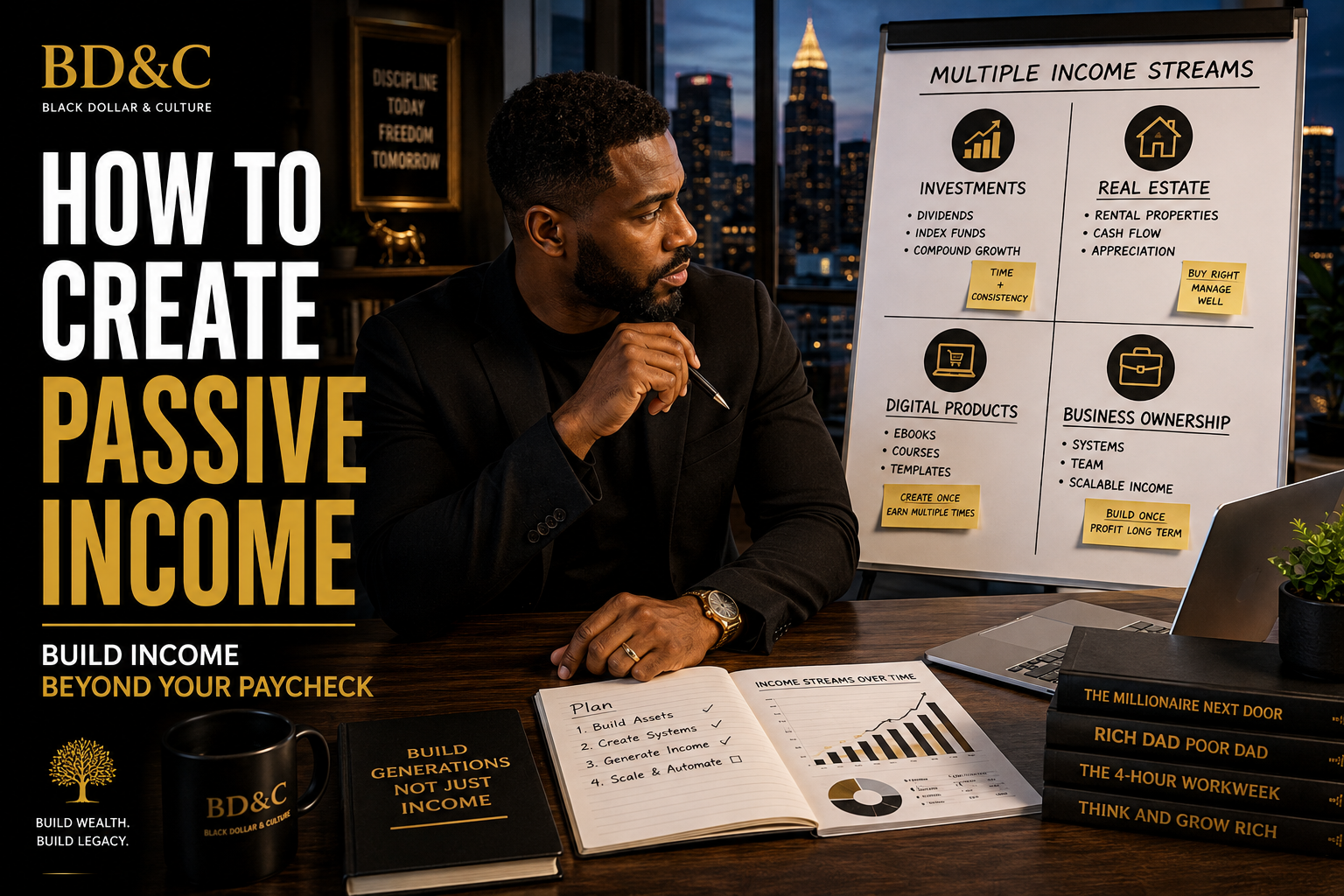
A rental property has to be purchased, financed, maintained and managed. A digital product has to be created and marketed. A business has to develop systems before the owner can become less involved.
Even investing requires capital before investment income becomes meaningful.
So don’t ask:
“How can I make money without working?”
A better question is:
“What can I build or own today that could continue producing value tomorrow?”
That’s the foundation.
Your money can become one of your employees
Investing is one of the simplest examples of putting capital to work.
Stocks and other investments can potentially generate returns through appreciation, interest or dividends. Investor.gov also emphasizes that investments involve risk and don’t provide guaranteed rates of return.
Suppose you eventually built a $100,000 investment portfolio that produced a hypothetical 3% in annual cash distributions.
That’s approximately:
$3,000 per year
or an average of:
$250 per month.
That doesn’t mean you’ll receive exactly 3%, and dividends can be reduced or eliminated. The example simply demonstrates what happens when the asset base becomes large enough.
This is why building capital matters.
Someone starting with $500 shouldn’t expect investments to replace a paycheck next year.
The first objective is usually accumulation.
Automatic saving can help. The FDIC notes that scheduled transfers can move money into savings before it gets spent.
Build the capital first. Income opportunities become more meaningful later.
Rental property can produce income, but “passive” doesn’t mean effortless
Real estate is another popular route.
Imagine purchasing a property where rent eventually exceeds the mortgage, taxes, insurance, maintenance, vacancies, management and other expenses.
What’s left can potentially become cash flow.
But don’t confuse rent with profit.
A property collecting $2,000 per month isn’t necessarily producing $2,000 in passive income.
Maybe the real numbers look like:
Rent: $2,000
Mortgage/taxes/insurance: $1,400
Maintenance and vacancy reserve: $250
Management/other expenses: $150
That leaves roughly $200 under these simplified assumptions.
And one major repair could change the numbers quickly.
There’s also a difference between how people casually use “passive income” and how tax law defines passive activity. IRS rules generally classify rental activities as passive for federal tax purposes, with important exceptions and special rules.
Real estate can absolutely become part of a passive-income strategy. Just run the numbers as an owner, not as someone impressed by gross rent.
Digital assets can turn knowledge into something that sells repeatedly
Passive income doesn’t always require enormous starting capital.
Sometimes your knowledge becomes the asset.
You could create:
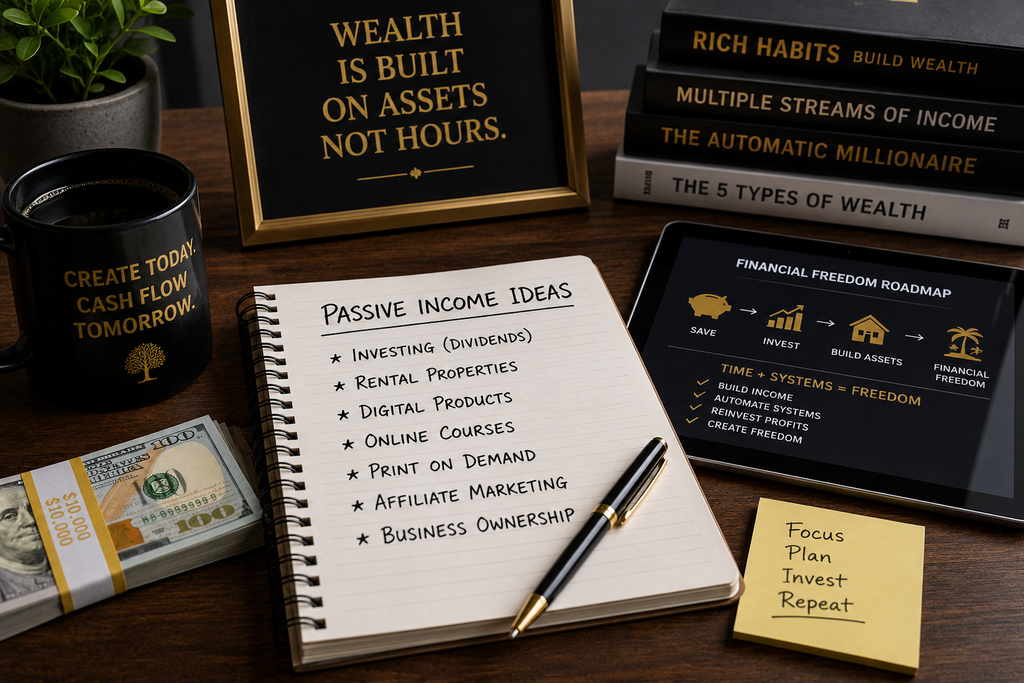
- An ebook
- A digital workbook
- Templates
- A paid course
- Downloadable guides
- Photography or design assets
- Licensed intellectual property
You might spend 30 hours creating a useful guide once and then sell copies for months or years.
That’s different from consulting, where every new customer may require another hour of your time.
But digital products still require work.
You need an audience.
People have to discover the product.
The offer has to solve a real problem.
Customer questions still exist.
Marketing doesn’t magically disappear.
The objective is to build something where revenue can become less directly tied to each additional hour worked.
A business becomes more passive when the system stops depending entirely on you
Owning a business isn’t automatically passive income.
If you own a cleaning company but personally clean every property, you’ve created a job.
If the company eventually has trained employees, operating procedures, scheduling software, management and repeat customers, your role can change.
You may still own the business while other people and systems handle more of the daily operation.
This idea applies across industries.
The transition is:
You do the work → you build the system → the system increasingly handles the work.
That’s one of the most powerful forms of leverage available to an entrepreneur.
Start with one stream instead of chasing seven
You’ve probably heard that millionaires have seven streams of income.
That idea often causes people to do the wrong thing.
They launch seven unfinished businesses instead of building one valuable asset.
Try something simpler.
Keep your primary income.
Use part of it to strengthen your emergency savings and financial foundation.
Then choose one additional income-producing asset that fits your resources.
If you have capital, that might eventually be investing or real estate.
If you have knowledge but little capital, perhaps it’s a digital product.
If you already own a business, perhaps the next move is creating systems that reduce how much the business depends on your personal labor.
Build one.
Improve it.
Reinvest some of the income.
Then consider adding another.
The ultimate goal is to own more of your income
Passive income isn’t a get-rich-quick strategy.
It’s an ownership strategy.
Every asset you accumulate can potentially reduce how dependent your financial life is on tomorrow’s paycheck.
Maybe your first income stream produces only $75 a month.
That’s okay.
Then it reaches $200.
Then $500.
Eventually you may have investments, property, intellectual property or businesses producing income from several directions.
The important change isn’t just the dollar amount.
You’re gradually moving from earning all your money through labor toward owning assets capable of producing some of it for you.
That’s where passive income becomes much bigger than a side hustle.
It becomes part of your wealth-building system.
Turn Income Into Family Wealth
Creating additional income is powerful. Building a system that helps your family preserve and redeploy capital takes the idea further.
Family Bank Starter System
Get the Family Bank Starter System
And as your family accumulates more assets, estate and wealth-transfer planning can become increasingly important.
Family Wealth Trust Blueprint / ILIT Guide
Get the Family Wealth Trust Blueprint
SEO BLOCK
SEO TITLE: How to Create Passive Income: A Practical Guide to Building Multiple Income Streams
META DESCRIPTION: Learn how to create passive income through investing, real estate, digital products and business systems while avoiding common passive-income myths.
URL SLUG: how-to-create-passive-income
FOCUS KEYPHRASE: how to create passive income
CATEGORY: Finance
ESTIMATED READING TIME: 5–6 minutes
FEATURED IMAGE ALT TEXT: Entrepreneur planning how to create passive income through investments, real estate, digital products and business ownership.