By Sir Hannibal | Black Dollar & Culture

On paper, the American household doesn’t appear to be doing dramatically worse.
The Federal Reserve reported that 73% of U.S. adults said they were either doing okay financially or living comfortably in 2025, essentially unchanged from the previous year.
But buried underneath that national number is a much more troubling story.
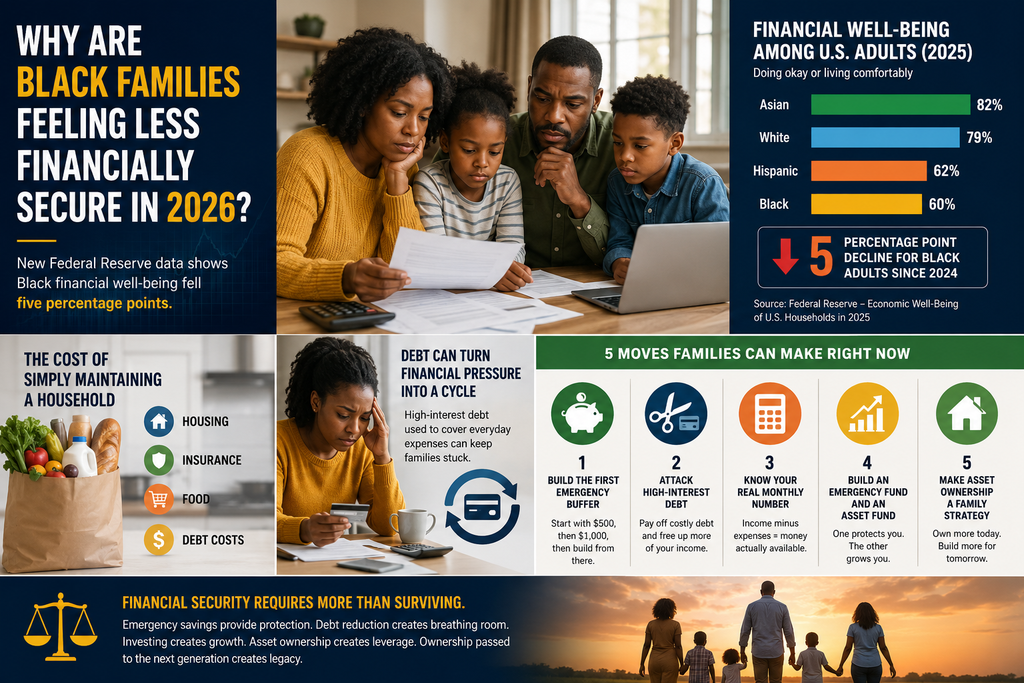
Among Black adults, only 60% reported doing okay or living comfortably financially — down five percentage points from 2024.
In 2024, that figure had been 65%.
That means while America’s overall financial well-being appeared relatively stable, Black financial well-being moved noticeably backward.
And that deserves our attention.
What the Federal Reserve Discovered
In May 2026, the Federal Reserve released its latest Report on the Economic Well-Being of U.S. Households, based on a survey conducted in October 2025.
The headline numbers initially appear encouraging.
About 73% of American adults said they were doing okay financially or living comfortably.
But when the Federal Reserve separated those responses by race, significant differences appeared.
Approximately:
- 82% of Asian adults reported doing okay or living comfortably.
- 79% of White adults reported the same.
- 62% of Hispanic adults did.
- Only 60% of Black adults did.
Even more concerning, Black adults experienced a five-percentage-point decline from the previous year, while financial well-being among White adults increased.
The Federal Reserve also noted evidence of worsening circumstances for Black adults in other parts of the survey, including increased reports that higher prices had damaged their finances.
This isn’t simply about how people feel.
It reflects the financial pressure households experience every month.
National Averages Don’t Tell Every Family’s Story
This is why national economic statistics can sometimes be misleading.
Imagine hearing:
“73% of Americans are doing okay financially.”
That sounds relatively positive.
But averages combine millions of households with dramatically different incomes, assets, debts, housing situations and expenses.
The Federal Reserve found that just 60% of Black adults considered themselves financially okay or comfortable.
That’s a 19-percentage-point gap compared with White adults.
And there’s another important distinction.
Income and wealth aren’t the same thing.
A household can earn a respectable salary and still have limited financial security if most of that income disappears into housing, transportation, food, insurance, childcare and debt.
Wealth creates another layer of protection.
Savings can absorb emergencies.
Investments can grow without requiring additional hours at work.
Home equity can become a major family asset.
Retirement accounts can provide long-term security.
Businesses and other productive assets can generate additional income.
Without those financial cushions, increases in everyday expenses can hit much harder.
The Cost of Simply Maintaining a Household
The pressure isn’t necessarily coming from one giant expense.
It’s often several expenses rising at the same time.
Housing
Housing remains one of the largest expenses in most family budgets.
The Federal Reserve found that 23% of renters had fallen behind on rent at some point during the previous 12 months, up from 21% in 2024 and 17% in 2021.
For homeowners, owning the house doesn’t eliminate the pressure.
Property taxes, maintenance, utilities and insurance can continue increasing even when the mortgage payment itself remains relatively stable.
Insurance
Homeowners insurance is becoming another source of financial strain.
The Federal Reserve found that 14% of insured homeowners struggled to afford their premiums, while 20% said they couldn’t afford as much coverage as they wanted.
Another 6% of homeowners had no homeowners insurance at all, with cost being the primary reason for most uninsured homeowners.
That creates a dangerous situation.
Families may own valuable property but struggle to afford the protection necessary to preserve it.
Food and Everyday Expenses
Higher prices haven’t disappeared simply because inflation has slowed from previous peaks.
A slower rate of inflation doesn’t mean prices return to where they used to be.
It simply means they’re increasing more slowly.
The Federal Reserve found that 58% of adults said price changes had made their financial situation worse. Among Black adults, that figure was 56%, up seven percentage points from the previous year.
Consumers responded by changing their behavior.
Sixty-two percent switched to cheaper products, 60% reduced or stopped using certain products, and 41% reduced their savings because of higher prices.
That last number matters enormously.
Because when families stop saving to survive today, tomorrow becomes more financially vulnerable.
Debt Can Turn Financial Pressure Into a Cycle
When expenses rise faster than the money available to pay them, debt often fills the gap.
The Federal Reserve reported that Black and Hispanic adults were more likely to carry credit-card balances and more likely to use alternative forms of credit such as Buy Now, Pay Later services and small-dollar credit products.
Debt isn’t automatically bad.
A mortgage used to acquire property or financing used responsibly to build a profitable business can help acquire assets.
The danger is high-interest consumer debt used repeatedly to cover ordinary living expenses.
If groceries go on the credit card because the checking account is empty, next month’s income must pay for next month’s groceries plus last month’s groceries plus interest.
That’s how financial pressure compounds.
Five Moves Black Families Can Make Right Now
We can’t personally control interest rates, housing prices or the cost of groceries.
But families can strengthen the part of the financial system they can control.
1. Build the First Emergency Buffer
Don’t allow the idea of needing six months of expenses to prevent you from saving anything.
Start smaller.
Build the first $500.
Then $1,000.
Then work toward one month of essential expenses.
Eventually, the goal can become three to six months.
The Federal Reserve specifically recognizes emergency savings as an important buffer against unexpected expenses and income disruptions.
The first goal isn’t becoming rich.
It’s preventing every emergency from becoming new debt.
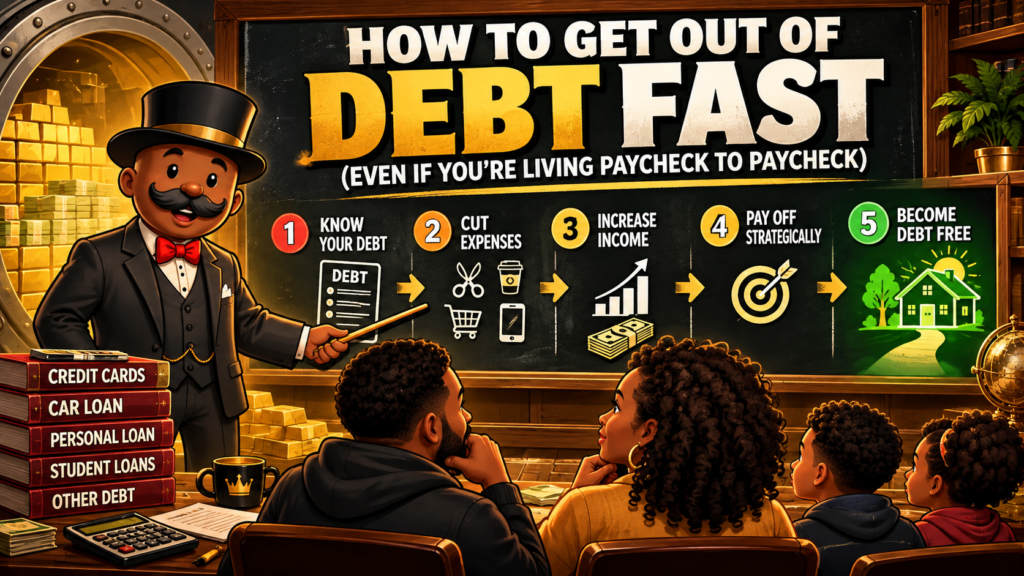
2. Attack High-Interest Consumer Debt
List your debts by:
Balance
Interest rate
Minimum payment
Then develop an aggressive payoff strategy.
Every high-interest debt eliminated frees money that can eventually be redirected toward savings and assets.
A family paying $700 every month toward consumer debt isn’t simply losing $700.
It’s losing the opportunity to use some of that money to build wealth.
3. Know Your Real Monthly Number
Families should know one number:
Income − Required Expenses = Money Actually Available
Not your salary.
Not your gross income.
Not the amount sitting in the bank immediately after payday.
How much money remains after everything necessary has been paid?
That number determines how aggressively you can save, invest and eliminate debt.
4. Build an Emergency Fund and an Asset Fund
These should eventually become two different buckets.
Your emergency fund protects you.
Your asset fund grows you.
Once the financial foundation becomes stronger, money should consistently move toward assets such as retirement accounts, diversified investments, real estate, business ownership or other productive assets appropriate for the family’s circumstances.
Even small amounts matter when the habit continues for years.
5. Make Asset Ownership a Family Strategy
The long-term objective cannot simply be earning more money.
It must include owning more assets.
Ask a different question:
What does our family own today that could be worth more 10 years from now?
Stocks.
Retirement accounts.
Businesses.
Real estate.
Intellectual property.
Other productive investments.
Then ask another question:
What will our children inherit besides our belongings?
That’s where personal finance becomes generational wealth building.
Financial Security Requires More Than Surviving
The Federal Reserve’s findings should serve as a warning.
National financial well-being remained relatively stable.
Black financial well-being didn’t.
And if the response is simply working more hours to pay increasingly expensive bills, families can find themselves running faster without actually moving forward.
The strategy has to become bigger.
Emergency savings provide protection.
Debt reduction creates breathing room.
Investing creates growth.
Asset ownership creates leverage.
Ownership passed to the next generation creates legacy.
The goal isn’t simply surviving another expensive year.
The goal is gradually building a financial system strong enough that every increase in groceries, rent, insurance or interest rates doesn’t threaten the family’s entire financial foundation.
Because ultimately, financial security isn’t determined only by how much money comes into the household.
It’s determined by how much you keep, what you own, what you owe, and what you’re building for the future.
🏦 Family Bank Starter System
Get the Family Bank Starter System
🏛️ Family Wealth Trust Blueprint
Get the Family Wealth Trust Blueprint
For this particular “Why Are Black Families Feeling Less Financially Secure in 2026?” article, I’d push the Family Bank Starter System first because it connects naturally to emergency savings, debt reduction, pooling resources, and building family assets.