By Sir Hannibal | Black Dollar & Culture
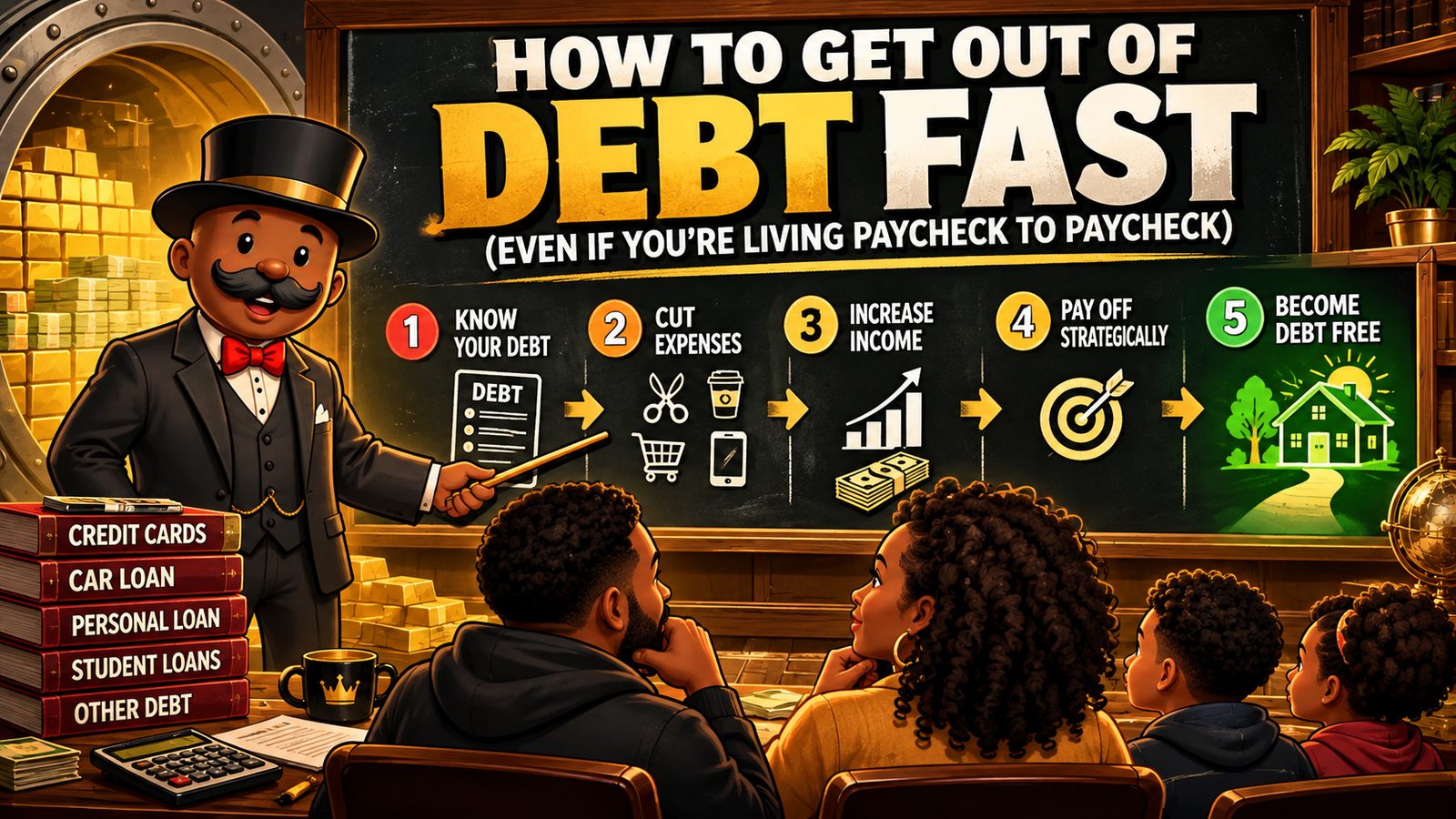
There’s a particular kind of financial stress that comes from working all week, getting paid on Friday, and watching nearly every dollar disappear before Monday.
Rent gets paid. The car note comes out. Credit cards take their minimum payments. Groceries cost more than expected.
And somehow, you’re right back where you started.
If you’re living paycheck to paycheck, getting out of debt can feel impossible. How are you supposed to pay extra toward debt when you barely have enough money to cover your bills?
Here’s what I want you to understand.
You don’t necessarily need to make more money before you can begin getting out of debt. But you do need a system that stops your debt from controlling every paycheck.
The goal isn’t to become debt-free overnight. It’s to create enough financial breathing room that your balances begin moving in the right direction.
And once that happens, momentum becomes your greatest advantage.
First, Find Out Exactly How Much Debt You Have
One reason debt feels overwhelming is that people often avoid looking at the total.
You know there’s a credit card.
A car loan.
Maybe a personal loan.
A few buy-now-pay-later payments.
But when was the last time you put every balance on one sheet of paper?
Before you can attack your debt, you need to know what you’re fighting.
Imagine your household looks like this:
| Debt | Balance | Interest rate |
|---|---|---|
| Credit card | $2,500 | 27% |
| Personal loan | $4,000 | 16% |
| Store card | $1,200 | 30% |
| Car loan | $12,000 | 7% |
| Total | $19,700 |
That’s nearly $20,000 in debt.
But here’s the important part: not all of it deserves the same attention.
The store card charging 30% interest is a much more expensive debt per dollar borrowed than the car loan charging 7%.
That’s why your debt payoff strategy matters.
Stop Trying to Pay Everybody Extra
One mistake people make is spreading extra money across every account.
An extra $20 here.
Another $30 there.
Maybe $50 toward the car.
The problem is that you don’t create much momentum.
Instead, choose one debt to attack while making the required minimum payments on the others.
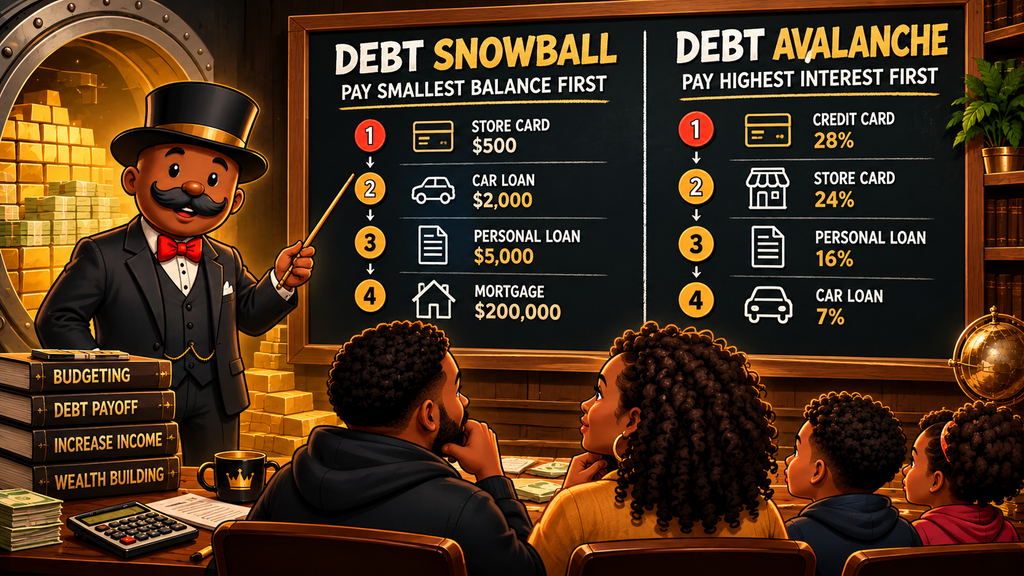
Two popular methods can help.
The debt snowball starts with the smallest balance, regardless of interest rate. Once that debt is eliminated, you redirect its payment toward the next-smallest balance.
The debt avalanche starts with the highest-interest debt, regardless of balance. This generally saves more interest when compared with paying lower-interest debt first, assuming the same payment budget.
The CFPB recognizes both strategies as ways to organize debt repayment.
Which should you choose?
If small victories keep you motivated, the snowball may work better for you.
If your priority is minimizing interest costs, the avalanche is usually the more efficient approach.
The important thing is choosing a method you can maintain.
Your First Victory Should Be Creating $100 of Breathing Room
If you’re living paycheck to paycheck, forget trying to find an extra $1,000 immediately.
Start smaller.
Can you find $100 this month?
Look at your last 30 days of transactions.
Maybe you discover:
- $40 in unused subscriptions.
- $35 in unnecessary convenience purchases.
- $25 from switching to a cheaper phone plan.
That’s $100.
Not life-changing money by itself.
But if you consistently put $100 toward debt every month, that’s $1,200 in additional payments over a year.
More importantly, you’ve created a repeatable habit.
If you genuinely have no money left after necessities, don’t force an unrealistic repayment target. Your first priority is stabilizing essential expenses and addressing any payments you’re already struggling to make.
Stop Creating New Debt While Paying Off Old Debt
Imagine trying to empty a bathtub while the faucet is still running.
That’s what happens when you pay $200 toward a credit card and then charge another $250 to it.
You’re working hard, but the balance isn’t going down.
For the next 90 days, consider a temporary spending reset.
Avoid unnecessary financing.
Remove saved credit cards from shopping apps.
Pause discretionary purchases that would require borrowing.
Use cash or debit for planned everyday expenses when practical.
But there’s an important distinction.
Stopping new debt doesn’t mean skipping food, medication, transportation to work or other essential needs.
If you’re using credit cards to survive, the deeper problem may be insufficient income, high fixed expenses or both.
That requires a different response than simply telling yourself to stop spending.
The Fastest Debt Payoff Strategy Uses Both Sides of Your Budget
There’s a limit to how much you can cut.
If rent is $1,700, groceries are $600, transportation is $500 and utilities keep climbing, canceling Netflix won’t magically solve everything.
This is why I believe people should approach debt from two directions:
Reduce expenses and increase income.
Let’s say you free up $150 through spending changes.
Then you earn an additional $350 monthly through overtime, weekend work, freelancing or a small service business.
EXAMPLE: YOUR DEBT ATTACK FUND
Monthly expense reductions
$150
Additional take-home income
$350
Extra debt payment every month
$500
That’s potentially $6,000 in additional payments over 12 months, before accounting for interest and changes to your other payments.
That $500 can make a meaningful difference.
And unlike a temporary tax refund or bonus, a repeatable monthly system can keep working until your debt is eliminated.
Call Your Credit Card Company Before Things Get Worse
Here’s something more people should know.
You don’t always have to accept your current credit-card terms without asking questions.
If you’re struggling, contact the issuer and explain your situation.
Ask whether they offer hardship assistance, a reduced interest rate, a temporary payment arrangement or another option that could help.
The CFPB advises consumers who cannot make credit-card payments to contact their card company promptly. You don’t necessarily need to be behind to ask for assistance.
A lower interest rate can make a real difference.
For example, a $5,000 balance at 28% APR costs approximately $117 in interest during a simplified first month.
At 15%, that figure is approximately $63.
That’s roughly $54 less in interest for that month, assuming the balance and calculation period are comparable.
There is no guarantee your lender will lower the rate.
But asking is worth considering.
Build a Small Emergency Cushion While Paying Off Debt
This may sound backward.
Why save money when you’re trying to eliminate debt?
Because life doesn’t stop happening while you’re paying bills.
Your tire can still go flat.
Your child can still need something unexpectedly.
Your refrigerator can still break.
Without any savings, the next emergency can send you straight back to the credit card.
Consider building a modest starter cushion—perhaps $500 or $1,000, depending on your circumstances—while staying current on required payments.
The goal isn’t to hold enormous amounts of cash while expensive debt grows.
It’s to prevent every surprise from becoming another loan.
Once you’ve established that initial protection, you can direct more available cash toward debt repayment.
What If You Can’t Afford Your Minimum Payments?
There’s a difference between having debt you want to eliminate faster and having debt you genuinely cannot afford.
If you’re falling behind on rent, utilities, food or transportation just to keep credit cards current, your immediate priority should be financial stability.
Protect essential living expenses and understand the consequences of missing payments on secured debts such as your car loan or mortgage.
Then contact creditors about hardship options.
A reputable nonprofit credit counselor may also help you develop a realistic repayment plan and, in some cases, negotiate lower interest rates or payments.
Consumer Financial Protection Bureau
+1
Be especially cautious with companies promising to eliminate your debt for pennies on the dollar.
Debt settlement can involve substantial fees, damaged credit, lawsuits and additional interest.
Consumer Financial Protection Bureau
+1
If your debts are genuinely unmanageable, a consultation with a qualified bankruptcy attorney may also help you understand your legal options.
The objective is to improve your finances—not make a difficult situation worse.
Your 90-Day Debt Freedom Challenge
You may not eliminate $20,000 in 90 days.
But you can make the next three months a turning point.
Your 90-Day Debt Attack Plan
Your progress
0 of 12 completed
Days 1–30
Get ControlList every debt, interest rate and minimum paymentReview spending and identify your first $100 of savingsChoose the snowball or avalanche methodContact lenders about hardship options if needed
Days 31–60
Build MomentumDirect extra cash toward your target debtExplore sustainable ways to earn additional incomeBuild a small emergency cushionAvoid unnecessary new borrowing
Days 61–90
Make It RepeatableReview how much principal you’ve eliminatedRoll any freed-up payment into the next debtAdjust your budget based on real spendingSet your next 90-day debt reduction target
Copy My Checklist
Don’t Let Debt Become a Permanent Family Tradition
Here’s the bigger picture.
Getting out of debt isn’t only about paying off credit cards.
It’s about changing what happens to your income.
Imagine eliminating $600 in monthly debt payments.
That’s $7,200 per year that no longer has to go toward those payments.
You could direct that money toward emergency savings, retirement investments, business capital or your family’s long-term financial goals.
Over five years, $600 per month represents $36,000 in contributions before any investment returns.
That’s the real opportunity.
Money that once belonged to creditors can begin working toward your own financial future.
And if you have children, there’s another benefit.
They get to see a different financial example.
They see a household that plans its spending, manages borrowing carefully, saves consistently and makes financial decisions with intention.
The goal isn’t just to get out of debt. It’s to stay out of destructive debt and turn the money you recover into ownership.
You don’t have to accomplish everything this month.
Start with one balance.
One budget adjustment.
One extra payment.
One financial habit you can maintain.
Then keep going.
Because financial freedom rarely begins with one dramatic decision.
It begins when you finally decide that your paycheck needs to start building your future instead of only paying for your past.
Turn Debt Freedom Into Family Wealth
Once you’ve created breathing room in your finances, the next goal is building a system that helps your family accumulate and manage capital.
Family Bank Starter System
Learn how to organize family contributions, establish lending rules and create a framework for building family capital.Get the Family Bank Starter System
Family Wealth Trust Blueprint / ILIT Guide
Explore how insurance trusts and estate planning may help families protect and transfer wealth.Get the Family Wealth Trust Blueprint