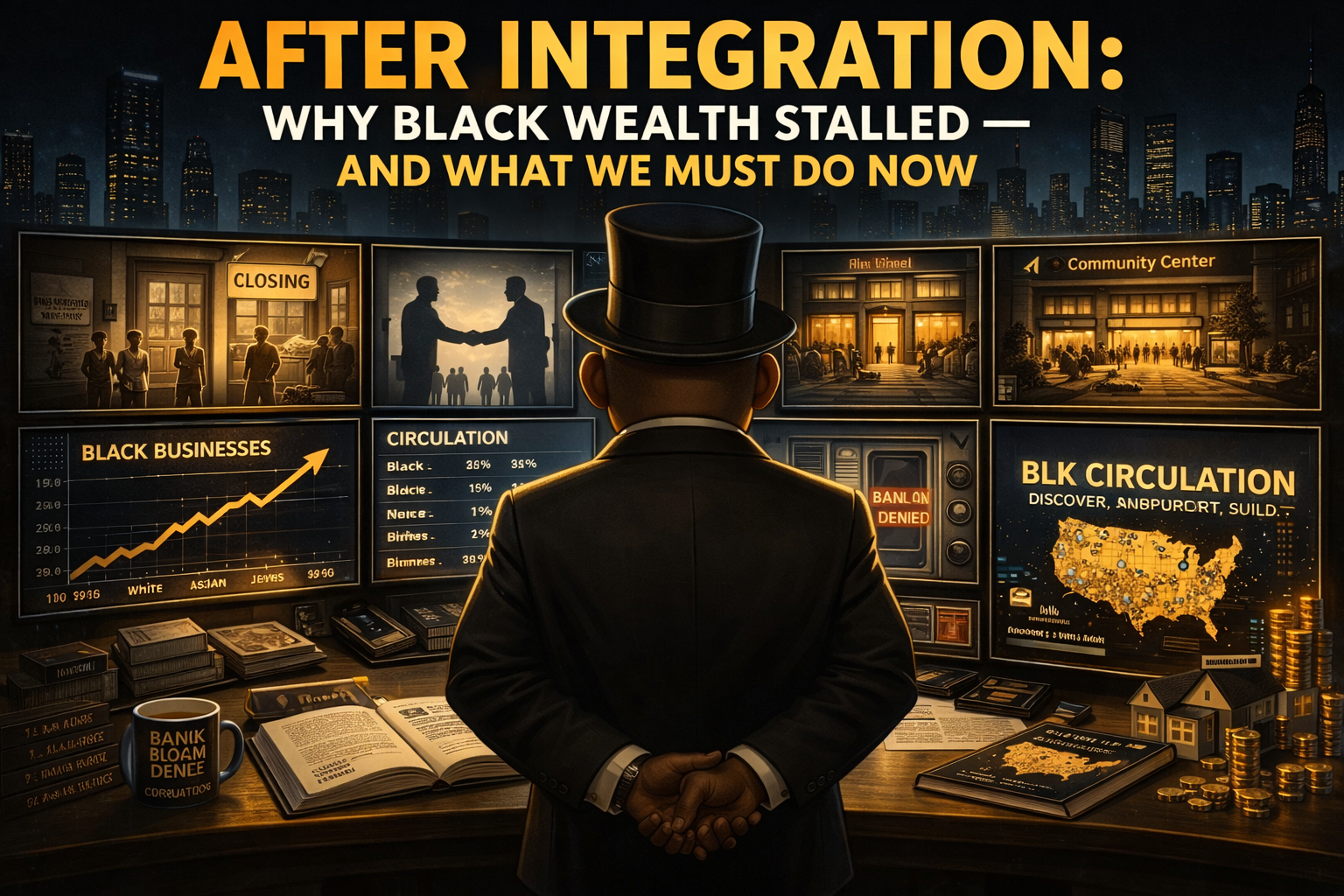
There was a moment in American history when the doors finally opened.
Schools began to integrate. Businesses that once turned us away now allowed us to walk in. Opportunities that were once denied started to appear within reach.
From the outside, it looked like progress.
It looked like victory.
But underneath that surface… something else was happening.
Because while we were celebrating access, we were quietly losing control.
Before integration, Black communities had no choice but to depend on themselves. And out of that necessity came something powerful—circulation.
Black dollars moved through Black hands. Black doctors served Black families. Black teachers educated Black children. Black banks funded Black dreams. Entire ecosystems were built, not because it was trendy… but because it was required.
Places like Tulsa’s Greenwood District—often called Black Wall Street—weren’t accidents. They were the result of forced unity, economic discipline, and a clear understanding: if we don’t build for ourselves, nobody will.
But integration changed the direction of that energy.
For the first time, we were allowed to spend freely outside of our communities. And understandably, many did. After generations of exclusion, the ability to go anywhere felt like freedom.
But here’s the part nobody talks about enough:
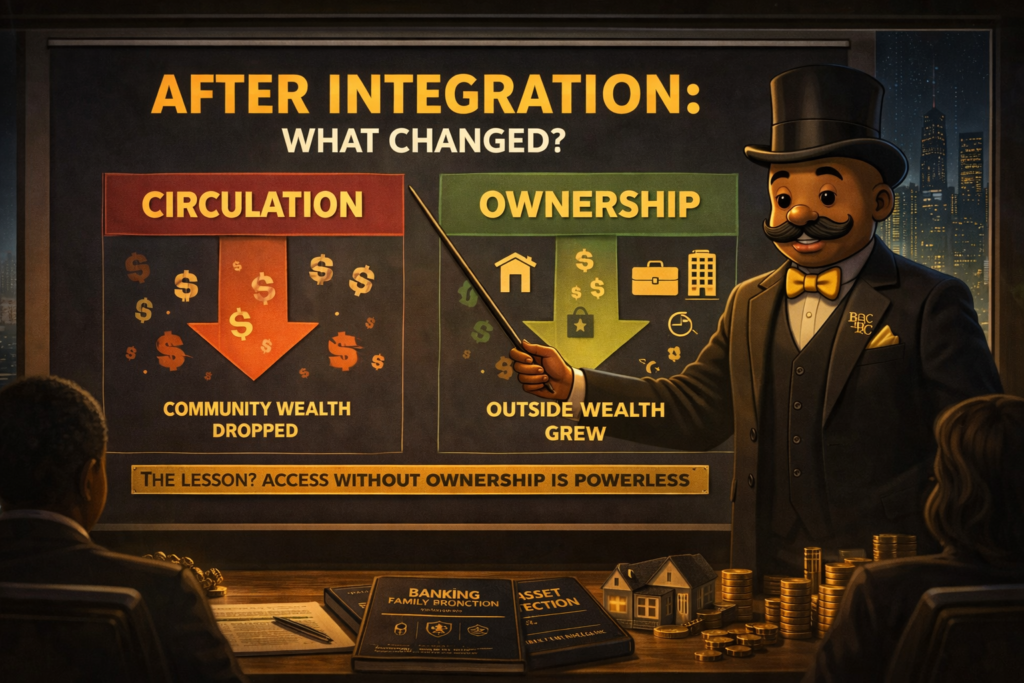
Access without ownership is not power.
Because while we gained access to other systems… we slowly stopped investing in our own.
The same dollar that once circulated multiple times within our neighborhoods began to leave almost immediately. Black-owned businesses, once the backbone of the community, started losing consistent support. Institutions we built out of necessity were now competing with systems that had far more resources, visibility, and capital.
And over time, the shift became clear.
We integrated into the economy…
But we didn’t anchor ourselves within it.
So instead of controlling wealth, we began participating in it.
There’s a difference.
Participation means you can spend money.
Control means you can direct where it goes, how it grows, and who it benefits.
And that difference is what we’re still feeling today.
Now let’s be clear—this is not about going backwards.
This is not about rejecting integration.
This is about understanding what was lost… so we can rebuild it with intention.
Because the real issue was never integration itself.
The issue was that we integrated without a strategy.
We entered larger systems without building strong systems of our own first. We pursued inclusion without securing ownership. And we adopted spending habits without maintaining economic discipline.
And the result?
We became some of the most influential consumers in the world…
But not the most powerful owners.
So the question becomes:
What must we do now?
Not emotionally.
Not politically.
But economically.
Because wealth is not built through feelings—it’s built through systems.
1. Rebuild Internal Circulation (The Foundation)
Every strong community has one thing in common: money flows within it before it flows out.
Right now, the Black dollar leaves the community faster than almost any other group. That means even when money is earned, it doesn’t stay long enough to multiply.
This is where intentionality comes in.
Supporting Black businesses is not just about culture—it’s about economics. Every dollar spent internally creates jobs, strengthens businesses, and builds stability.
And this is exactly where action meets solution.
Because one of the biggest problems today isn’t willingness… it’s visibility.
People want to support Black businesses.
They just don’t always know where to find them.
That’s why platforms like:
…are so important right now.
BLK Circulation is built to solve the discovery problem—connecting the community directly to Black-owned businesses so the dollar doesn’t just get earned… it gets recycled.
Instead of money leaving immediately, it can now circulate intentionally.
Discover. Support. Build.
That’s how ecosystems are rebuilt.
2. Build Family Financial Systems (Not Just Income)
Income alone doesn’t create wealth.
Systems do.
Most families operate financially as individuals—everyone earning, spending, and surviving on their own. But wealthy families think differently. They operate like institutions.
That’s where the concept of a Family Bank comes in.
Instead of sending interest to outside banks, families can create internal lending systems—funding businesses, covering emergencies, and keeping capital circulating within the family unit.
This is how money starts to work for the family instead of constantly leaving it.
👉 Start building yours here:
💰 Family Bank Starter System
https://stan.store/blackdollarandculture/p/the-family-bank-starter-system
3. Protect Wealth Before You Build It
One of the biggest mistakes people make is focusing only on making money… without protecting it.
Because if wealth isn’t structured properly, it can disappear just as fast as it’s created—through taxes, legal issues, or lack of planning.
This is where tools like trusts come in.
An Irrevocable Life Insurance Trust (ILIT) allows families to pass down wealth efficiently, avoiding unnecessary taxation and ensuring the next generation actually benefits.
👉 Learn how to structure yours here:
🛡️ ILIT Trust Blueprint
https://stan.store/blackdollarandculture/p/get-your-family-wealth-trust-blueprint-now
4. Shift From Consumer Identity to Owner Identity
We’ve mastered influence.
Music. Culture. Trends. Style. Language.
But influence without ownership is rented power.
The next level is ownership.
Ownership of businesses.
Ownership of land.
Ownership of systems.
Ownership of platforms.
Because when you own, you don’t just participate in the economy—you shape it.
5. Think in Generations, Not Moments
Everything changes when the mindset shifts from:
“What can I do this year?”
to
“What can my family control in 30 years?”
That’s how wealth is built.
Not through one viral moment.
Not through one paycheck.
But through consistent systems that outlive the individual.
The truth is… integration gave us access.
But access alone was never the goal.
Ownership is.
Control is.
Legacy is.
And the next chapter won’t be defined by what we were allowed into…
It will be defined by what we build, protect, and pass down.
Because the real power was never just in being included.
It’s in owning the system itself.
Two families. Same income. Different mindset.
One spends freely and hopes for the best.
The other builds systems, protects assets, and circulates money intentionally.
Ten years later, one is still working for money…
The other has money working for them.
The difference isn’t luck.
It’s structure.
If you’re ready to stop just participating in the economy—and start building real, lasting wealth—this is where it begins:
🌐 Start circulating the dollar intentionally:
https://blkcirculation.com
💰 Build Your Family Bank:
https://stan.store/blackdollarandculture/p/the-family-bank-starter-system
🛡️ Protect It With a Trust (ILIT Blueprint):
https://stan.store/blackdollarandculture/p/get-your-family-wealth-trust-blueprint-now
Black wealth, generational wealth, black ownership, family bank, ILIT trust, black businesses, economic empowerment, build black wealth, black dollar circulation, ownership mindset

Focus Keyphrase
Black wealth after integration
Slug
black-wealth-after-integration
Meta Description
Did integration slow Black wealth growth? Learn what changed, what was lost, and how platforms like BLK Circulation help rebuild ownership and economic power today.