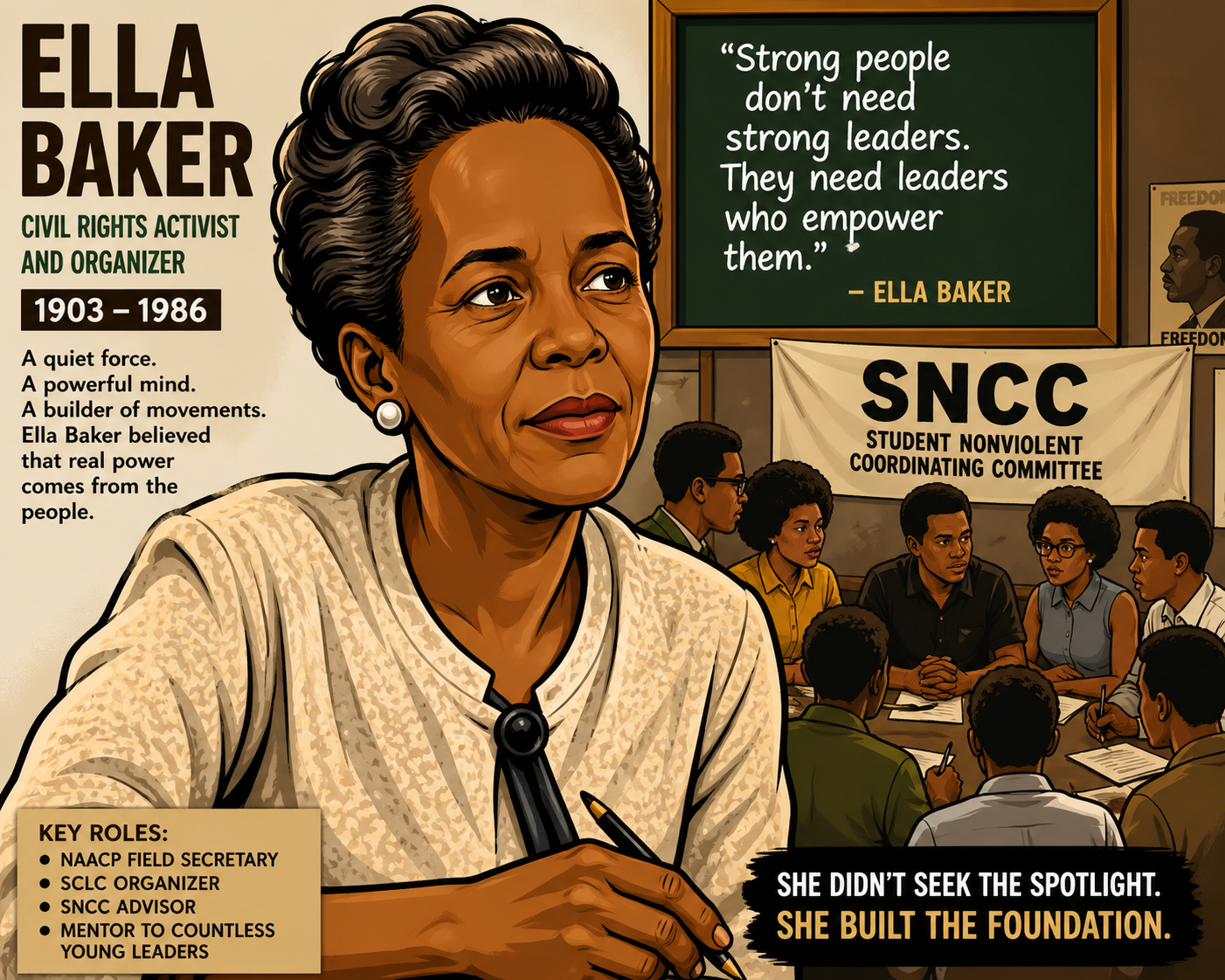
History remembers the speeches.
But historians remember the structure.
And when you study the Civil Rights Movement closely, one name keeps appearing—not in headlines, but in the foundation:
Ella Baker.
She was not simply a participant in history.
She was one of its chief designers.
Early Life: A Mind Formed by Resistance
Ella Baker was born in Norfolk, Virginia, and raised in North Carolina in the early 1900s—a time when Black life in America was defined by segregation, violence, and systemic exclusion.
But her worldview wasn’t shaped by fear.
It was shaped by story and resistance.
Her grandmother, who had been enslaved, told her stories of refusing to marry a man chosen by a slave owner—choosing punishment over submission.
That story stayed with Baker.
It taught her something critical early:
👉 Authority is not always legitimate
👉 Resistance is a choice
She carried that mindset into everything she built.
Education and Awakening
Baker attended Shaw University, one of the oldest HBCUs in the country, where she graduated as valedictorian.
But unlike many who pursued personal advancement, Baker moved toward collective struggle.
In the 1930s, during the Great Depression, she became involved in cooperative economic movements—organizations focused on shared ownership and group survival.
This is often overlooked.
Before civil rights organizing…
Ella Baker was already studying economic systems.
The NAACP Years: Building From the Ground Up
When Baker joined the NAACP, she didn’t stay in an office.
She traveled.
Town to town.
Community to community.
Listening. Organizing. Building.
She eventually became a national director of branches, helping grow the NAACP’s reach across the country.
But more importantly…
She built local leadership.
Not followers.
Leaders.
That distinction would define her entire legacy.
Challenging Power Within the Movement
Baker later worked with the Southern Christian Leadership Conference, where she crossed paths with Martin Luther King Jr..
But she didn’t blindly follow.
In fact, she challenged the structure of the organization.
She believed it was too dependent on charismatic leadership.
Too centralized.
Too fragile.
Her position was clear:
A movement that depends on one leader… can collapse with one leader
She pushed for a broader base of empowered individuals.
That idea would soon reshape the movement.
The Birth of SNCC: Her Most Powerful Contribution
In 1960, as student sit-ins spread across the South, Baker saw something others didn’t:
A new generation ready to lead.
She organized a meeting at Shaw University, bringing these young activists together.
From that meeting came the Student Nonviolent Coordinating Committee.
SNCC became one of the most effective grassroots organizations in American history.
And its structure reflected Baker’s philosophy:
- Decentralized leadership
- Local autonomy
- Community-driven action
This wasn’t just activism.
This was strategy.
A Leadership Style Rooted in Humility
Unlike many public figures, Ella Baker avoided the spotlight.
She didn’t seek recognition.
She didn’t build a personal brand.
She built people.
She mentored young leaders like:
- Diane Nash
- John Lewis
And through them, her influence multiplied.
This is why her impact is so difficult to measure.
It lives inside the actions of others.
The Historian’s Conclusion: Why She Matters
From a historical standpoint, Ella Baker represents a different model of power.
Not symbolic power.
Not performative power.
Structural power.
The kind that:
- Builds institutions
- Develops leaders
- Sustains movements across generations
She understood something timeless:
If you want change to last… you must design it to survive you
BD&C Perspective: This Is the Same Blueprint for Wealth
Take her philosophy and apply it today:
Most people chase income.
Few build systems.
Most people build for themselves.
Few build for generations.
Ella Baker’s model translates directly into modern wealth strategy:
- Family Banks = decentralized financial power
- Trusts (ILITs) = protected generational structure
- Group economics = community-level resilience
This isn’t new thinking.
It’s historical thinking.
Build What Lasts
If you’re serious about applying this level of strategy to your life:
👉 Start your family’s internal system
The Family Bank Starter System
https://stan.store/blackdollarandculture/p/the-family-bank-starter-system
👉 Lock in long-term protection and legacy
Get Your Family Wealth Trust Blueprint (ILIT)
https://stan.store/blackdollarandculture/p/get-your-family-wealth-trust-blueprint-now
Final Reflection
Ella Baker didn’t need a microphone to shape history.
She needed vision.
Discipline.
And a deep understanding of how power really works.
Her name may not always be the loudest…
But her impact is among the deepest.
FAQ: Ella Baker in Depth
Where was Ella Baker born?
She was born in Norfolk, Virginia, and raised in North Carolina.
What made her leadership unique?
She focused on grassroots organizing and empowering everyday people instead of relying on centralized leadership.
Who did she mentor?
She influenced major figures like John Lewis and Diane Nash, among many others.
Why is she less well-known?
Because she intentionally stayed behind the scenes, prioritizing impact over recognition.
Continue the Real Story
📘 The First World Before Erasure
https://stan.store/blackdollarandculture/p/the-first-world-before-erasure
Final Word
Some leaders build movements.
Ella Baker built the people who built the movements.
That difference…
Changes everything.
#EllaBaker #BlackHistory #CivilRightsMovement #SNCC #NAACP #BlackLeaders #GenerationalWealth #BlackDollar #EconomicPower #Ownership #Legacy #BDandC
Focus Keyphrase: Ella Baker civil rights strategist
Slug: ella-baker-civil-rights-strategist
Meta Description: Explore the life of Ella Baker, the strategist behind the Civil Rights Movement, and learn how her approach to leadership connects to generational wealth and lasting systems today.