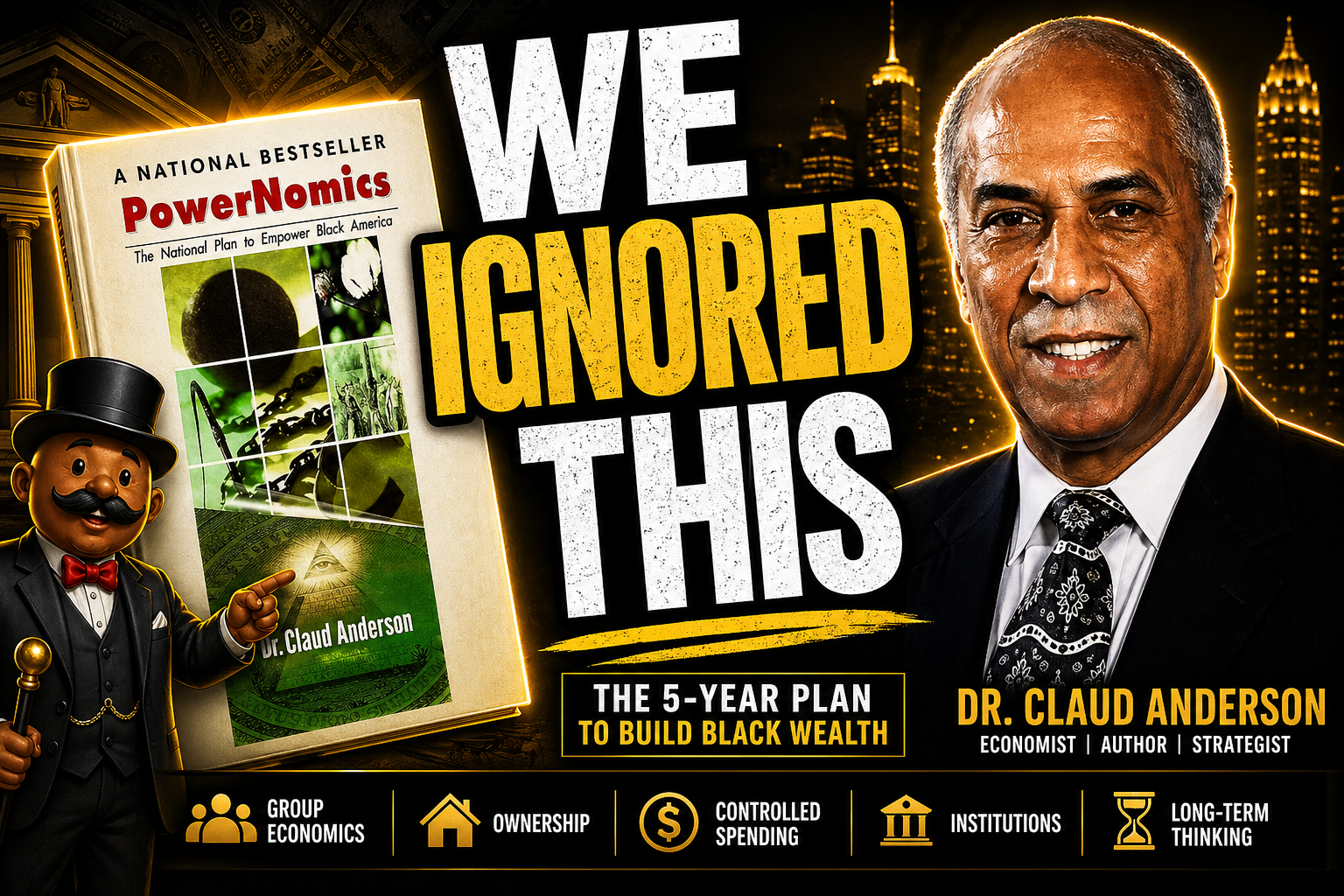
In 1995, a blueprint was laid out that most people never truly studied.
Not because it was hidden.
Not because it was complicated.
But because it required something most people weren’t ready for:
Discipline, structure, and long-term thinking.
Dr. Claude Anderson didn’t speak in vague ideas. He didn’t deal in motivation. He laid out a system — one that explained exactly why wealth wasn’t sticking, and what it would take to change that.
And if we’re being honest…
The problem was never a lack of information.
It was a lack of application.
The Real Issue Was Never Just Money
Most people think the problem is income.
“If we just made more, everything would change.”
But that’s not how wealth works.
Dr. Anderson pointed to something deeper — something most people overlook:
Control.
You can make money and still be broke in the long run if you don’t control:
- Where your money goes
- Who benefits from your spending
- What systems your dollars are feeding
If money comes in and immediately leaves, it doesn’t matter how much you earn.
You’re not building wealth.
You’re financing someone else’s.
How Money Actually Builds Power
Let’s slow this down and make it real.
Imagine two different communities.
Community A
- A family earns money
- They spend it at businesses outside their community
- Those businesses hire people from their own networks
- Profits are reinvested back into their own systems
The money is gone within days.
No ownership. No return. No growth.
Community B
- A family earns money
- They spend it with local businesses
- Those businesses hire within the community
- Those employees spend within the same network
- Profits are reinvested into new businesses, property, and services
Now that same dollar:
- Pays wages
- Funds expansion
- Creates jobs
- Builds assets
It doesn’t just move.
It multiplies.
That’s the difference between spending and circulation.
And that difference determines everything.
Why Ownership Is the Foundation
One of the clearest messages from PowerNomics is this:
If you don’t own it, you don’t control it.
That applies to:
- Land
- Housing
- Businesses
- Banks
- Distribution channels
- Media
When you don’t own these, you are always operating inside someone else’s system.
That means:
- You don’t control pricing
- You don’t control hiring
- You don’t control opportunity
You participate… but you don’t direct.
And participation without ownership doesn’t build lasting wealth.
The Hidden Trap: High Income, No Structure
This is where a lot of people today get caught.
There are more people making money now than ever before.
But ask yourself:
- How much of that money is being turned into assets?
- How much is being passed down?
- How much is structured to last beyond one lifetime?
Because here’s the reality:
You can have a high income and still leave nothing behind.
Why?
Because income without structure turns into:
- Lifestyle spending
- Temporary comfort
- Short-term wins
But not long-term power.
Why Wealth Keeps Resetting Every Generation
This is one of the most important parts of the conversation.
A generation works hard.
They buy a house.
They save some money.
They build something.
Then life happens:
- Death
- Taxes
- Medical costs
- Poor planning
And because there’s no structure:
- Assets get sold
- Money gets split and spent
- Ownership disappears
So the next generation…
Starts over.
That’s not bad luck.
That’s a missing system.
The Part PowerNomics Tried to Fix
Dr. Anderson wasn’t just pointing out problems.
He was trying to install a mindset shift:
From:
- Individual success
To:
- Collective strategy
From:
- Spending freely
To:
- Spending intentionally
From:
- Earning money
To:
- Controlling systems
Because wealth isn’t about one person getting ahead.
It’s about building something that continues after you’re gone.
What This Looks Like in Real Life
Let’s bring this down to something practical.
Instead of thinking:
“I made money this year.”
The question becomes:
“What system did I build this year?”
That could mean:
- Buying property instead of renting forever
- Starting a business that serves your community
- Creating a structure where money stays within your family
- Setting up protection so assets aren’t lost
Because once systems are in place…
Money starts working differently.
This Is Where Most People Need to Get Serious
A lot of people agree with these ideas.
But agreement doesn’t change anything.
Execution does.
And execution requires:
- A plan
- A structure
- A willingness to move differently than most people
Because the default system is designed for money to leave your hands.
You have to intentionally build something that keeps it.
If You’re Ready to Move From Ideas to Structure
This is where most people stop.
They understand the concept… but don’t build the system.
If you’re serious about applying what you just read, you need tools that actually help you implement it.
👉 Start building your internal system here:
The Family Bank Starter System
https://stan.store/blackdollarandculture/p/the-family-bank-starter-system
👉 Make sure what you build actually lasts:
Get Your Family Wealth Trust Blueprint (ILIT)
https://stan.store/blackdollarandculture/p/get-your-family-wealth-trust-blueprint-now
👉 Understand the deeper historical context behind all of this:
The First World Before Erasure
https://stan.store/blackdollarandculture/p/the-first-world-before-erasure
The Truth Most People Don’t Want to Say Out Loud
The blueprint wasn’t missing.
It wasn’t hidden.
It was there.
Since 1995.
Clear. Direct. Actionable.
So the real question now isn’t about awareness.
It’s about accountability.
What are you going to build with the information you already have?
FAQ
What is PowerNomics?
A framework created by Dr. Claude Anderson focused on building wealth through ownership, group economics, and strategic control of resources.
Why is ownership more important than income?
Because ownership gives you control over assets, opportunities, and long-term wealth, while income alone is temporary.
What is a Family Bank?
A structured system where families pool and circulate money internally to fund opportunities and build wealth collectively.
What is an ILIT and why does it matter?
An Irrevocable Life Insurance Trust helps protect and transfer wealth efficiently, preventing assets from being lost through taxes or poor planning.

#PowerNomics #BlackWealth #GroupEconomics #OwnershipMatters #GenerationalWealth #FamilyBank #FinancialStrategy #WealthBuilding #EconomicPower #BlackDollar
Focus Keyphrase: PowerNomics Blueprint Explained
Slug: powernomics-blueprint-explained
Meta Description: A deep breakdown of Dr. Claude Anderson’s PowerNomics blueprint and how ownership, circulation, and structure build real generational wealth.