By Sir Hannibal

Twenty thousand dollars is a serious amount of money. But in real estate, it can disappear surprisingly fast.
A first-time investor may look at $20,000 in savings and think, “That’s my down payment.” The smarter question is different:
How much of this $20,000 can safely become a down payment while still leaving enough money to actually own the property?
That distinction matters.
Buying your first rental property with $20,000 down is possible in some markets and financing situations. But the goal should not be to squeeze into the most expensive property a lender will approve. The goal is to buy something that can survive vacancies, repairs, taxes, insurance and the occasional expensive surprise without forcing you to reach for a credit card.
Here is how to think about that first $20,000 like an investor rather than simply a homebuyer.
$20,000 doesn’t automatically mean you can buy a $130,000 rental
Start with the math.
Fannie Mae’s 2026 eligibility matrix allows up to 85% loan-to-value on the purchase of a one-unit investment property under its standard Desktop Underwriter requirements. Freddie Mac also lists an 85% maximum LTV for qualifying one-unit investment-property purchases. In plain English, that means certain conventional investment-property loans can potentially be made with 15% down, although lender requirements, pricing, credit, debt-to-income ratios and other underwriting factors still apply.
At 15% down, the numbers initially look attractive:
| Purchase Price | 15% Down Payment |
|---|---|
| $80,000 | $12,000 |
| $100,000 | $15,000 |
| $120,000 | $18,000 |
| $130,000 | $19,500 |
That $130,000 property looks like it fits.
It probably doesn’t.
The Consumer Financial Protection Bureau says closing costs typically run about 2% to 5% of the purchase price, separate from the down payment. Those costs can include appraisal charges, title insurance, taxes, prepaid property taxes, insurance and interest.
Put 15% down on a $130,000 property and you’ve spent $19,500 before accounting for those expenses.
You would essentially be walking into your new rental with empty pockets.
That’s not the position you want to be in as a new landlord.
Your real budget begins after you protect your cash reserve
Suppose you have exactly $20,000 available for your first investment.
Instead of immediately asking how large a down payment you can make, divide the money mentally into three buckets:
Money to acquire the property.
Money to get the property ready.
Money to keep the property alive when something goes wrong.
For example, imagine targeting a $90,000 property with 15% down.
Your down payment would be:
$13,500
If closing costs were 3% for illustration:
$2,700
That brings the cash requirement to:
$16,200
You would have:
$3,800 remaining
That’s much more comfortable than spending practically the entire $20,000 at closing, but even $3,800 isn’t a huge reserve if the property immediately needs a water heater, HVAC repair or plumbing work.
The CFPB recommends considering an emergency cushion when deciding how much cash you can afford to commit to a purchase.
For a rental investor, that cushion deserves even more attention because you have two financial lives to protect: your personal household and your rental property.
This is why a less expensive property that leaves you with cash can sometimes be a better first investment than a more impressive property that drains your savings.
The rent matters more than how beautiful the house looks
A rental property is ultimately an income-producing asset.
That sounds obvious, but first-time investors can still shop for rentals the way they shop for their own homes.
They fall in love with granite countertops.
They love the backyard.
They like the neighborhood.
They imagine how nice the property will look after renovations.
None of those things automatically make it a good investment.
The property has to work financially.
Suppose you find a house for $100,000 and believe it can rent for $1,350 per month.
That’s $16,200 in potential annual gross rent.
But gross rent is not profit.
From that income may come:
- Mortgage principal and interest
- Property taxes
- Insurance
- Repairs and maintenance
- Vacancy
- Property management, if used
- Homeowners association fees, if applicable
- Utilities paid by the owner
- Landscaping or pest control
- Larger future capital expenses
A house collecting $1,350 per month can still lose money.
The question isn’t:
“How much rent can I charge?”
The question is:
“How much money should realistically remain after this property pays its bills?”
That’s a very different calculation.
Run the property as if something will eventually go wrong—because something will
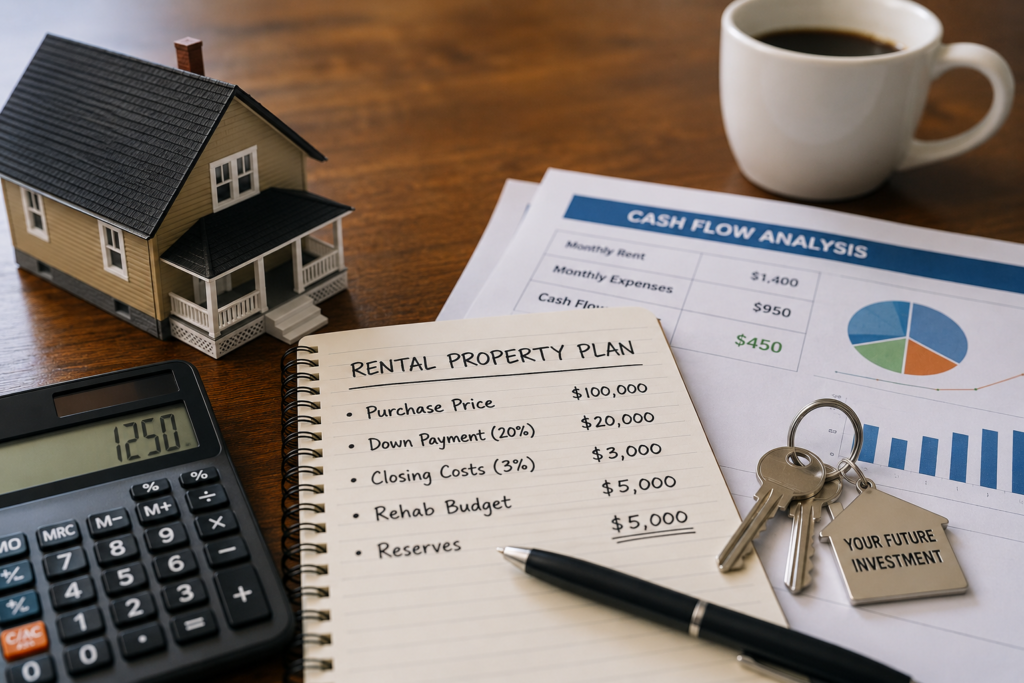
Imagine a rental producing $1,350 per month.
For illustration, suppose the property’s mortgage principal and interest, taxes and insurance total $900 per month.
At first glance:
$1,350 rent
− $900 housing payment
= $450 per month
A beginner might call that $450 cash flow.
Not yet.
Suppose you budget 5% of rent for vacancy:
$67.50
Another 8% for repairs and maintenance:
$108
And another 5% toward larger future capital expenses:
$67.50
Now the picture becomes:
$1,350 rent
− $900 mortgage/taxes/insurance
− $67.50 vacancy allowance
− $108 maintenance allowance
− $67.50 capital-expense allowance
= $207 per month
And if you hire professional management, the margin could shrink further.
The exact percentages an investor uses will vary by property, market and strategy. An older house with aging systems may deserve a much larger repair budget than a recently renovated property.
That’s the point.
Don’t make the property look profitable by pretending expenses don’t exist.
Conservative math before closing is much cheaper than optimistic math after closing.
A $20,000 budget makes the condition of the property extremely important
There is nothing inherently wrong with buying a fixer-upper.
But a fixer-upper can be dangerous when your entire investment budget is only $20,000.
Imagine two houses.
House A costs $82,000 but needs $18,000 of work.
House B costs $98,000 and is essentially rent-ready.
House A looks cheaper.
But depending on financing, closing costs and your available cash, House B could actually be the more realistic first investment.
Before buying, pay close attention to expensive systems rather than cosmetic flaws.
A dated bathroom may be ugly.
A failing foundation can be financially devastating.
Old cabinets may need paint.
A severely damaged roof needs real money.
Look carefully at the roof, foundation, electrical system, plumbing, HVAC equipment, water heater, windows, drainage and signs of previous water damage.
A professional inspection does not eliminate risk, but skipping proper due diligence because you’re trying to save a few hundred dollars can expose you to problems costing thousands.
Your first rental doesn’t need to be perfect.
It needs to be financially survivable.
There is another strategy that can stretch $20,000 much further
There’s a major difference between buying a property strictly as an investor and buying a property that will initially be your primary residence.
That opens the door to the strategy commonly called house hacking.
Instead of buying a traditional investment property and immediately renting the entire house, you purchase a qualifying primary residence and rent part of it.
That might mean:
- Buying a duplex and living in one unit
- Buying a small multifamily property and occupying one unit
- Buying a house and renting bedrooms where legally permitted
- Buying a property with an eligible accessory dwelling unit
Owner-occupied financing can have different down-payment requirements than financing for a non-owner-occupied investment property. Fannie Mae’s current matrix, for example, allows substantially higher maximum LTVs for qualifying principal-residence purchases than for one-unit investment properties.
That can dramatically change what $20,000 can accomplish.
But there is an important line that should never be crossed:
If you obtain owner-occupied financing, you must genuinely satisfy the lender’s occupancy requirements.
Don’t claim a property will be your primary residence simply to obtain more favorable financing if you don’t intend to occupy it as required.
House hacking works because you’re combining your housing decision with your first real-estate investment—not because you’re pretending an investment property is your home.
Don’t start with Zillow. Start with a lender
One of the biggest mistakes a first-time investor can make is spending months looking at properties before understanding what financing is actually available.
Talk with multiple lenders or mortgage brokers who regularly work with investment properties.
Ask specifically about:
Investment-property loans.
Find out the minimum down payment, expected interest-rate range, reserve requirements and underwriting standards.
Owner-occupied multifamily financing.
If you’re willing to live in the property, ask how the numbers change.
Closing-cost expectations.
Get realistic estimates for your market instead of assuming the down payment is the entire transaction.
How rental income is treated.
Depending on the loan program and your situation, projected or existing rental income may be treated differently during underwriting.
Cash reserves.
Ask how much money the lender expects you to have remaining after closing.
Your objective isn’t merely to hear:
“You’re approved for $150,000.”
You want to understand what purchasing at $150,000 would actually require in cash and what the monthly payment could look like.
The neighborhood can make or break the spreadsheet
A cheap property is not automatically a bargain.
Sometimes it’s cheap because the local rental economics are poor.
Before making an offer, research what comparable properties actually rent for.
Don’t base your investment on the highest rent you see advertised online.
Look for properties that closely resemble the one you’re considering:
Same number of bedrooms.
Similar bathrooms.
Similar square footage.
Similar condition.
Same general neighborhood.
Then investigate the demand behind those numbers.
How long do rentals appear to sit vacant?
Are there major employers nearby?
What are property taxes?
Are insurance costs unusually high?
Is the neighborhood experiencing population or employment changes?
Are there flood risks or other location-specific expenses?
Are there HOA restrictions affecting rentals?
A property that appears to cash-flow beautifully before insurance and taxes can look completely different once you obtain actual quotes.
Get real numbers whenever possible.
Your first tenant is part of the investment decision
Finding a property is only half the job.
The other half is operating it.
A vacant house produces no rent, but many of its expenses continue.
That creates pressure on new landlords to accept the first person willing to move in.
Resist that pressure.
Develop a written screening process that complies with applicable fair-housing and landlord-tenant laws. Depending on your criteria and local rules, screening may include income verification, rental history, credit information and other lawful factors.
Use consistent standards.
Have a written lease appropriate for your jurisdiction.
Understand security-deposit rules.
Know how repairs must be handled.
Know the local rules governing notices, entry and eviction procedures.
Owning a rental property isn’t simply buying an asset.
You are operating a small housing business.
Treat it accordingly.
Tax benefits are real, but they shouldn’t rescue a bad deal
Rental real estate can come with valuable tax considerations.
The IRS explains that rental-property owners generally report rental income while potentially deducting qualifying expenses such as insurance, maintenance, management fees, mortgage interest, repairs and taxes, subject to applicable rules and limitations.
Residential rental buildings are also generally depreciated under the Modified Accelerated Cost Recovery System. Under the General Depreciation System, residential rental property is generally depreciated using the straight-line method over 27.5 years. Land itself isn’t depreciated.
For example, imagine purchasing a $100,000 rental where $20,000 of the value is allocated to land and $80,000 represents the depreciable building basis.
Very roughly:
$80,000 ÷ 27.5 = about $2,909
That illustrates the scale of a full-year straight-line depreciation calculation before considering IRS conventions, placed-in-service timing, basis adjustments or individual tax circumstances.
Depreciation can reduce taxable rental income, but tax rules become complicated quickly. The IRS also has rules involving passive activity losses, basis, depreciation and eventual property sales. A qualified tax professional can be valuable once rental property becomes part of your financial life.
More importantly, never buy a property that loses money simply because somebody tells you the tax write-offs make it worthwhile.
A tax deduction doesn’t magically turn a bad investment into a good one.
Your first property should teach you how to own the second one
This is where the larger wealth-building strategy begins.
Your first rental doesn’t have to make you rich.
It should put you in a stronger position than you were before you bought it.
Imagine purchasing a modest rental that produces $200 per month in average cash flow after your realistic operating allowances.
That’s:
$2,400 per year.
Instead of spending that money, suppose you keep it in a dedicated property reserve and future-investment account.
Over five years, that’s potentially $12,000 from cash flow alone before considering taxes, vacancies, changing expenses or any changes in rent.
Meanwhile, tenants’ rent payments may help cover the property’s mortgage, including principal repayment.
The property may appreciate over time—or it may not. Appreciation should be treated as potential upside, not the foundation of your entire investment plan.
The real opportunity is combining several forces:
Cash flow.
Principal reduction.
Potential long-term appreciation.
Potential tax benefits.
Experience.
That final one is underrated.
After successfully operating one property, you’ll understand things that are difficult to learn from videos.
You’ll know what repairs actually cost.
You’ll know how vacancies feel.
You’ll understand tenant screening.
You’ll understand contractors.
You’ll understand your market.
You’ll recognize better deals faster.
The second property may become easier because the first one taught you how the business actually works.
A boring first rental may be exactly what you need
There’s a temptation to make the first deal exciting.
Big renovation.
Huge projected appreciation.
Up-and-coming neighborhood.
Massive transformation.
But boring can be profitable.
A simple property in a stable rental area, purchased at a sensible price, with ordinary tenants paying ordinary rent every month can be a powerful wealth-building asset.
You don’t need your first rental to become a social-media success story.
You need the numbers to work.
You need adequate cash reserves.
You need financing you can comfortably manage.
You need a property you can realistically maintain.
And you need enough margin for the investment to survive when reality doesn’t match your spreadsheet.
$20,000 is not just a down payment—it’s your starting capital
If you’ve managed to save $20,000 for a rental property, you’ve already accomplished something important.
Now protect that accomplishment.
Don’t let the excitement of becoming a landlord convince you that every dollar needs to go into the closing.
Run the numbers with conservative assumptions. Compare financing. Research actual rents. Inspect the property. Price the insurance. Check the taxes. Understand the neighborhood. Protect a cash reserve.
And be willing to walk away.
Sometimes the best real-estate decision you make will be the property you don’t buy.
Your goal isn’t simply to say, “I own a rental.”
The goal is to own an asset that strengthens your financial position, produces income, builds equity and eventually helps create opportunities for the next generation.
Twenty thousand dollars can be enough to open that door.
Just make sure you don’t spend every dollar getting through it.
Keep Building Your Family Wealth
Buying your first rental property can be one piece of a much larger wealth strategy. The bigger goal is learning how to own assets, organize them intelligently and build systems that can continue beyond one generation.
Family Wealth Trust Blueprint
Learn how families can begin thinking about ownership, asset protection and long-term wealth organization.
https://stan.store/blackdollarandculture/p/get-your-family-wealth-trust-blueprint-now
The Family Bank Starter System
Learn how to begin building a family-centered system for saving, lending, investing and circulating money with purpose.
https://stan.store/blackdollarandculture/p/the-family-bank-starter-system
SEO TITLE: How to Buy Your First Rental Property With $20K Down
META DESCRIPTION: Learn how to buy your first rental property with $20,000, including down payments, closing costs, cash reserves, rental-property math, financing and house hacking.
URL SLUG: how-to-buy-first-rental-property-with-20k-down
FOCUS KEYPHRASE: how to buy your first rental property with 20k down
CATEGORY: Real Estate & Wealth Building
ESTIMATED READING TIME: 10–12 minutes