By Sir Hannibal

The holidays have a way of making normal spending rules disappear.
A $40 gift doesn’t seem like much. Neither does a $75 dinner, $30 worth of decorations, another online order, matching pajamas, travel, food for the family gathering, or a few last-minute gifts.
But put all of those purchases together and suddenly December becomes one of the most expensive months of the year.
Then January arrives.
The decorations come down, but the credit-card balance stays.
That’s why the best holiday budget isn’t about being cheap. It’s about deciding how much you can afford to celebrate before the spending begins.
Start with one number for the entire holiday season
Before making a gift list, determine your total holiday budget.
Maybe your household can comfortably spend $500.
Maybe it’s $1,000.
Maybe it’s $2,500.
The number isn’t nearly as important as whether you can actually afford it.
If spending $2,000 means putting $1,500 on a high-interest credit card that you won’t pay off for months, then your real holiday budget probably isn’t $2,000.
It’s closer to $500.
That’s a difficult distinction because the holidays involve emotion. We want our children to have memorable Christmases. We want to give meaningful gifts. We don’t want to appear cheap around friends or relatives.
But your January bills don’t care about December’s emotions.
Your holiday budget is bigger than Christmas gifts
One of the biggest budgeting mistakes is creating a gift budget instead of a holiday budget.
Imagine a family decides:
“We’re spending $1,000 on Christmas.”
They allocate the entire $1,000 to gifts.
Then everything else begins.
Holiday dinner: $225.
Decorations: $100.
Office gift exchange: $50.
Family photos: $150.
Travel: $250.
Matching pajamas: $100.
Last-minute purchases: $175.
Their “$1,000 Christmas” actually cost $2,050.
That’s why your budget should account for the entire season.
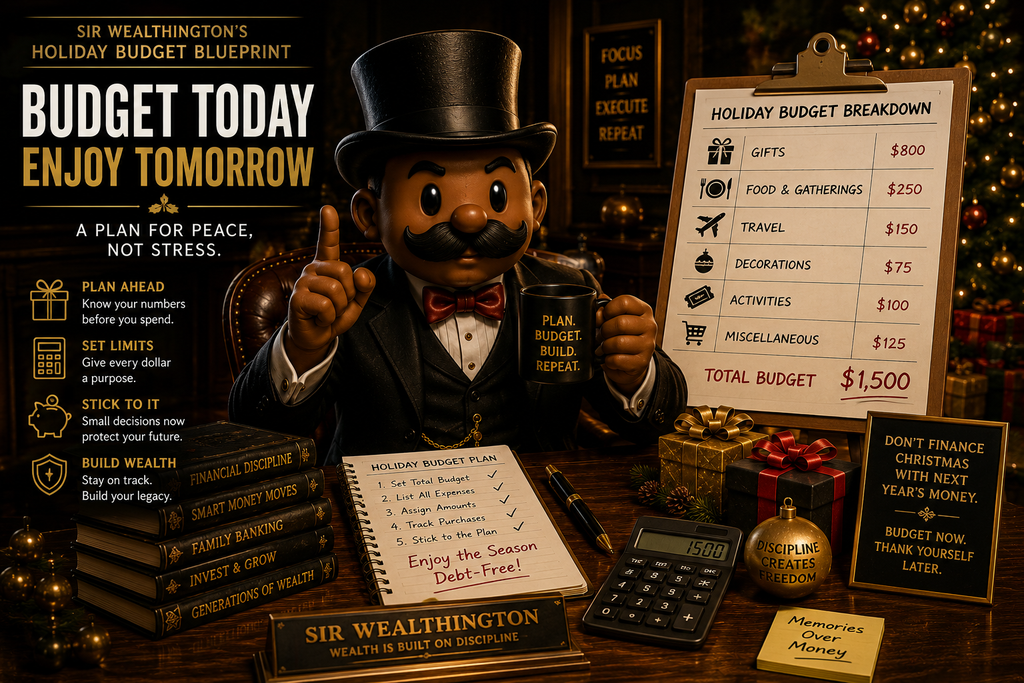
A $1,500 holiday budget might look more like this:
| Holiday Expense | Budget |
|---|---|
| Gifts | $800 |
| Food & gatherings | $250 |
| Travel | $150 |
| Decorations | $75 |
| Activities | $100 |
| Miscellaneous | $125 |
| Total | $1,500 |
Now you have boundaries before the spending starts.
Give every person a spending limit
Write down everyone you’re buying for.
Then assign a maximum amount beside each name.
Your list might say:
Children — $200 each
Spouse — $150
Parents — $75 each
Other relatives — $40 each
Friends/coworkers — $25 each
You don’t necessarily have to spend the maximum.
It’s a ceiling, not a goal.
This also helps prevent what I call gift creep.
You buy someone a $50 gift.
Then you see something else they’ll love for $25.
Then another little item for $15.
Now your $50 person became a $90 person without you realizing it.
Multiply that across ten people and your budget can disappear quickly.
Don’t finance one Christmas with the next six months
Credit cards aren’t automatically bad.
Using a card for rewards or convenience and paying the statement balance in full is very different from using debt because the purchase doesn’t fit your budget.
Credit-card interest can make holiday purchases substantially more expensive when balances are carried forward. The CFPB recommends paying credit-card bills on time and notes that paying more than the minimum reduces interest costs and helps balances disappear faster.
So ask yourself one question before charging a holiday purchase:
“If I buy this today, can I pay for it without disrupting next month’s finances?”
If the answer is no, reconsider the purchase.
Your family shouldn’t still be paying for Christmas in June.
Create a holiday sinking fund before you need it
Here’s where holiday budgeting becomes much easier.
Christmas isn’t an emergency.
It happens every year.
Instead of trying to find $1,500 in November and December, save for it throughout the year.
If your target is $1,500:
$1,500 ÷ 12 months = $125 per month.
Put $125 aside every month and by December you’ve accumulated your holiday money without needing to raid your emergency savings.
The FDIC specifically discusses automatic transfers as a way to build savings consistently.
You could even create a separate savings account labeled:
HOLIDAY FUND
That creates a psychological boundary between money intended for Christmas and money intended for emergencies, bills or investing.
Your children don’t need your financial stress as a Christmas present
Parents can feel enormous pressure during the holidays.
We want the tree overflowing with presents.
But children don’t know whether you spent $500 or $2,000 unless we teach them that the size of Christmas determines its quality.
Some of the strongest family traditions cost very little.
Cook together.
Watch Christmas movies.
Decorate the house.
Volunteer.
Drive around looking at Christmas lights.
Have a family game night.
Let the children make gifts for relatives.
Create traditions they’ll eventually repeat with their own children.
There’s nothing wrong with buying nice gifts when you can afford them.
The problem begins when we’re willing to damage January, February and March financially just to make December look impressive.
Protect the financial progress you made all year
Imagine you’ve spent eleven months paying down debt, building emergency savings and investing consistently.
Then December arrives and you withdraw $3,000 from savings and add another $2,000 to credit cards.
You’ve allowed one month to erase months of progress.
Instead, decide which financial habits will not be interrupted by Christmas.
Maybe retirement contributions continue.
Your emergency fund remains untouched.
Your normal debt payment continues.
Your household bills remain fully funded.
Then holiday spending fits around those priorities—not the other way around.
That’s a major mindset shift.
You’re no longer asking:
“How much Christmas can we buy?”
You’re asking:
“How can we enjoy Christmas without sacrificing what our family is building?”
Give yourself permission to have a smaller Christmas
This may be the most important holiday budgeting advice of all.
You don’t owe anyone an expensive Christmas.
Not your extended family.
Not your coworkers.
Not Instagram.
Not your neighbors.
And not even your children.
If money is tight this year, reduce the budget.
A financially responsible $600 Christmas is better than a $3,000 Christmas followed by months of anxiety.
Wealth is built through thousands of decisions that often look ordinary from the outside.
The holiday season is simply another one of those decisions.
Celebrate.
Give.
Enjoy your family.
Make memories.
But when January arrives, the greatest gift may be looking at your finances and realizing:
Christmas didn’t destroy the progress your family worked all year to build.
Make Family Money Part of the Conversation
Holiday budgeting can also be an opportunity to teach your family how money decisions are made. If you’re working toward a larger family financial system, these resources can help.
Family Bank Starter System
Get the Family Bank Starter System
Family Wealth Trust Blueprint / ILIT Guide