Born Free in a Time of Slavery
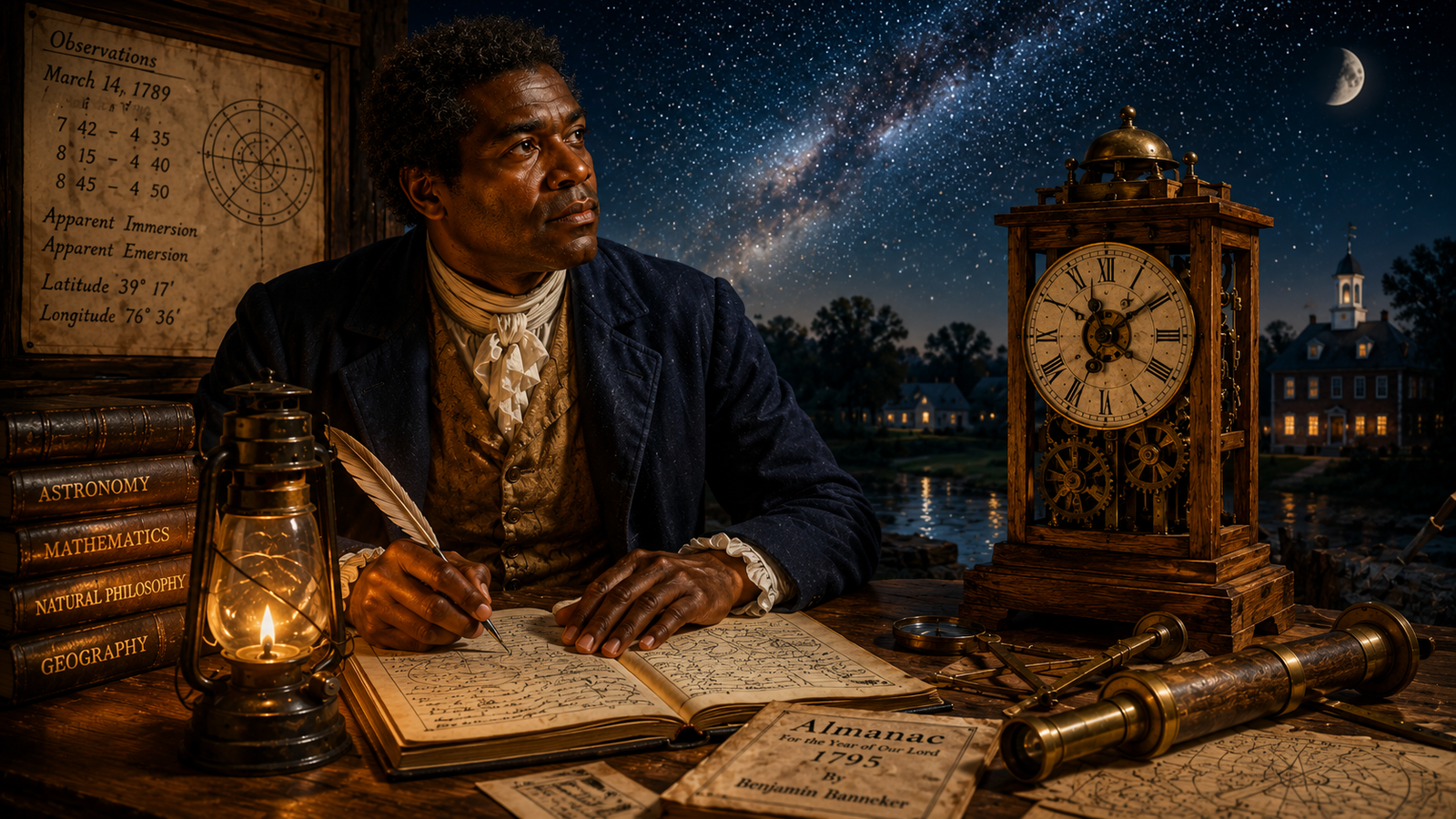
On November 9, 1731, Benjamin Banneker was born in Baltimore County, Maryland.
The American colonies were still under British rule, and slavery had become deeply woven into everyday life. While millions of Africans and African Americans were enslaved, Benjamin Banneker entered the world as a free man because both of his parents had obtained their freedom.
Freedom, however, did not mean equality.
Black Americans faced enormous barriers to education, property ownership, and opportunity. Yet from an early age, Benjamin possessed something no law or prejudice could ever take away—an extraordinary desire to learn.
His grandmother introduced him to reading by using the Bible, and he later attended a small Quaker school for a brief period before returning home to help work on the family farm.
That short education would be the only formal schooling Benjamin Banneker ever received.
Everything else…
He would teach himself.
A Mind That Refused to Stop Learning
Benjamin Banneker was fascinated by how the world worked.
While many people accepted the knowledge they were given, Benjamin constantly searched for more.
He borrowed books whenever he could and spent countless hours studying mathematics, astronomy, engineering, mechanics, and geography.
He wanted to understand everything.
How did the stars move?
Why did eclipses occur?
How could someone accurately measure time?
His farm became his classroom.
The night sky became his laboratory.
His curiosity became his greatest teacher.
Without realizing it, Benjamin was preparing himself to become one of the greatest scientific minds in early American history.
The Wooden Clock That Amazed America
One day, Benjamin borrowed a pocket watch from a friend.
Instead of simply looking at it, he carefully studied every moving part.
Every gear.
Every spring.
Every tiny mechanism.
After returning the watch, he carved enlarged wooden versions of every piece entirely by hand.
Then he assembled them.
The result was astonishing.
Benjamin Banneker built a fully functioning wooden striking clock that reportedly kept accurate time for decades.
News of his remarkable invention spread throughout Maryland.
People traveled simply to see the clock built by a self-taught Black farmer who had never attended engineering school.
His invention proved that intelligence is not determined by where someone learns—but by their willingness to keep learning.
Reaching for the Stars
Benjamin’s interests soon expanded far beyond clocks.
Each evening he observed the heavens, carefully recording the movement of stars, planets, and the moon.
Over time, he mastered advanced mathematical calculations that allowed him to predict:
- Solar eclipses
- Lunar eclipses
- Planetary positions
- Seasonal changes
- Astronomical events
His observations became so accurate that respected surveyors and scientists recognized his extraordinary abilities.
Benjamin Banneker had become one of America’s leading astronomers.
Helping Build the Nation’s Capital
Benjamin’s reputation eventually reached renowned surveyor Andrew Ellicott.
In 1791, Banneker joined the surveying team responsible for mapping the land that would become Washington, D.C.
Using astronomy and mathematics, he helped establish the precise reference points needed to survey the new federal district.
Although a popular legend claims Banneker recreated Pierre L’Enfant’s city plans entirely from memory after they were lost, historians have found little evidence supporting that story.
The truth is impressive enough.
His verified work helped survey what would become the capital of the United States.
His contributions became part of American history.
America’s Almanac Genius
Following the surveying project, Benjamin returned home and focused on publishing annual almanacs.
During the 1700s, almanacs were among the most useful books a family could own.
Farmers relied upon them.
Merchants used them.
Sailors depended on them.
Benjamin’s almanacs contained:
- Astronomical calculations
- Weather predictions
- Tide tables
- Planting calendars
- Mathematical tables
- Essays
- Poetry
- Anti-slavery writings
From 1792 through 1797, his almanacs were widely distributed throughout the Mid-Atlantic, demonstrating that a Black scholar could excel in science, mathematics, and literature despite the prejudices of the time.
The Letter That Challenged Thomas Jefferson
Benjamin Banneker’s most courageous achievement may not have involved science at all.
In 1791, he wrote a respectful but powerful letter to Thomas Jefferson.
Jefferson had questioned the intellectual abilities of Black people.
Benjamin challenged those beliefs.
He reminded Jefferson that the ideals of liberty and equality proclaimed during the American Revolution should apply to every human being.
Instead of arguing with emotion, Benjamin included one of his almanacs as proof of Black intellectual achievement.
His work became his evidence.
Jefferson later acknowledged Benjamin’s accomplishments and forwarded the almanac to a scientific society in France, introducing his work to an international audience.
Today, the letter remains one of the earliest and most influential arguments for racial equality written by a Black American.

A Lifetime Dedicated to Knowledge
Benjamin Banneker never stopped learning.
Even after his almanacs were no longer published, he continued studying astronomy, recording observations, and solving mathematical problems.
He remained committed to expanding his knowledge until the very end of his life.
He understood something many people still overlook today.
Education is not a destination.
It is a lifelong journey.
A Tragic Ending
Benjamin Banneker passed away on October 9, 1806, just weeks before his seventy-fifth birthday.
Only days after his funeral, tragedy struck.
His home caught fire.
The flames destroyed many of his journals, scientific instruments, handwritten notes, personal belongings, and his famous wooden clock.
Although much of his life’s work was lost forever, his published almanacs, surviving letters, and historical records preserved the legacy of one of America’s greatest self-taught scholars.
Lessons We Can Learn from Benjamin Banneker
Never Stop Learning
Benjamin proved that education does not end when school ends.
The people who continue learning are often the people who continue growing.
Curiosity Creates Opportunity
Every major accomplishment in Benjamin’s life began with a question.
Never stop asking why.
Invest in Knowledge
Money can be lost.
Possessions can disappear.
Knowledge stays with you forever.
Benjamin invested in his mind long before the world recognized his brilliance.
Let Your Work Speak for You
Benjamin rarely argued with those who underestimated him.
Instead, he built clocks.
He calculated eclipses.
He published almanacs.
His excellence became impossible to ignore.
Final Thoughts
Benjamin Banneker was far more than an inventor or astronomer.
He was a visionary.
A mathematician.
A scientist.
A writer.
A surveyor.
Most importantly, he proved that determination, discipline, and education can overcome extraordinary obstacles.
More than two hundred years later, his achievements continue to inspire people around the world to pursue knowledge, think independently, and never allow others to define their potential.
The Beginning
At Black Dollar & Culture, we don’t tell these stories simply to remember history—we tell them because history provides a blueprint for the future.
Benjamin Banneker reminds us that true wealth doesn’t begin with money.
It begins with knowledge.
With discipline.
With curiosity.
With the willingness to invest in yourself long before the world notices your potential.
His life teaches us that education is an asset, skills are a form of wealth, and learning is one investment that no one can ever take away from you.
As we continue building stronger families, stronger businesses, and stronger communities, let Benjamin Banneker’s example inspire us to keep learning, keep building, and keep believing that greatness is possible regardless of the obstacles placed before us.
History isn’t just something we inherit.
It’s something we continue to build.
SEO Information
Meta Title: Benjamin Banneker: The Self-Taught Black Genius Who Helped Build America
Meta Description: Discover the inspiring story of Benjamin Banneker, the self-taught mathematician, astronomer, inventor, and surveyor whose brilliance helped shape early America.
Slug: benjamin-banneker-story
Focus Keyword: Benjamin Banneker
Article Category: Black History
Estimated Reading Time: 8–10 minutes
Featured Image Alt Text: Benjamin Banneker studying the stars beside his handmade wooden clock in colonial Maryland.