By Sir Hannibal
When people tell the story of electric light, Thomas Edison usually gets most of the attention. When they tell the story of the telephone, Alexander Graham Bell takes center stage.
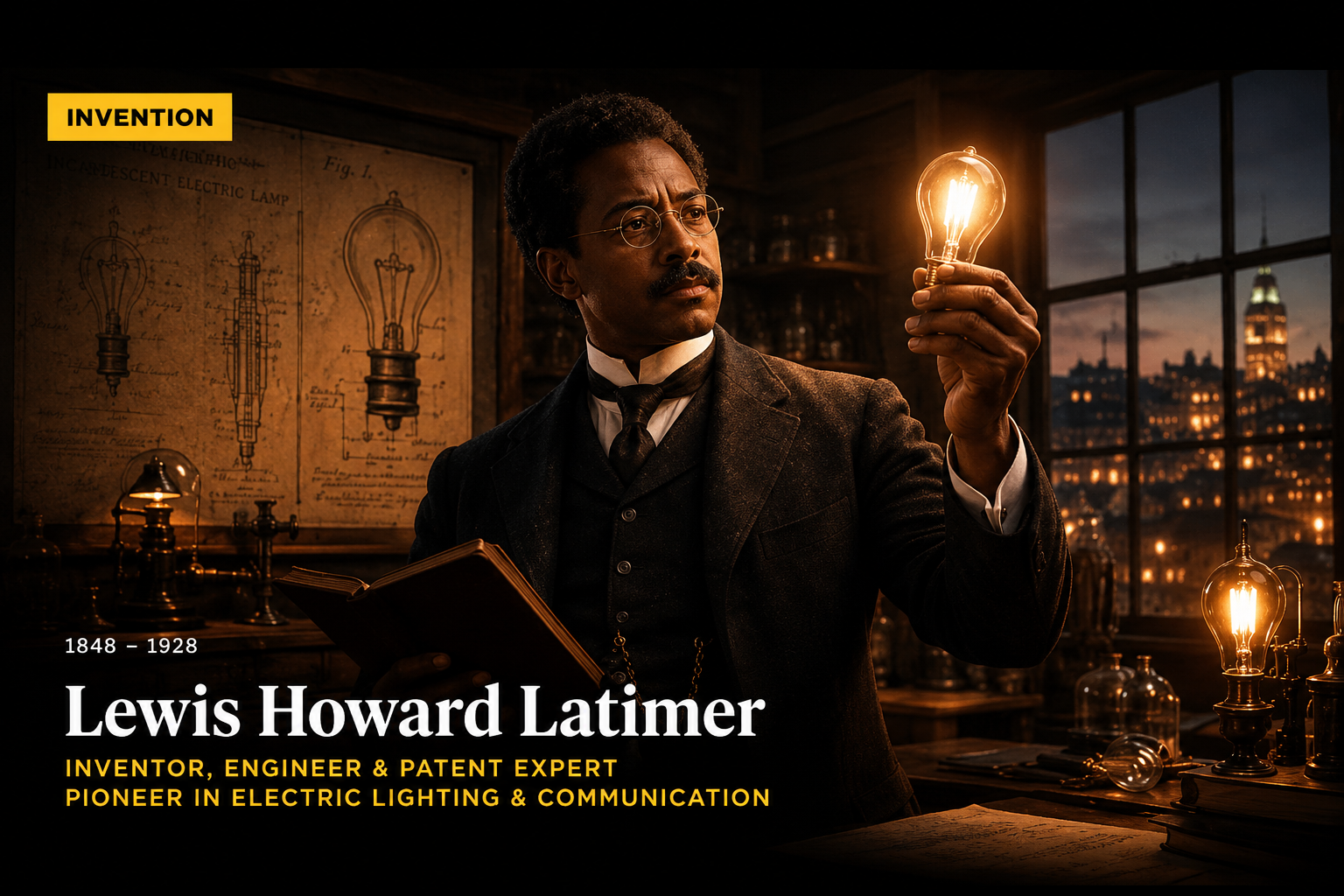
But standing remarkably close to both of those technological revolutions was a Black inventor, draftsman, engineer, author, and patent expert named Lewis Howard Latimer.
Latimer did not invent the light bulb, despite a popular claim that sometimes circulates online. His actual contribution is more interesting than the myth.
He developed an improved process for manufacturing carbon filaments used in incandescent lamps, received a U.S. patent for that process, worked in the emerging electric-lighting industry, helped oversee lighting installations, and eventually became an important member of Thomas Edison’s organization.
Years earlier, Latimer had also prepared patent drawings connected to Alexander Graham Bell’s telephone.
Think about that for a moment.
One man found himself involved in the development and protection of technologies associated with two of the biggest transformations of the 19th century: electric lighting and the telephone.
And he did it as the son of parents who had escaped slavery.
Lewis Latimer’s story began only six years after his parents escaped slavery
Lewis Howard Latimer was born in Chelsea, Massachusetts, on September 4, 1848.
His parents, George and Rebecca Latimer, had escaped slavery in Virginia several years before his birth. Their experience illustrates just how close Latimer’s life was to the institution of American slavery.
He wasn’t born centuries after slavery.
He was born into a family directly shaped by it.
The Smithsonian’s Lemelson Center notes that Latimer was the youngest child in his family and attended grammar school. But like many children of the era, he also spent significant time working.
His life took another dramatic turn during the Civil War.
At only 16, Latimer joined the U.S. Navy after falsifying his age. He served during the final period of the war and was honorably discharged.
What happened afterward would ultimately put him on a path toward engineering and invention.
Latimer found work at Crosby and Gould, a Boston patent law firm.
He didn’t walk through the door as a trained engineer.
He started as an office boy.
But Latimer watched the draftsmen.
He studied their work.
He read books about mechanical drawing and taught himself how to use the specialized tools required to create accurate technical illustrations.
This mattered enormously in the 19th-century patent world. Before computer-aided design, technical drawings had to communicate an invention with extraordinary precision.
Latimer became so good at it that the firm promoted him to draftsman.
According to the Smithsonian, his pay reportedly jumped from $3 per week to $20 per week.
That wasn’t merely a raise.
It represented a transformation in the economic value of his skills.
And those skills would soon put him in a room with Alexander Graham Bell.
Before his work with electric light, Latimer helped Alexander Graham Bell document the telephone
One of the most fascinating parts of Latimer’s career happened before his famous work with lighting.
Alexander Graham Bell was developing his telephone and racing to secure patent protection for it.
Bell needed highly accurate technical drawings.
Lewis Latimer was one of the people capable of producing them.
According to the Smithsonian’s Lemelson Center, Bell hired Latimer to prepare the drawings for his telephone patent application. Latimer worked late into the night helping prepare the materials necessary for the filing.
Bell’s historic U.S. telephone patent was filed in February 1876.
Latimer didn’t invent Bell’s telephone.
That distinction matters.
But neither should his contribution be erased simply because he wasn’t the person whose name appeared at the top of the history-book chapter.
Innovation rarely happens because of a single person working alone.
Engineers need manufacturers.
Inventors need draftsmen.
Companies need patent specialists.
Technologies need people capable of taking an idea and turning it into something that can be documented, protected, manufactured, installed, and improved.
Latimer became exceptionally valuable because he understood several parts of that process.
The light bulb already existed. The challenge was making electric lighting practical
This is where the Lewis Latimer story is often oversimplified.
You’ll sometimes see a claim that Latimer “invented the light bulb.”
He didn’t.
Electric-light technology had been developing through the work of numerous inventors, including Thomas Edison and others.
Latimer’s contribution involved one of the difficult engineering problems surrounding incandescent lighting: the carbon filament.
An incandescent lamp produces light by passing electricity through a filament until it becomes hot enough to glow.
Early filaments could be fragile.
If electric lighting was going to move beyond demonstrations and become a dependable technology used in homes and businesses, the components inside the lamps had to be manufactured reliably.
Latimer entered the electric-lighting industry at exactly the right moment.
In 1880, he began working for the United States Electric Lighting Company, which was associated with inventor Hiram Maxim.
There, Latimer gained direct experience with incandescent lighting.
And he didn’t simply sit behind a drafting table.
He became involved with the installation and production of electric-lighting equipment in American cities and abroad.
This was the infrastructure stage of innovation.
Inventing something is one challenge.
Making it work repeatedly in the real world is another.
Latimer’s carbon-filament patent addressed a real manufacturing problem
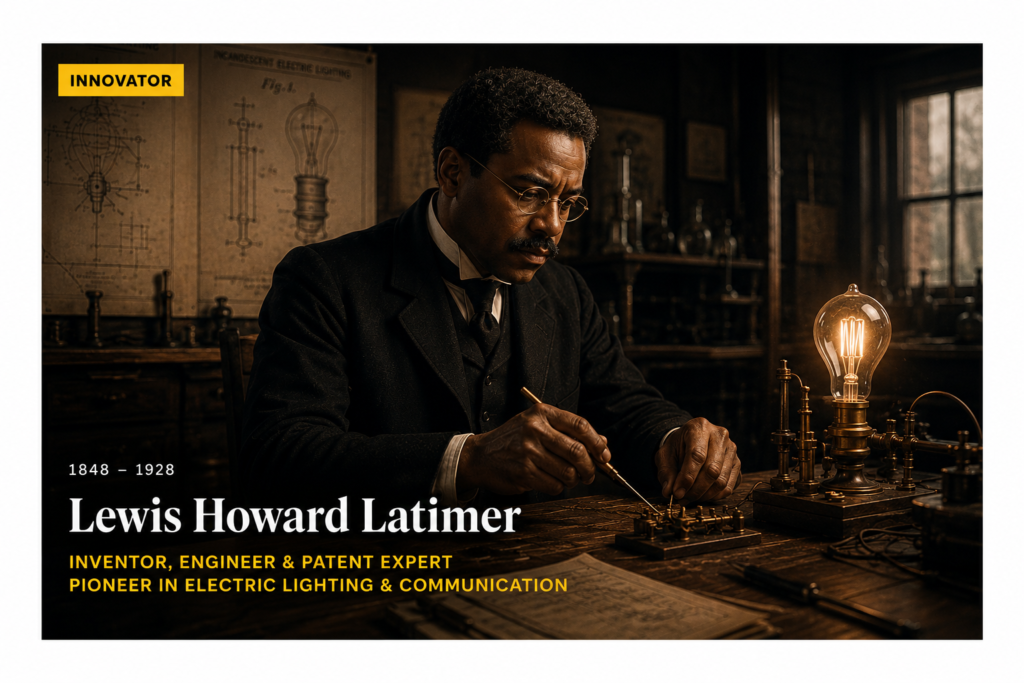
Latimer’s most famous patent is U.S. Patent No. 252,386, titled Process of Manufacturing Carbons.
The patent was granted on January 17, 1882.
Latimer explained that his invention related particularly to carbonizing conductors used in incandescent lamps.
The manufacturing process presented a delicate problem.
Materials used to create carbon components could break, distort, buckle, or shift during the intense heating required to carbonize them.
Latimer developed a process that protected the delicate carbonizable material during this stage of manufacturing.
Rather than simply saying that Latimer “made a better light bulb,” it’s more accurate to understand what he was doing:
He was solving a manufacturing problem inside an emerging industry.
That distinction makes his accomplishment more impressive, not less.
The National Inventors Hall of Fame credits Latimer with a method for producing a more durable carbon filament and recognizes him for his contribution to making incandescent electric lighting more practical.
He was inducted into the National Inventors Hall of Fame in 2006.
The real wealth lesson in Latimer’s story is the value of solving bottlenecks
There’s an economic lesson hiding inside this history.
Some of the most valuable opportunities aren’t created by inventing an entirely new industry.
They appear when an industry already exists but has a problem preventing it from growing.
Imagine an emerging technology with enormous potential.
People want it.
Investors are interested.
Companies are competing.
But one component is too expensive, too fragile, too slow to manufacture, or too difficult to distribute.
Solve that bottleneck and you can create tremendous value.
We see the same principle today.
Electric vehicles create opportunities beyond manufacturing cars. They need batteries, charging infrastructure, software, maintenance equipment, minerals, financing, and recycling.
Artificial intelligence isn’t only an opportunity for companies building AI models. The industry needs semiconductors, data centers, electricity, cooling systems, cybersecurity, training, consulting, and specialized applications.
Housing isn’t only about building houses. There are opportunities in financing, inspections, property management, construction materials, insurance, repairs, and technology.
Latimer’s career is an early example of something entrepreneurs still need to understand:
You don’t always have to invent the revolution. Sometimes the opportunity is solving the problem keeping the revolution from expanding.
Working for Edison put Latimer inside another technology empire
In 1884, Latimer joined Thomas Edison’s organization.
By then, he wasn’t merely someone who knew how to draw inventions.
He understood electric lighting, engineering, patents, manufacturing, and the competitive landscape surrounding the industry.
Those skills made him useful in a different way.
The Smithsonian reports that Latimer became involved in patent investigations and served as an expert witness in patent disputes. His knowledge helped Edison’s organization defend its intellectual property.
Latimer also managed technical information and dealt with materials from overseas.
Eventually, he wrote about the technology himself.
In 1890, Latimer published Incandescent Electric Lighting: A Practical Description of the Edison System.
Consider the progression of his career.
Office boy.
Self-taught draftsman.
Patent illustrator.
Inventor.
Electrical engineer.
Lighting specialist.
Patent expert.
Author.
That’s an extraordinary example of skill accumulation.
Latimer kept adding capabilities that made the previous capabilities more valuable.
Drawing gave him access to patents.
Patent knowledge put him around inventors.
That exposure helped him enter emerging technologies.
Engineering knowledge made him valuable to electric-light companies.
His combined legal, technical, and practical experience later made him useful in patent disputes.
That’s a career strategy that still works.
Ownership matters, but so does understanding intellectual property
Black Dollar & Culture talks frequently about ownership because earning income and owning assets are not the same thing.
Latimer’s career adds another dimension to that conversation: intellectual property.
A patent can give an inventor legal rights over a new and useful invention for a defined period, subject to the requirements of patent law.
That doesn’t mean every patent becomes valuable.
Most ideas don’t automatically turn into fortunes simply because paperwork was filed.
Commercial value still depends on whether an invention solves a meaningful problem, whether customers want it, whether it can be produced economically, and whether the inventor or company can successfully bring it to market.
But patents can be assets.
So can trademarks, copyrights, proprietary processes, brands, software, designs, formulas, and other forms of intellectual property.
Latimer spent much of his professional life in environments where people understood this.
They weren’t merely creating.
They were documenting.
They were filing.
They were protecting.
They were licensing.
They were building companies around ideas.
For today’s entrepreneur, creator, or business owner, that’s worth remembering.
Creating something can generate income.
Owning the rights connected to what you create can potentially generate leverage.
Latimer’s career also challenges the myth of the lone genius
History loves simple stories.
One inventor.
One brilliant idea.
One breakthrough moment.
Reality is usually messier.
The development of electric lighting involved scientists, inventors, engineers, investors, manufacturers, electricians, patent attorneys, draftsmen, factory workers, utilities, and competing companies.
Latimer’s story helps us see the ecosystem.
He could move between invention, engineering, drafting, manufacturing, installation, and intellectual property.
That’s why reducing him to “the Black man who invented the light bulb” actually does him a disservice.
His real story is richer.
He was a technical professional operating near the center of America’s emerging electrical industry at a time when racial discrimination placed enormous barriers in front of Black Americans.
He didn’t need to have invented the light bulb for his accomplishments to be extraordinary.
He became the only Black charter member of the Edison Pioneers
Latimer’s standing within the early electrical industry was eventually formally recognized.
In 1918, he became one of the original members of the Edison Pioneers, an organization formed by people who had worked closely with Thomas Edison during the early development of his technologies.
Latimer was the only Black member among the original group.
By then, decades had passed since the young office boy had watched draftsmen work inside a Boston patent firm.
He had built a career around knowledge.
That might be one of the most powerful parts of his story.
Latimer couldn’t control the America he was born into.
But he continually expanded the number of things he knew how to do.
Mechanical drawing.
Patent documentation.
Engineering.
Electric lighting.
Manufacturing.
Installation.
Technical writing.
Patent analysis.
Each skill opened another door.
Lewis Latimer’s legacy is bigger than a light bulb
Lewis Howard Latimer died on December 11, 1928.
But the world he left looked radically different from the one he entered.
When Latimer was born in 1848, slavery remained legal across much of the United States.
When he died 80 years later, electric lighting and telephones were helping reshape modern life.
Latimer had managed to participate professionally in both technological revolutions.
That’s the story worth teaching.
Not because we need to replace one famous inventor with another.
Not because history needs to become a competition over who deserves all the credit.
But because understanding innovation means understanding the many people who make breakthroughs possible.
For Black families in particular, Latimer’s life offers another lesson.
Our economic history shouldn’t only be a record of what was denied to us.
It should also document what Black Americans built, patented, engineered, improved, wrote, owned, and understood despite those barriers.
And for anyone thinking about entrepreneurship today, Latimer’s career still has something to say.
Learn valuable skills.
Get close to growing industries.
Pay attention to the problems those industries haven’t solved.
Understand the difference between creating something and owning it.
Document your ideas.
Protect valuable intellectual property when appropriate.
And never underestimate how powerful it can be to become the person who understands both the technology and the business surrounding it.
Lewis Latimer didn’t have to invent the light bulb to help illuminate the future.
His actual contribution was remarkable enough.
Sources
Historical and patent details in this article were verified using the Smithsonian Institution’s Lemelson Center for the Study of Invention and Innovation, the National Inventors Hall of Fame, and U.S. Patent No. 252,386. The patent was granted to Lewis H. Latimer on January 17, 1882, for his “Process of Manufacturing Carbons.”
SEO BLOCK
SEO TITLE: Who Was Lewis Latimer and What Did He Invent?
META DESCRIPTION: Discover what Lewis Latimer invented, how he improved electric-light technology, his work with Thomas Edison and Alexander Graham Bell, and the remarkable story behind his patents.
URL SLUG: lewis-latimer-inventions-light-bulb
FOCUS KEYPHRASE: Lewis Latimer inventions
CATEGORY: Black Inventors & Innovation
ESTIMATED READING TIME: 10–12 minutes