By Sir Hannibal | Black Dollar & Culture
Today in Black History — October 13
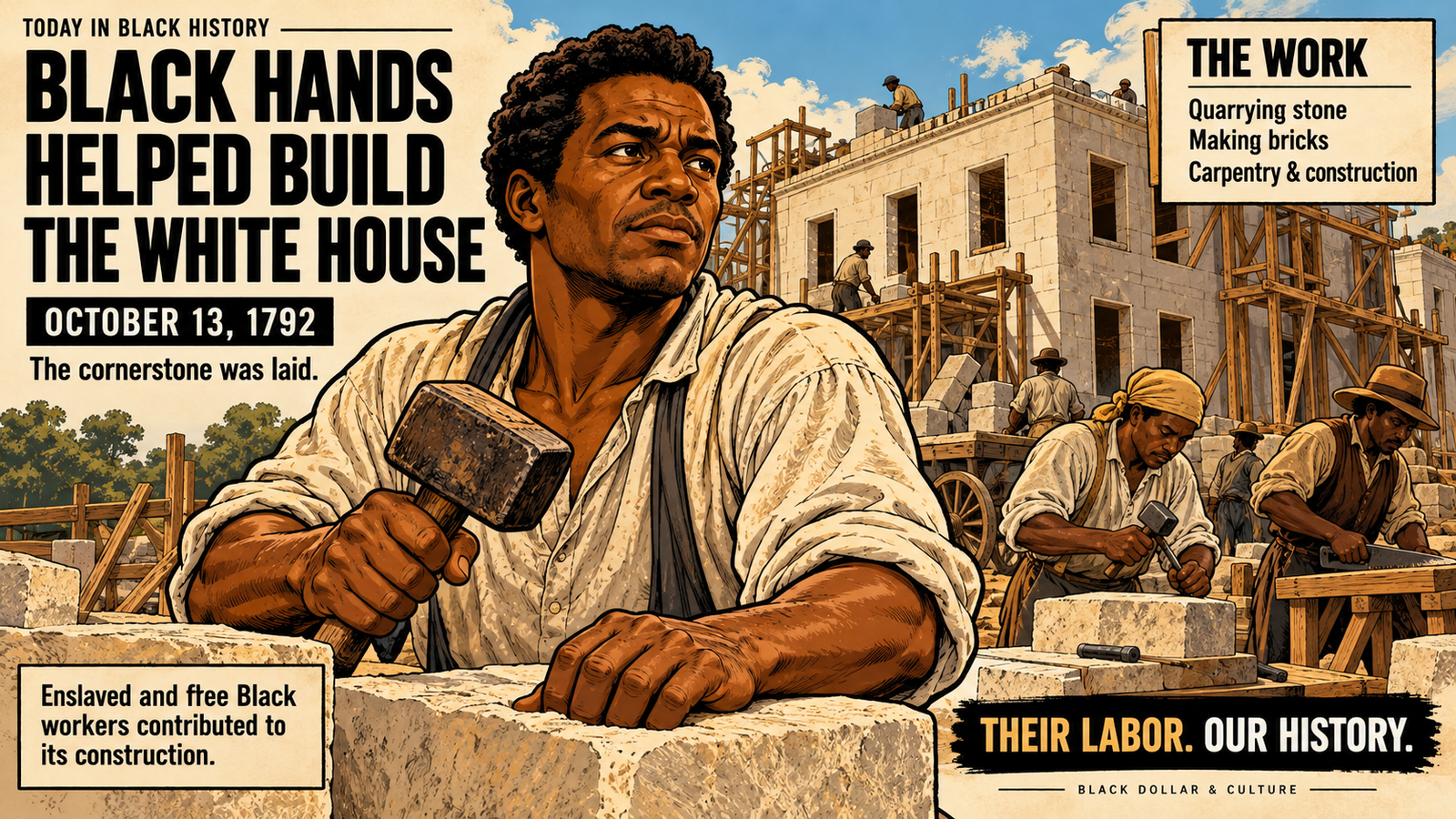
Before the White House became a backdrop for presidential speeches, state dinners and national celebrations, it was a construction site. Stone had to be cut. Timber had to be shaped. Bricks had to be made. Every wall depended on people doing the physical work of turning an architectural plan into a building.
On October 13, 1792, the laying of its cornerstone marked the official beginning of White House construction. Among the people whose labor brought the building into existence were enslaved African Americans, working alongside free Black workers, European craftsmen and other wage laborers. Their contribution belongs at the center of the story. White House Historical Association
For Black America, this anniversary raises a question that reaches beyond one landmark: What happens when people help create something valuable but are denied control over the rewards?
The White House offers a documented example of that injustice. It also gives us an opportunity to remember the workers as human beings with knowledge, ability and identities—not simply as an unnamed labor force.
A National Symbol With a Complicated Foundation
The President’s House, as the building was originally known, took shape as the federal government developed its new capital. Architect James Hoban supervised construction. The project continued for eight years, and President John Adams moved into the still-unfinished residence on November 1, 1800. nps.gov
The National Park Service describes a construction workforce that included American, English, Scottish and Irish wage laborers and craftsmen, along with enslaved African Americans hired out by their enslavers. Free and enslaved workers labored alongside one another to build the residence. nps.gov
That distinction matters. The historical record does not require us to claim that Black workers built every part of the White House alone. It requires us to acknowledge that their labor was integral to a project frequently remembered through the names of presidents and architects.
A building can carry several histories at once. The White House is a symbol of the presidency, an architectural landmark and a place where enslaved labor contributed to the construction of a government that spoke of liberty.
Understanding all three makes the history more complete.
The Work Behind the Walls
The phrase “enslaved labor” can become so familiar that we stop thinking about the tasks it describes.
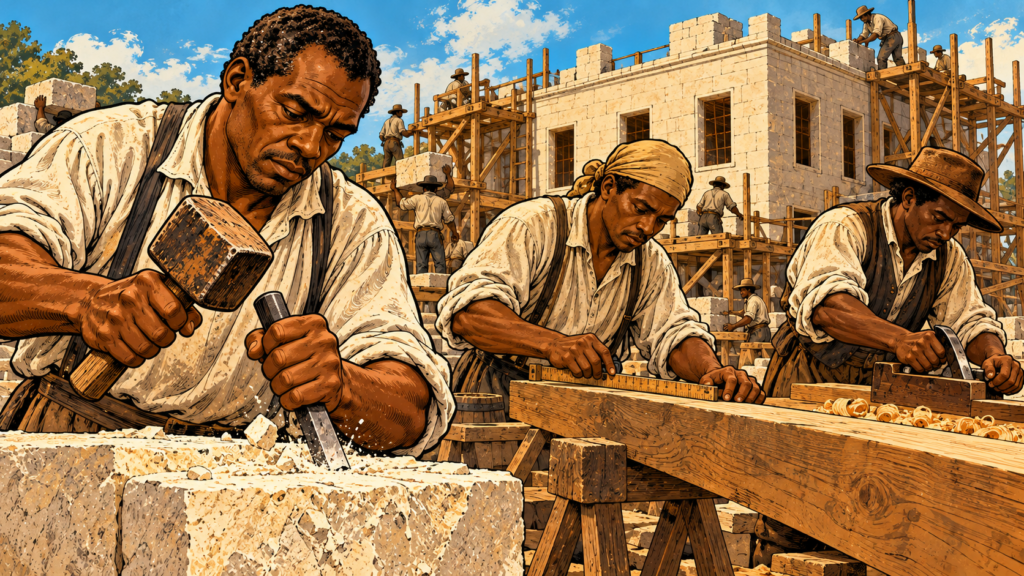
At the White House, those tasks included cutting timber, producing bricks, quarrying and moving stone, carpentry, and the demanding work of construction. Enslaved workers participated throughout the building process. White House Historical Association
Consider what those jobs involved. A usable building material does not appear simply because someone orders it. Trees must become beams. Raw stone must become pieces that can be transported and fitted into a structure. Tools must be handled with care, and materials must be prepared for the people working next in the process.
Remembering that work changes how we see the finished building.
The walls become evidence of effort. The construction story becomes a story about people whose contributions deserve attention alongside the plans they followed.
Recognizing craftsmanship does not soften the brutality of slavery. The injustice becomes even clearer when we recognize the ability of people who were compelled to work while being denied freedom.
Their skill belonged to them. The system sought to claim the value it produced.
Who Received the Money?
One of the most revealing parts of this history appears in the payment records.
The National Archives preserves payrolls and other documents showing the use of enslaved labor at the White House and the Capitol. Its historical explanation describes payments made to enslavers for the work of the people they held in bondage. It also notes that some workers occasionally received small incentive payments beyond the amounts paid to their enslavers. Those exceptions did not make the arrangement free employment. National Archives
The basic relationship remained coercive: the people doing the work did not have the freedom to negotiate their employment or control the principal payments made for their labor.
This is where the story connects directly to Black Dollar & Culture’s focus on wealth.
Creating value and receiving value are different experiences. A person can contribute to an asset without possessing it. Someone else can receive income from work they did not personally perform.
Under slavery, that separation was enforced through the ownership of human beings. The White House construction records make the arrangement visible in ordinary financial documents.
Behind an entry on a payroll was a person. Beside that person’s work stood someone else’s claim to the payment.
Remembering Ben, Daniel, Harry and Peter
History becomes more personal when names survive.
Research published by the White House Historical Association identifies Ben, Daniel, Harry and Peter as enslaved carpenters held by James Hoban who appeared in records connected to the President’s House. Their presence shows that enslaved workers contributed skilled labor as well as physically demanding general labor. White House Historical Association
We should approach those names with care. The surviving records do not give us permission to invent their conversations, ambitions or feelings. They give us a reason to remember them and to ask what more can be learned.
An architect’s name can remain attached to a building for centuries. Workers’ names may survive only in a few lines of accounting.
That imbalance affects public memory. When the most visible names belong to the people directing a project, the people carrying it out can fade from view.
Saying Ben, Daniel, Harry and Peter helps restore some of that visibility. It reminds readers that the workforce consisted of individuals, each with a life larger than the task recorded beside his name.
What the Records Cannot Tell Us
The documentation has limits.
Workers and materials moved between federal construction projects, making it difficult to assign every recorded person to a particular building. Surviving records also often identify enslaved people only by first name and connect them to an enslaver whose identity is easier to trace. White House Historical Association
Those gaps deserve honesty. We cannot supply missing biographies with confident guesses, and we should avoid giving a precise total for White House workers when the evidence does not support one.
Still, an incomplete record is not an empty record.
Enough documentation survives to establish that enslaved African Americans helped build the White House. The uncertainty concerns many individual details, not the existence of their contribution.
This distinction is especially important when sharing history online. A powerful headline should lead readers toward the evidence. Accuracy gives the story staying power beyond the first reaction.
The Ownership Question This History Raises
The modern lesson requires care. Present-day employment and entrepreneurship operate under very different conditions from slavery. Treating them as equivalent would flatten the history and obscure the coercion these workers endured.
But the records invite a lasting economic question: Who controls the value that work creates?
For today’s families, that question can guide conversations about income, businesses, property and inheritance.
When we teach children about work, we can also teach them how a business earns money and who owns it. When we celebrate a family member’s professional skill, we can discuss the options that skill might create. When relatives talk about building something together, we can ask how ownership, compensation and decision-making will be shared.
These are practical discussions about the future.
History helps explain why they matter. The people who built valuable institutions were not always allowed to accumulate wealth from their contributions. Remembering that exclusion gives greater meaning to the pursuit of opportunity, fair compensation and ownership today.
Preserve the People Along With the Achievement
There is another lesson here: preserve the names.
Families and communities can keep photographs, record oral histories, label old documents and write down the stories behind businesses, homes and careers. A saved image becomes more useful when someone records who appears in it. A family business story becomes stronger when it includes the workers and relatives who helped make it possible.
Public history depends on what survives. So does family history.
We cannot repair every missing record from the eighteenth century. We can make deliberate choices about the records we leave behind.
What October 13 Should Help Us Remember
The White House’s cornerstone anniversary marks the beginning of a building project whose workforce included people denied the freedom the nation claimed to value.
Remembering their contribution means looking beyond the finished residence. It means seeing the quarry, the timber, the tools and the payment records. It means giving attention to the people whose work made the structure possible.
For Black Dollar & Culture, the story carries both historical weight and a reason to keep teaching ownership. Our communities deserve to understand the value of their contributions and the importance of having a stake in what they help create.
Black hands helped build the White House. Their labor belongs in its history, and their names deserve a place in our memory.
Image caption: Interpretive illustration of Black craftspeople contributing to White House construction. The artwork is a modern reconstruction, not a documentary image of identified workers.
Sources for readers: White House Historical Association, National Archives, and National Park Service.