By Sir Hannibal
Imagine traveling by train in the late 1800s.
The locomotive is moving through the countryside, but there is no cell phone, radio, GPS, or digital dispatch system connecting the engineer to another train farther down the track.
Communication could literally become a matter of life and death.
That was the technological world Granville T. Woods entered.
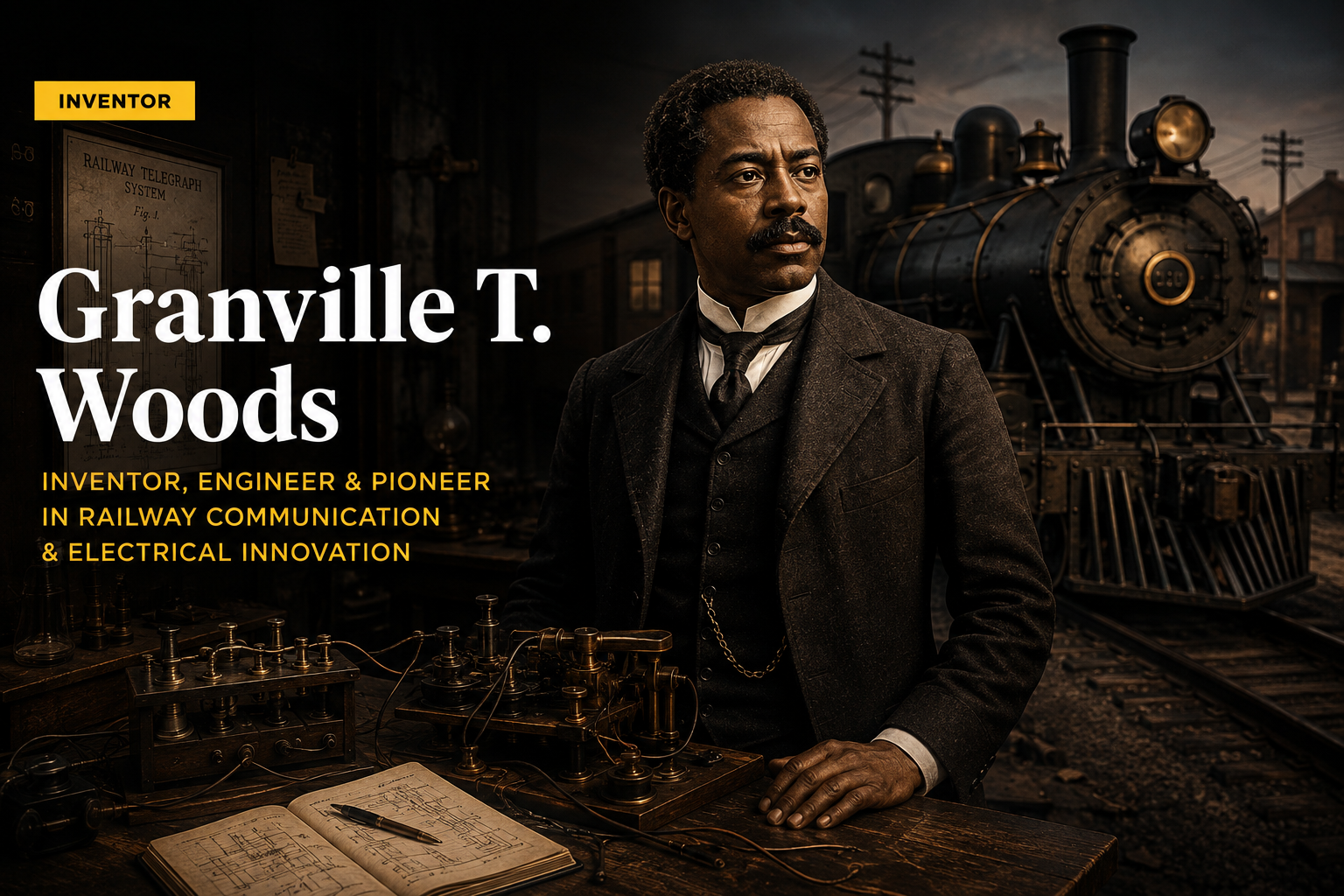
Born in 1856, Woods became one of America’s most prolific Black inventors during an era when railroads, electricity and telecommunications were transforming the country. He developed innovations involving railway communication, electrical transportation and other technologies, eventually receiving nearly 60 U.S. patents during his lifetime.
His best-known work helped moving trains communicate with railway stations and other trains.
But Woods’ story is about much more than one invention.
He studied emerging technology, worked around machinery, turned problems he witnessed into inventions, protected those inventions with patents and established his own company.
His career offers a remarkable look at what Black innovation and technological ownership looked like more than a century ago.
Granville Woods entered the world just as America was being rewired
Granville T. Woods was born in Columbus, Ohio, on April 23, 1856.
His timing matters.
America was entering an extraordinary period of technological development.
Railroad networks were expanding.
Telegraph lines were carrying information across enormous distances.
Electricity was moving from scientific experimentation toward commercial applications.
Within a few decades, electric streetcars, telephones and electric lighting would begin changing everyday life.
Woods became fascinated with the machinery behind this transformation.
According to the National Inventors Hall of Fame, Woods received formal schooling until around age 10 before beginning work as an apprentice with the goal of becoming a machinist and blacksmith.
He later worked in environments including railroads and steel mills and even served as chief engineer aboard a British steamship.
Those jobs gave Woods something that can be difficult to obtain from a textbook:
proximity to real problems.
He could see machinery operating.
He could see where systems failed.
He could see where communication was inefficient.
And he could think about how those systems might work better.
Woods also continued learning about electrical engineering, eventually studying electrical and mechanical engineering in New York.
By 1880, he had returned to Ohio and settled in Cincinnati, where he increasingly focused on invention.
The railroad wasn’t just transportation. It was one of America’s biggest technology platforms
To understand why Woods’ inventions mattered, we have to stop thinking about a railroad as simply a train.
Railroads were enormous systems.
They required tracks, stations, locomotives, signals, brakes, communications equipment, maintenance facilities and thousands of workers coordinating movement across long distances.
That created problems waiting to be solved.
One particularly important problem was communication.
A telegraph station could communicate with another station through wires.
But a moving train presented a different challenge.
How do you reliably communicate information to something traveling down the tracks?
Today the question seems simple because wireless communication surrounds us.
In Woods’ era, it was a serious engineering problem.
And Woods attacked it.
Woods helped give moving trains a way to communicate
Woods began developing what he called telegraphony, a technology combining aspects of telephone and telegraph communication.
It allowed communication using both voice and Morse code.
The technology attracted serious commercial attention.
According to the National Inventors Hall of Fame, the American Bell Telephone Company purchased rights to Woods’ telegraphony patent.
That transaction gave Woods something every inventor needs if invention is going to become a career:
capital.
Instead of simply producing ideas while working another job, Woods was able to devote himself more fully to invention.
Then came the technology for which he would become especially well known.
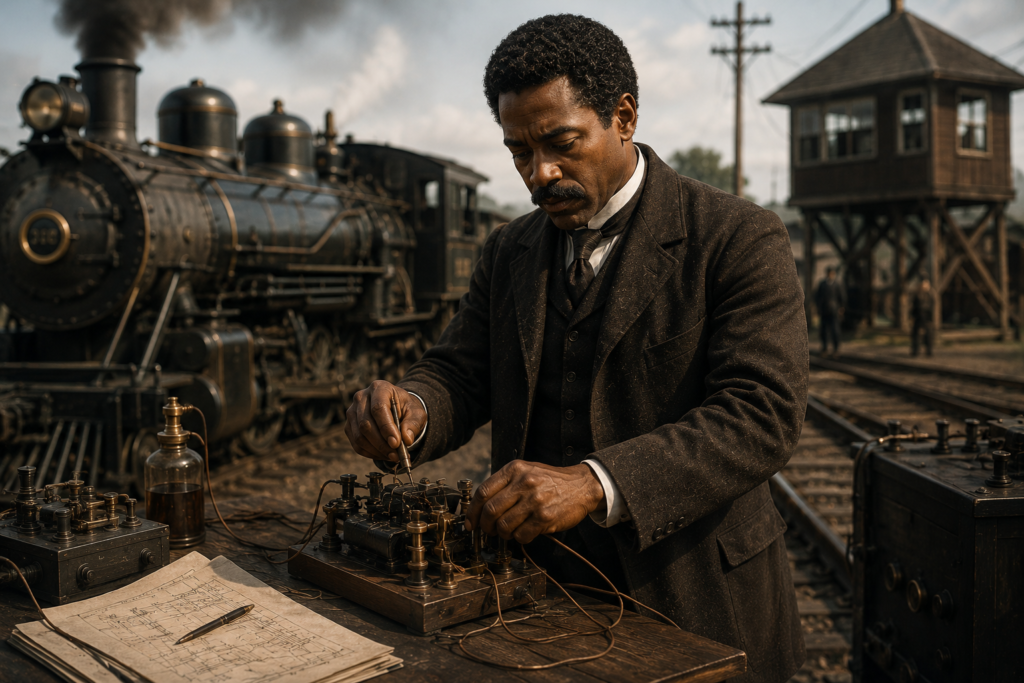
In 1887, Woods developed an induction telegraph for railway communication.
The system used electrical induction associated with telegraph lines running alongside railroad tracks to make communication possible between moving trains and railway stations.
Woods later developed his synchronous multiplex railway telegraph.
The National Inventors Hall of Fame credits this technology with allowing moving trains to communicate with stations and other trains while also helping dispatchers determine train locations.
That might sound like obscure 19th-century engineering.
It wasn’t.
It addressed a basic transportation problem:
How do you coordinate machines moving toward one another at high speed?
Better information could mean better coordination.
Better coordination could mean safer rail travel.
Woods was helping build an early layer of connected transportation infrastructure.
U.S. Patent No. 373,383 put Woods’ railway technology on paper
One of Woods’ important railway communication patents was U.S. Patent No. 373,383, associated with railway telegraphy.
A patent matters because an invention isn’t only an idea.
It can also become intellectual property.
Woods understood that.
Over his career, he accumulated nearly 60 patents, according to the National Inventors Hall of Fame.
Think about what that represents.
Every patent required Woods to identify a problem, develop a technical solution and document enough of that solution to seek legal protection.
And he was doing this as a Black inventor in the United States during the late 19th and early 20th centuries.
This was the era of Jim Crow.
The Supreme Court’s Plessy v. Ferguson decision would come in 1896.
Black Americans faced severe discrimination in employment, education, housing, business and access to capital.
Yet Woods was operating in sophisticated areas of electrical engineering and intellectual property.
That makes the business side of his career especially important.
Woods didn’t only invent technology. He created a company around his ideas
After receiving his railway telegraph patent, Woods established the Woods Electric Company in Cincinnati.
He later moved the business to New York in 1890 and worked with his brother Lyates Woods, who was also an inventor.
This is where Woods’ story connects directly to one of the central ideas behind Black Dollar & Culture:
Innovation and ownership should be discussed together.
There is a difference between being technically talented and controlling the economic rights connected to your talent.
Woods sought patents.
He sold or transferred rights to inventions.
He operated a company.
He negotiated with major corporations.
Those actions placed him inside the business of technology, not merely the workshop.
It’s an important distinction.
An employee might be paid once for completing work.
An owner can potentially control an asset.
A patent doesn’t guarantee wealth, of course. An invention still needs commercial demand, financing, manufacturing, distribution and effective business execution.
But intellectual property can create leverage.
Woods understood that more than 130 years ago.
His inventions attracted Thomas Edison’s attention — and legal challenges
Success in technology often attracts competition.
Woods’ railway telegraph technology became valuable enough to trigger patent disputes involving Thomas Edison.
According to the National Inventors Hall of Fame, Edison filed patent suits involving Woods’ multiplex telegraph technology.
Woods prevailed.
The Hall of Fame also reports that Edison later offered Woods a partnership in one of his businesses.
Woods declined.
He preferred remaining an independent inventor.
That episode has become one of the most famous parts of Woods’ story.
But the deeper lesson isn’t that Woods somehow “defeated Edison.”
It’s that his intellectual property was valuable enough to defend.
That’s a very different way of looking at Black economic history.
Woods wasn’t simply asking to participate in the technological revolution.
He was creating intellectual property inside it.
Rail communication was only part of what Woods was building
Woods continued working on electrical transportation.
Among his innovations were systems involving overhead electrical conductors for railway and trolley cars.
Instead of depending entirely on steam power, urban transportation was beginning to use electricity.
Woods developed technology connected to delivering electrical current to moving rail vehicles.
He also worked on third-rail technology.
If you’ve ridden certain subway or rail systems, you’ve probably seen—or at least been warned about—the electrified rail running alongside the track.
The concept allows electricity to be supplied to trains through an additional conductor rail.
The National Inventors Hall of Fame credits Woods with developing a third-rail system and other electrical railway improvements.
He also worked on braking technology.
Taken together, these inventions show that Woods wasn’t randomly patenting unrelated gadgets.
Much of his work clustered around a technological ecosystem he understood extremely well:
transportation + electricity + communication.
That’s an entrepreneurial strategy worth studying.
Woods shows why expertise in one industry can produce multiple businesses
Entrepreneurs sometimes spend years searching for completely unrelated business ideas.
Woods’ career suggests another approach.
Learn one industry deeply enough that you begin seeing multiple problems inside it.
Imagine someone entering the railroad industry in Woods’ time.
They might notice problems with:
communication,
power delivery,
braking,
signaling,
safety,
equipment,
or electrical control.
Solve one problem and you learn more about the system.
That knowledge exposes another problem.
Solve that problem and your expertise becomes even deeper.
Woods repeatedly invented around technologies he understood.
Modern entrepreneurs can use the same principle.
Someone who deeply understands trucking might eventually identify opportunities in fleet software, dispatching, maintenance, logistics, insurance, driver training or equipment.
Someone who understands real estate might discover opportunities in property management, inspections, construction, financing, software or maintenance.
Someone working in healthcare might recognize problems invisible to outsiders.
The opportunity doesn’t always begin with asking:
“What business should I start?”
A better question can be:
“What problems do I understand better than most people?”
Woods understood railroads and electrical systems.
Then he built around that knowledge.
Nearly 60 patents tell us something important about how innovation actually happens
People often imagine inventors having one brilliant idea.
Woods’ career tells a different story.
Nearly 60 patents suggest repetition.
Observation.
Experimentation.
Failure.
Modification.
Documentation.
Another invention.
Another patent.
Another improvement.
That’s closer to how meaningful innovation usually happens.
Woods wasn’t waiting for one magical idea to make him famous.
He kept working.
His patents eventually attracted companies that were helping build America’s industrial infrastructure.
According to the National Inventors Hall of Fame, patents associated with Woods were eventually purchased and used by companies including General Electric and the Westinghouse Air Brake Company.
That is an important part of his legacy.
His ideas weren’t merely curiosities sitting inside patent records.
Major industrial companies saw commercial value in them.
The nickname “Black Edison” doesn’t tell the whole story
Granville Woods is frequently referred to as the “Black Edison.”
It’s easy to understand why the nickname stuck.
Both men were prolific inventors working heavily with electricity during roughly the same technological era.
But the comparison can unintentionally shrink Woods’ identity.
Granville Woods wasn’t important because he resembled Thomas Edison.
He was important because he was Granville Woods.
His inventions addressed real engineering problems.
His patents stood on their own.
His railway communication technology had practical value.
His electrical transportation work contributed to an industry undergoing enormous change.
And his business decisions demonstrated an understanding of intellectual property and technological ownership.
Black history doesn’t need comparisons to famous white historical figures in order to become significant.
The accomplishments can stand on their own.
The most powerful lesson from Woods may be getting close to the problem
There is a pattern connecting Woods’ early life with his later inventions.
He worked around machinery.
He worked around railroads.
He learned mechanical engineering.
He studied electricity.
Then he invented solutions involving machinery, railroads and electricity.
That isn’t coincidence.
He positioned himself close enough to important industries to understand their weaknesses.
Today we might call that domain expertise.
Woods simply lived it.
This is particularly relevant for people who believe entrepreneurship requires immediately quitting a job and inventing something completely new.
Sometimes your job is giving you an education in problems other people don’t understand.
A warehouse worker sees inefficiencies customers never notice.
A truck driver understands logistics problems software developers may overlook.
A nurse sees workflow problems that investors sitting in an office might never encounter.
A teacher sees educational gaps parents and policymakers might miss.
The question is whether you recognize that knowledge as potentially valuable.
Granville Woods did.
Black innovation belongs inside the larger story of Black wealth
There is a reason stories like Woods’ belong on Black Dollar & Culture.
Black economic history can’t only be a history of wages, discrimination and wealth gaps.
Those subjects matter.
But they’re incomplete.
There is also a history of Black Americans creating businesses, acquiring property, filing patents, developing technology and building intellectual assets.
Granville Woods belongs in that history.
He was born less than five years before the Civil War began.
Yet he grew into an electrical engineer and inventor working in some of the most advanced technological industries of his era.
He formed a company.
He protected inventions.
He negotiated intellectual property.
He competed against powerful interests.
And he kept inventing.
That doesn’t erase the racial barriers of his era.
It makes his accomplishments even more revealing.
Granville Woods wasn’t watching the future arrive. He was helping build it.
Granville T. Woods died on January 30, 1910, at only 53 years old.
By then, the technological landscape of America had changed dramatically from the world into which he had been born.
Electric streetcars moved through growing cities.
Telephone networks were expanding.
Electric power was becoming increasingly important.
Railroads connected industries and communities across enormous distances.
Woods had spent much of his adult life working directly inside that transformation.
In 2006, he was inducted into the National Inventors Hall of Fame for railway telegraphy.
More than a century after his death, that’s what makes his story worth remembering.
Not simply because he was a Black inventor who accumulated patents.
But because Woods understood something that remains true today:
The future creates problems before it creates fortunes.
The people who learn the technology, understand the industry, identify those problems and own valuable solutions can put themselves in position to participate economically in whatever comes next.
Granville Woods did exactly that in the electrical revolution of the 19th century.
He didn’t stand outside America’s technological transformation watching other people build the future.
He put his name on the patents.
Sources
Historical and technical details were verified primarily through the National Inventors Hall of Fame, including its biographical record of Granville Woods and its educational material on his railway communication technology. The Smithsonian Institution’s collections also document Woods as an important African American inventor of the industrial age.
SEO BLOCK
SEO TITLE: Who Was Granville T. Woods and What Did He Invent?
META DESCRIPTION: Discover what Granville T. Woods invented, how his railway telegraph helped moving trains communicate, his patent battles with Thomas Edison, and the remarkable story of one of America’s great Black inventors.
URL SLUG: granville-t-woods-inventions-railway-telegraph
FOCUS KEYPHRASE: Granville T. Woods inventions
CATEGORY: Black Inventors & Innovation