Introduction
History is often remembered through the stories of kings, presidents, inventors, and military leaders. Yet some of the most important lessons come from the lives of ordinary people whose stories expose the strengths—and failures—of a nation.
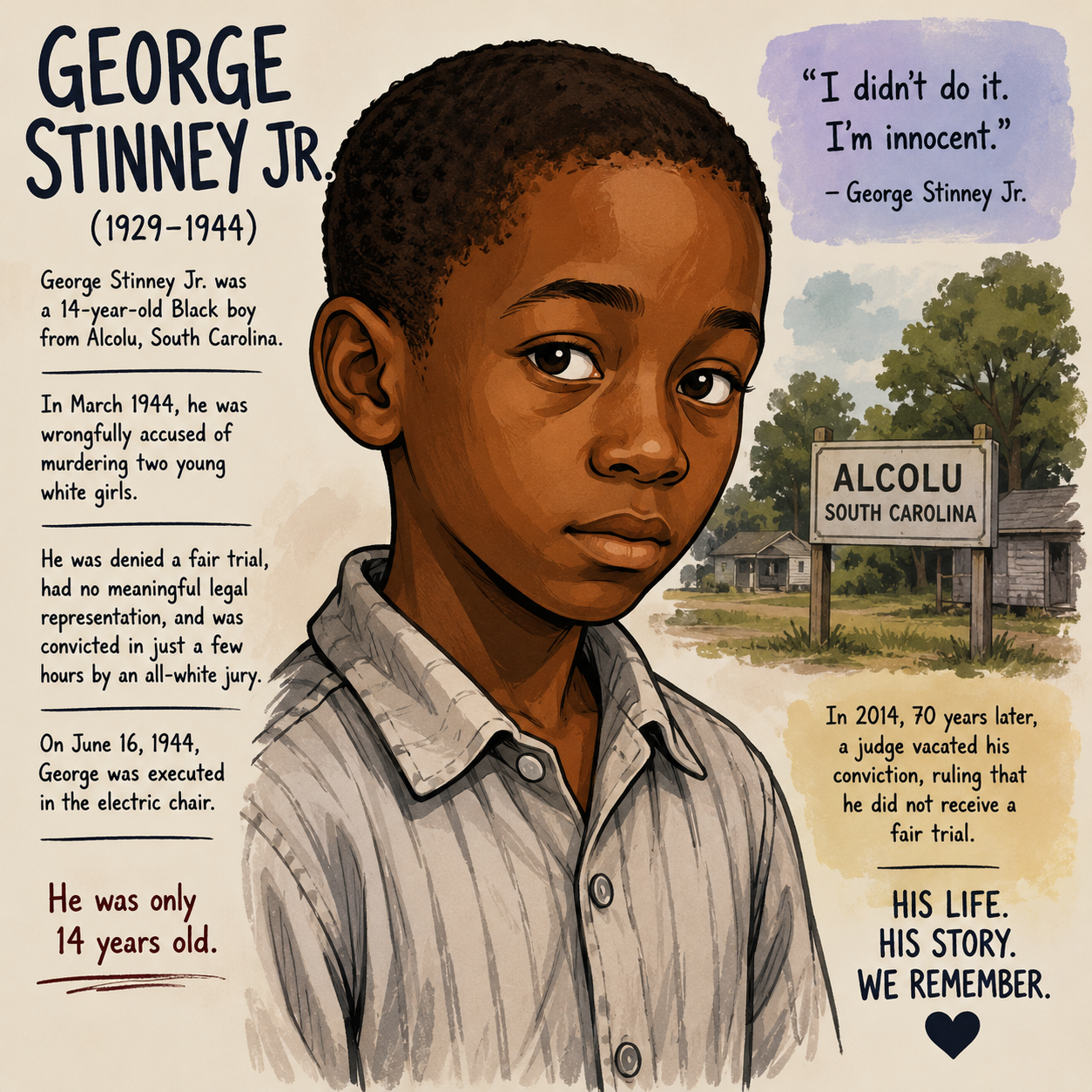
One such story is that of George Stinney Jr., a quiet 14-year-old Black boy from rural South Carolina whose life ended in the electric chair after one of the fastest criminal trials in American history.
More than seventy years later, his conviction was overturned by a judge who concluded that fundamental constitutional protections had been denied.
Today, George Stinney Jr.’s story remains one of the most widely discussed examples of racial injustice, due process failures, and juvenile justice in American history.
Growing Up in Alcolu, South Carolina
George Junius Stinney Jr. was born in 1929 and lived in the small mill town of Alcolu, South Carolina.
Like much of the American South during the 1940s, Alcolu was segregated. Black and white residents lived in separate neighborhoods, attended separate schools, and experienced vastly different opportunities under Jim Crow laws.
George lived with his parents and siblings in a modest company-owned home. Friends described him as a quiet, respectful boy who enjoyed helping his family and playing with neighborhood children.
No one could have imagined that within a few months, his name would become part of American legal history.
The Disappearance
On March 23, 1944, two white girls—11-year-old Betty June Binnicker and 7-year-old Mary Emma Thames—left home on bicycles while searching for flowers.
Witnesses later reported that the girls had briefly spoken with George and his sister, asking whether they knew where to find wildflowers.
The girls never returned home.
The next day, both children were found dead.
The town was devastated, and pressure mounted for authorities to identify a suspect quickly.
George Becomes the Prime Suspect
Police arrested George Stinney Jr. the same day.
Authorities claimed that George confessed during questioning.
However, several important facts have remained central to discussions about the case:
- No written confession was ever produced.
- No audio recording existed.
- No signed statement survives.
- There was no physical evidence directly linking George to the crime.
- His parents were not present during questioning.
After George’s arrest, his family feared for their safety and left Alcolu, leaving the 14-year-old to face the legal system alone.
A Trial That Lasted Only Hours
George’s murder trial began on April 24, 1944.
The proceedings lasted only a few hours.
His court-appointed attorney called no witnesses in George’s defense and presented little challenge to the prosecution’s case.
The jury consisted entirely of white men.
After hearing the evidence, the jury deliberated for approximately ten minutes before returning a guilty verdict.
George was sentenced to death.
He was just 14 years old.
The Youngest Person Executed in Modern America
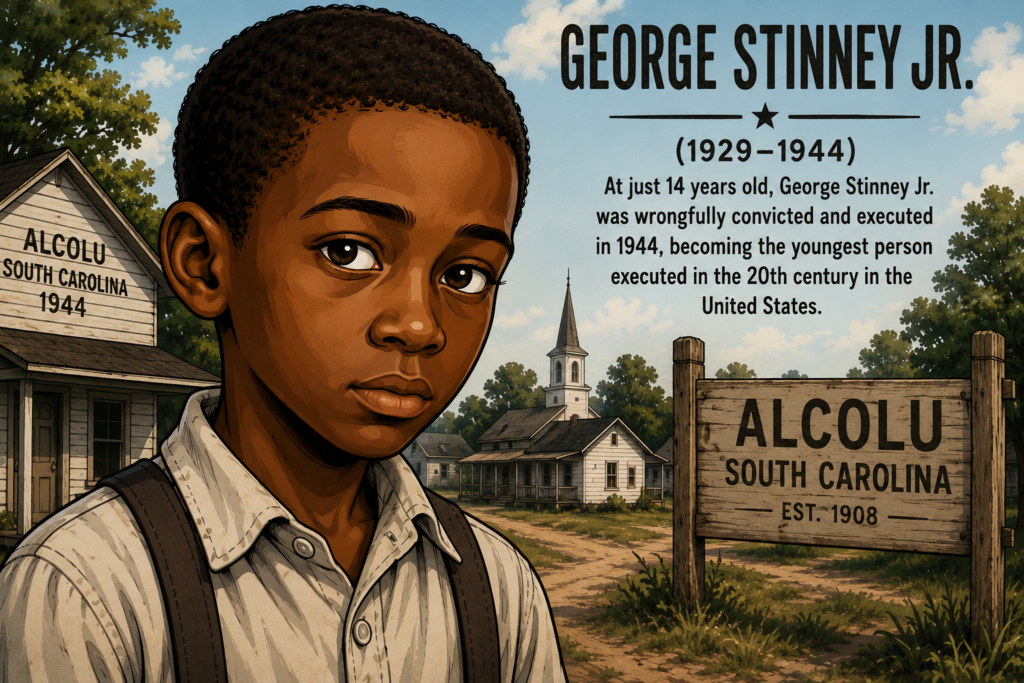
On June 16, 1944, George Stinney Jr. was executed in the electric chair.
Because he was so small—reportedly weighing around 95 pounds—accounts indicate that prison officials used books or other supports to help secure him in the chair.
He became the youngest person executed in the United States during the 20th century.
His execution shocked many people over the years as more details of his case became widely known.
Questions That Never Went Away
For decades, historians, legal scholars, journalists, and civil rights advocates continued examining the case.
Several concerns repeatedly surfaced:
- The extremely short trial.
- The lack of meaningful legal representation.
- The absence of physical evidence.
- The alleged confession that was never documented.
- George’s age.
- The racial climate of South Carolina during segregation.
These issues caused many people to question whether George had received the fair trial guaranteed under the Constitution.
Justice—Seventy Years Later
In 2014, George Stinney Jr.’s family sought to have the conviction reviewed.
After hearing testimony and examining the historical record, a South Carolina judge vacated his conviction.
The court ruled that George had been denied fundamental due process and that the original proceedings failed to meet basic standards of fairness.
The ruling did not determine factual innocence or guilt. Instead, it concluded that the legal process itself had been deeply flawed.
For George’s surviving relatives, the decision represented a measure of long-delayed justice.
Why George Stinney Jr.’s Story Still Matters
George’s story is about far more than one criminal case.
It raises enduring questions about:
- Equal justice under the law.
- The rights of children within the legal system.
- Competent legal representation.
- Racial inequality in American history.
- The importance of due process.
His case continues to be studied in law schools, history classrooms, documentaries, and discussions about criminal justice reform.
Lessons for Future Generations
History cannot change what happened to George Stinney Jr.
But history can teach future generations why constitutional protections matter.
Every citizen deserves a fair trial.
Every child deserves protection under the law.
Every justice system must be held accountable to the principles it claims to defend.
George’s story reminds us that fairness is not automatic—it must be protected by courageous judges, honest investigators, competent attorneys, and an informed public.
Conclusion
George Stinney Jr.’s life lasted only fourteen years, but his story continues to shape conversations about justice more than eight decades later.
His name has become a reminder that history is not only about celebrating great achievements—it is also about remembering painful moments so they are never repeated.
As historians continue to examine the past, George Stinney Jr.’s story stands as one of America’s most significant lessons about due process, racial injustice, and the enduring pursuit of equal justice under the law.
Continue Your Journey Through Black History
If you enjoyed this article, explore more stories that schools often overlook. At Black Dollar & Culture, we uncover the people, events, innovators, entrepreneurs, and pivotal moments that shaped history while connecting those lessons to wealth, ownership, and community building.