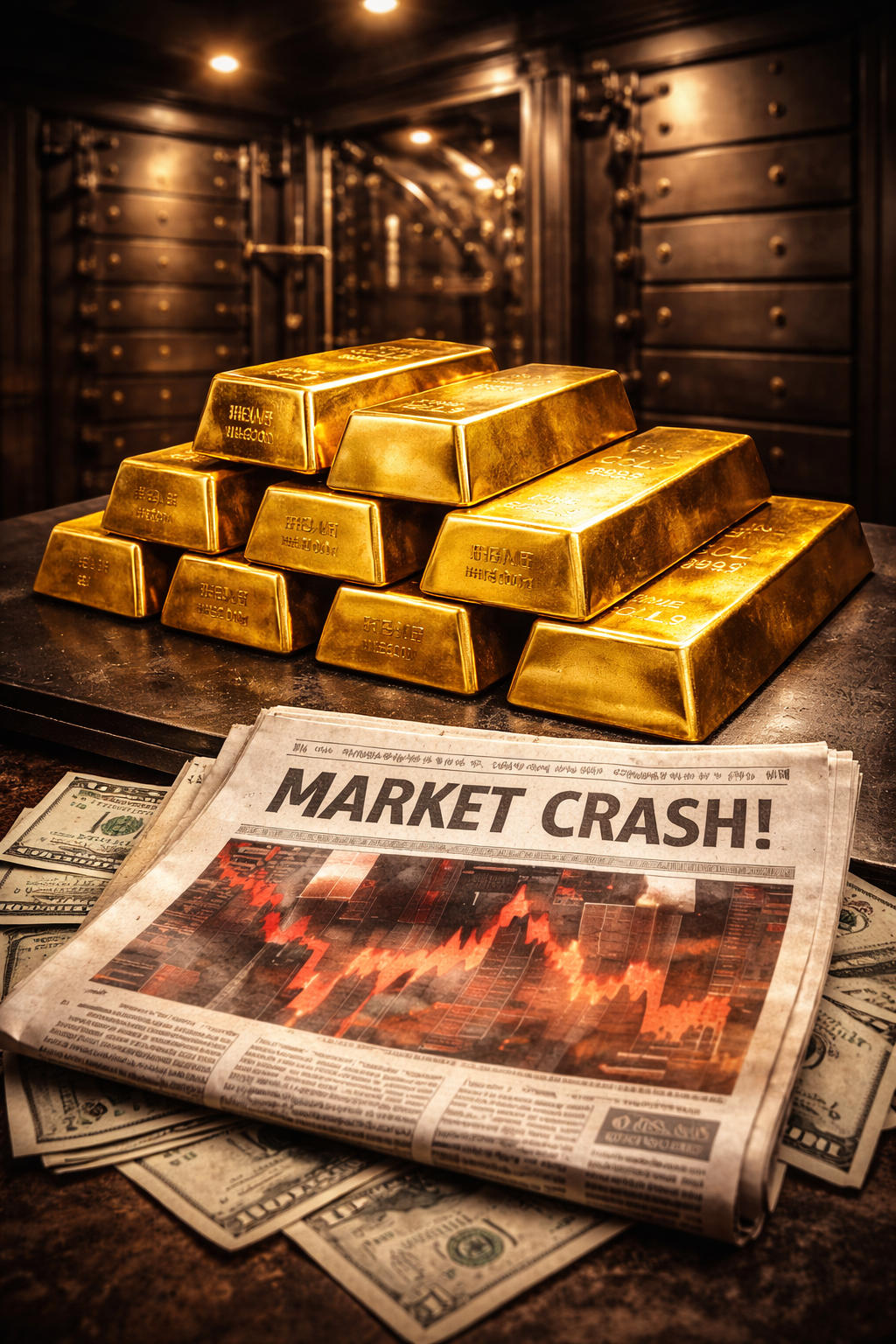

Markets don’t collapse overnight—they unravel quietly, then all at once. Long before the headlines turn red and panic becomes fashionable, confidence begins to erode beneath the surface. Liquidity tightens, assumptions fail, and investors realize—too late—that optimism was doing more work than fundamentals. When that confidence breaks, gold does what it has always done: it holds.
Gold has never been an asset of excitement. It doesn’t trend on social media, it doesn’t promise outsized returns, and it doesn’t rely on narratives. It exists for moments of stress—when systems are questioned, currencies are diluted, and trust in leadership weakens. After surviving multiple market cycles, one lesson becomes unavoidable: markets reward growth, but wealth survives through protection.
When stock markets collapse, it’s rarely because companies disappear overnight. It’s because valuations were built on fragile assumptions—cheap money, endless growth, stable geopolitics. Once those assumptions crack, repricing is swift and unforgiving. Gold doesn’t reprice on earnings calls or guidance forecasts. It responds to fear, uncertainty, and instability—the very conditions that define market collapses.
Cash feels safe during chaos, but history exposes its weakness. Inflation quietly erodes purchasing power while governments respond to crises with stimulus, debt expansion, and money creation. Every collapse is met with liquidity, and liquidity always comes at a cost. Gold has no printing press. Its scarcity is real, which is why it preserves value when paper assets struggle to do the same.
This is precisely why central banks hold gold. Not for tradition—but for credibility. When trust between nations weakens, gold becomes neutral ground. When debt loads grow uncomfortable, gold becomes reassurance. When currencies wobble, gold becomes stability. The same logic applies at the individual level.
Another overlooked advantage of gold during market collapses is optionality. The most dangerous position an investor can be in during a downturn is forced selling. Gold provides liquidity without forcing the liquidation of productive assets at the worst possible moment. It buys time, and time is often the difference between recovery and permanent loss.
Gold also behaves differently than most assets during crises. While correlations across markets tend to spike during panic, gold often diverges. It may not surge immediately, but it holds ground while others fall. That stability matters far more than aggressive upside when the goal is wealth preservation.
The wealthy understand this distinction clearly. They don’t buy gold to outperform equities in bull markets. They hold it to survive bear markets. Gold is not designed to make headlines—it’s designed to protect capital when headlines turn ugly.
History reinforces this lesson repeatedly. Empires rise and fall. Currencies are introduced, abused, and replaced. Financial systems evolve, break, and rebuild. Through every version of that cycle, gold remains relevant—not because it is old, but because it is independent.
Gold does not replace businesses, real estate, or equities. It complements them. Think of it as structural support rather than decoration. You don’t admire it when times are calm, but without it, the foundation cracks under pressure.
When markets collapse, emotions spread faster than facts. Gold does not react to emotion. It doesn’t panic, doesn’t promise, and doesn’t explain itself. It simply holds value while everything else explains why it can’t.
That is why gold protects wealth—not through excitement, but through endurance.
❤️ Support Independent Black Media
Black Dollar & Culture is 100% reader-powered — no corporate sponsors, just truth, history, and the pursuit of generational wealth.
Every article you read helps keep these stories alive — stories they tried to erase and lessons they never wanted us to learn.
Focus Keyphrase:
gold protects wealth
Slug:
why-gold-protects-wealth-when-markets-collapse
Meta Description:
When markets collapse and confidence disappears, gold has historically protected wealth. Learn why gold remains a powerful hedge during economic uncertainty.