By Sir Hannibal
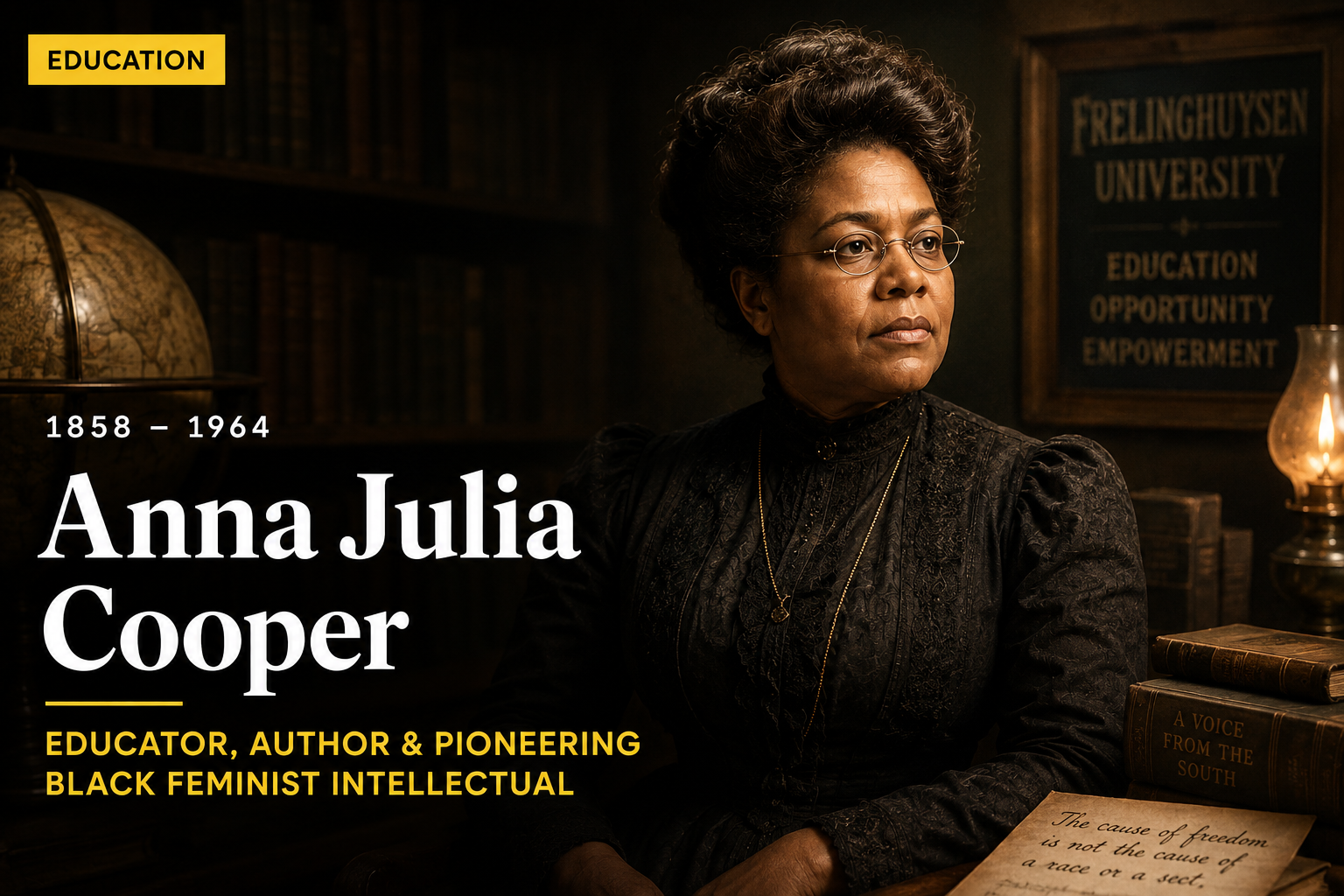
On August 10, 1858, Anna Julia Haywood Cooper was born in Raleigh, North Carolina.
That fact alone doesn’t tell you how remarkable her story would become.
Cooper entered the world enslaved. She was born at a time when Black Americans could be legally treated as property, when educating enslaved people was restricted across much of the South, and when the idea of a Black woman becoming one of America’s leading intellectuals would have seemed impossible to many people around her.
Yet Cooper would spend more than a century proving how dangerous those assumptions were.
She became an educator, author, scholar and activist. She challenged the limited education being offered to Black children. She argued publicly for the intellectual development of Black women. She wrote about the overlapping burdens of racism and sexism generations before modern scholars developed the language commonly used to describe them.
And in 1925, well into her sixties, she earned a doctorate from the University of Paris, Sorbonne.
Her journey from slavery to the highest levels of academia is why Anna Julia Cooper deserves to be remembered on August 10—and why her ideas deserve far more attention than they often receive.
Anna Julia Cooper was born enslaved on August 10, 1858
Cooper was born Anna Julia Haywood in Raleigh to Hannah Stanley Haywood, an enslaved woman. The National Park Service records Cooper’s birth as August 10, 1858, and notes that her mother did not reveal her father’s identity to her.
That meant Cooper’s first years unfolded during one of the most consequential periods in American history.
She was a young child when slavery was abolished.
For millions of formerly enslaved Black Americans, freedom created a new question: What could freedom actually become?
Education quickly became part of the answer.
Formerly enslaved people built schools, pursued literacy and fought to give their children opportunities that slavery had deliberately denied them.
Cooper became part of that generation.
In 1868, she entered Saint Augustine’s Normal School and Collegiate Institute in Raleigh, an institution established to educate formerly enslaved people. According to the Library of Congress, she was already tutoring at about age 10 to help cover her tuition.
Imagine the contrast.
A girl born into slavery was now sitting in a classroom studying—and helping teach others.
But gaining access to a school did not mean gaining equal access to education.
Cooper would soon discover that race wasn’t the only barrier standing in her way.
Being a girl came with another set of expectations.
Cooper refused to accept that certain subjects were only for men
The educational world Cooper entered still carried rigid ideas about what women should learn.
She wasn’t interested in accepting them.
When Cooper later attended Oberlin College in Ohio, she pushed to take the more rigorous curriculum available to male students. The Library of Congress notes that these so-called “gentlemen’s courses” included subjects such as higher mathematics, Latin and Greek.
That decision tells us something important about Cooper.
She wasn’t merely asking to be allowed into the room.
She wanted access to the same intellectual opportunities available to men.
Cooper earned her bachelor’s degree in mathematics from Oberlin in 1884 and a master’s degree in mathematics in 1887.
For a Black woman born enslaved less than three decades earlier, those accomplishments were extraordinary.
But education wasn’t simply a personal achievement for Cooper.
She saw it as a tool capable of changing what happened to entire communities.
That belief would eventually place her in the middle of a much larger argument over what kind of education Black Americans deserved.
She believed Black students deserved more than an education designed around society’s expectations
After earning her master’s degree, Cooper taught mathematics and science at Washington, D.C.’s M Street High School, one of the country’s most important institutions for Black education.
Cooper eventually became principal.
Her philosophy was ambitious.
She wanted Black students exposed to rigorous academic subjects and prepared for higher education.
That may sound obvious today. At the time, however, there was a major debate over the future of Black education.
Should Black students primarily receive industrial and vocational training that could prepare them for available jobs?
Or should they also receive rigorous academic preparation that could lead to universities and professional careers?
Cooper strongly defended the latter opportunity.
Her approach produced results.
The Library of Congress reports that while leading M Street, Cooper helped students gain admission to institutions including Brown, Mount Holyoke, Harvard and Yale after they passed entrance examinations.
But success didn’t protect her from opposition.
Her educational philosophy clashed with officials who favored a more limited curriculum. The Smithsonian’s National Museum of African American History and Culture notes that Cooper’s progressive approach faced resistance from the D.C. School Board and contributed to her losing her position as principal in 1906.
Think about what was really being contested.
It wasn’t simply a disagreement over a school schedule.
It was a disagreement over expectations.
Cooper believed Black students should be prepared to compete intellectually at the highest levels available to anyone else.
And she was willing to put her career behind that belief.
Cooper understood that Black women were fighting two battles at the same time
Education was only one part of Cooper’s intellectual work.
In 1892, she published A Voice from the South: By a Black Woman of the South.
The book established Cooper as one of the most important Black female thinkers of the nineteenth century.
She wrote about race.
She wrote about gender.
She wrote about education, class and labor.
More importantly, Cooper recognized something that wasn’t always acknowledged by the movements surrounding her: Black women could experience discrimination differently because they were both Black and women.
The National Park Service describes A Voice from the South as the first book-length articulation of Black feminist theory and an early articulation of ideas associated with what would later be called intersectionality.
The terminology came later.
Cooper was already describing the reality.
Black women could encounter racism within American society while simultaneously confronting sexism—including within movements supposedly working toward equality.
That put them in a position that couldn’t always be explained by discussing race alone or gender alone.
This wasn’t abstract theory to Cooper.
It affected education.
Employment.
Political participation.
Economic opportunity.
Leadership.
And whose voice society considered important enough to hear.
Educating Black women could strengthen entire communities
One of Cooper’s most important arguments was that educating Black women wasn’t simply beneficial to individual women.
It strengthened families and communities.
In A Voice from the South, Cooper challenged the idea that Black girls should be educated primarily for appearance or limited social roles.
Her message was much bigger.
Give the girls an opportunity.
Expect something from them.
Educate them because their abilities are needed.
That philosophy feels remarkably modern because Cooper was challenging a problem that hasn’t completely disappeared: what happens when talent exists but opportunity doesn’t?
A society can have brilliant children everywhere.
But if those children don’t have access to good schools, books, teachers, expectations and opportunities, enormous amounts of human potential can disappear before anyone gets the chance to see it.
Cooper understood that more than a century ago.
She wasn’t asking society to rescue Black women.
She was arguing that society needed to stop preventing them from fully contributing.
There’s a significant difference between those two ideas.
Her fight for education didn’t end when she became an accomplished educator herself
It would have been understandable for Cooper to settle into the accomplishments she had already earned.
She didn’t.
She kept studying.
Cooper pursued doctoral work across years while continuing her professional and family responsibilities.
And then, in 1925, she successfully defended her doctoral thesis at the Sorbonne in Paris.
The National Park Service and Smithsonian identify Cooper as the fourth Black woman in the United States to earn a Ph.D.
She was in her sixties.
Her dissertation examined France’s attitudes toward slavery during the French Revolution.
Pause on that journey for a moment.
A woman who had entered life enslaved in North Carolina was now completing advanced scholarship in Paris about slavery and revolution.
The institution that once defined the circumstances of her birth had become something she could examine as a scholar.
That’s a remarkable reversal.
Her doctorate wasn’t simply another credential.
It represented decades of refusing to allow other people’s expectations to determine the boundaries of her intellectual life.
Cooper brought education to people who couldn’t simply stop working and attend college
Cooper’s commitment to education continued long after receiving her doctorate.
After retiring from Dunbar High School, formerly M Street High School, she became associated with another remarkable institution: Frelinghuysen University.
The school served working Black adults in Washington, D.C.
These weren’t necessarily traditional college students with the luxury of dedicating several uninterrupted years to school.
They were people with jobs.
People with responsibilities.
People whose circumstances could easily have placed higher education beyond their reach.
Cooper eventually served as president of the institution.
When Frelinghuysen struggled financially, she went even further.
She allowed part of the university’s operations to function from her own home on T Street in Washington.
The Smithsonian notes that after financial and institutional obstacles threatened the school, Cooper moved some of its administrative and teaching services into her residence.
That’s where Cooper’s philosophy becomes especially powerful.
She didn’t merely write about education.
She built access to it.
Her home became part of the infrastructure.
Anna Julia Cooper’s lifetime stretched from slavery into the Civil Rights Movement
Sometimes the easiest way to understand Cooper’s extraordinary life is simply to look at the dates.
She lived to be 105 years old, dying in Washington, D.C., on February 27, 1964.
Consider how much America changed during those years.
Cooper was born before the Civil War.
She experienced emancipation.
She witnessed Reconstruction and its collapse.
She lived through the rise and entrenchment of Jim Crow.
She saw Black Americans establish schools, businesses, newspapers, churches and political organizations despite systematic discrimination.
She lived through two world wars.
She saw the Great Migration reshape American cities.
She watched generations of Black students enter colleges and universities that people born during her childhood could scarcely have imagined attending.
And she lived long enough to see the modern Civil Rights Movement challenge segregation across the country.
When Cooper died in February 1964, the Civil Rights Act of 1964 had not yet been signed into law.
It would become law only months later.
Few lives provide such an extraordinary bridge between slavery and modern America.
Her words eventually appeared inside one of America’s most recognizable documents
There’s a final piece of Cooper’s legacy that millions of Americans may have encountered without realizing whose words they were reading.
A quotation adapted from Cooper’s A Voice from the South was included in the redesigned United States passport.
Her message was simple but enormous in meaning:
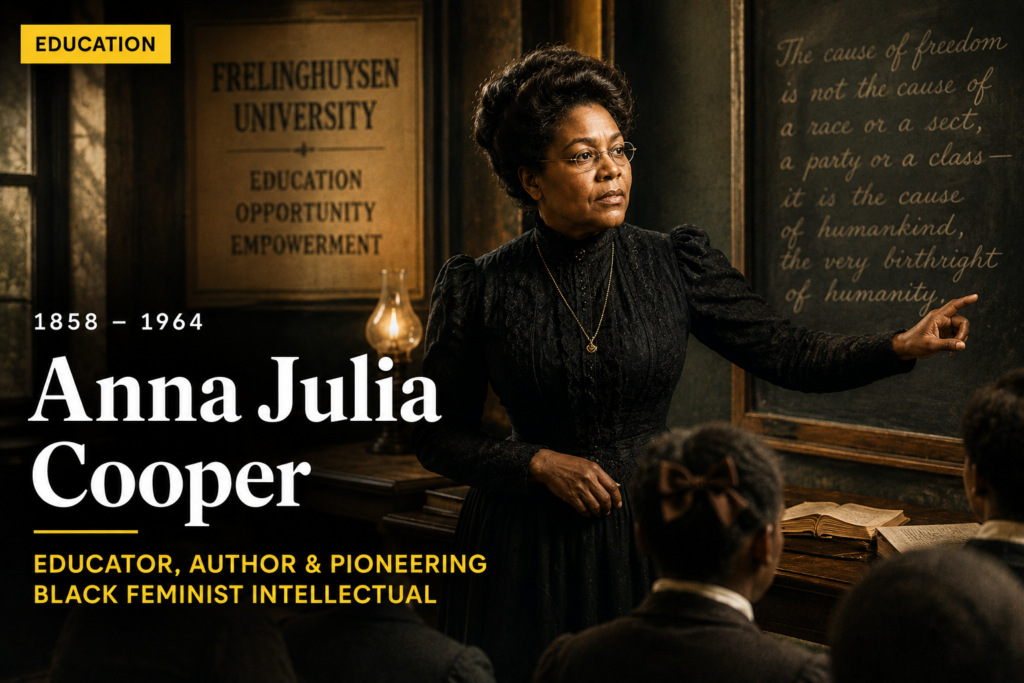
“The cause of freedom is not the cause of a race or a sect…”
Cooper’s larger argument was that freedom ultimately belongs to humanity rather than one favored group.
The National Park Service notes that Cooper’s quotation was incorporated into the 2007 passport redesign and identifies it as the only quotation in the passport from a woman.
There is something fitting about that.
A Black woman born enslaved in North Carolina eventually had her words about freedom printed inside a document carried by Americans traveling around the world.
History has a way of producing moments like that.
Anna Julia Cooper’s story is bigger than a list of accomplishments
It’s easy to turn historical figures into résumés.
Born here.
Graduated there.
Published this.
Worked there.
Died on this date.
But doing that with Anna Julia Cooper misses the larger story.
Her life was about expectations—and what happens when someone refuses to live within expectations designed to make them smaller.
She was born into a system that denied Black people ownership of their own lives.
She pursued education.
She encountered a society that considered certain academic subjects inappropriate for women.
She pursued them anyway.
She entered a world where Black students were often expected to accept limited educational opportunities.
She pushed them toward universities.
She watched Black women become marginalized inside conversations about both race and women’s rights.
She wrote from the perspective people were overlooking.
And when many people would have considered their academic years long behind them, she completed a doctorate in her sixties.
That is why August 10 shouldn’t simply be remembered as Anna Julia Cooper’s birthday.
It should remind us of a much larger principle.
Talent can appear anywhere.
Intelligence can appear anywhere.
Ambition can appear anywhere.
The real question is whether society builds doors for that talent to walk through—or barriers designed to keep it outside.
Anna Julia Cooper spent more than a century pushing those barriers aside.
And more than 160 years after her birth, we’re still learning from what she had to say.
About the Author
Sir Hannibal writes about Black history, financial education, ownership and generational wealth for Black Dollar & Culture.
SEO & Publishing Information
SEO Title: Today in Black History: How Anna Julia Cooper Went From Slavery to Earning a Ph.D.
Meta Description: Born into slavery on August 10, 1858, Anna Julia Cooper became an educator, author and pioneering Black intellectual before earning her Ph.D. in her sixties.
URL Slug: anna-julia-cooper-today-in-black-history
Focus Keyphrase: Anna Julia Cooper
Category: Black History
Featured Image Alt Text: Historic portrait of Black educator, author and scholar Anna Julia Cooper, born August 10, 1858.