After Integration: Why Black Wealth Stalled — And What We Must Do Now

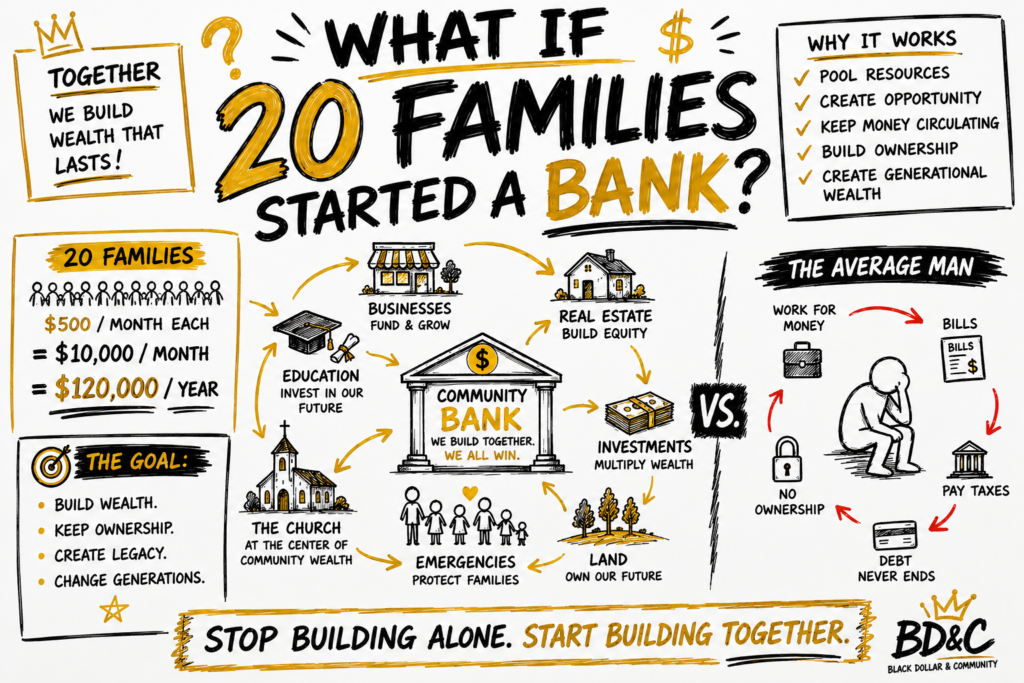
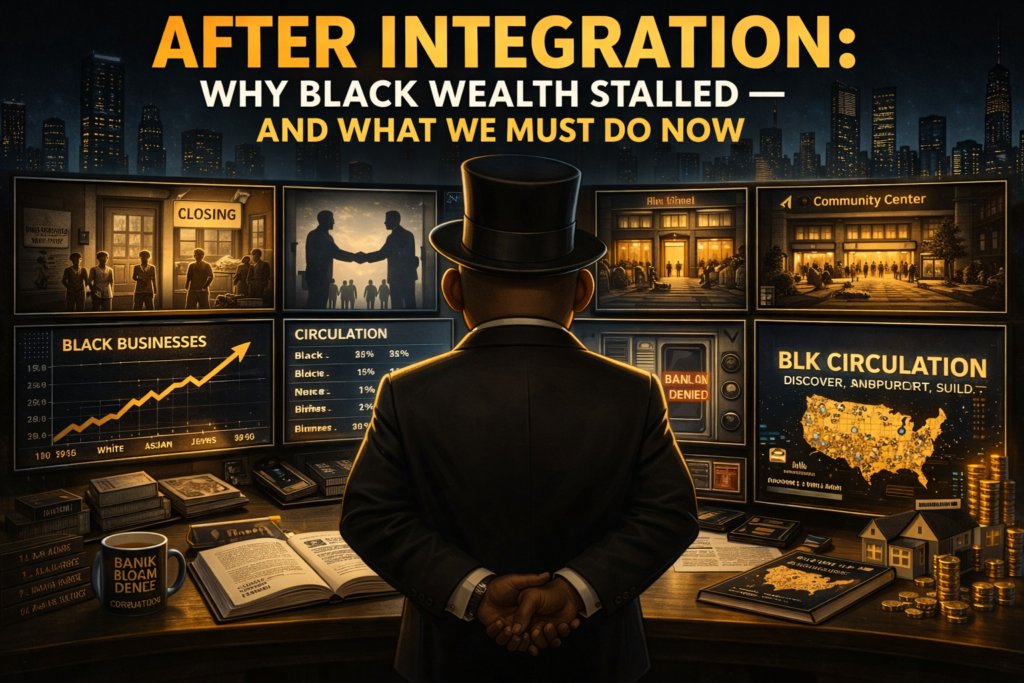
There was a moment in American history when the doors finally opened. Schools began to integrate. Businesses that once turned us away now allowed us to walk in. Opportunities that were once denied started to appear within reach. From the outside, it looked like progress.It looked like victory. But underneath that surface… something else was happening. Because while we were celebrating access, we were quietly losing control. Before integration, Black communities had no choice but to depend on themselves. And out of that necessity came something powerful—circulation. Black dollars moved through Black hands. Black doctors served Black families. Black teachers educated Black children. Black banks funded Black dreams. Entire ecosystems were built, not because it was trendy… but because it was required. Places like Tulsa’s Greenwood District—often called Black Wall Street—weren’t accidents. They were the result of forced unity, economic discipline, and a clear understanding: if we don’t build for ourselves, nobody will. But integration changed the direction of that energy. For the first time, we were allowed to spend freely outside of our communities. And understandably, many did. After generations of exclusion, the ability to go anywhere felt like freedom. But here’s the part nobody talks about enough: Access without ownership is not power. Because while we gained access to other systems… we slowly stopped investing in our own. The same dollar that once circulated multiple times within our neighborhoods began to leave almost immediately. Black-owned businesses, once the backbone of the community, started losing consistent support. Institutions we built out of necessity were now competing with systems that had far more resources, visibility, and capital. And over time, the shift became clear. We integrated into the economy…But we didn’t anchor ourselves within it. So instead of controlling wealth, we began participating in it. There’s a difference. Participation means you can spend money.Control means you can direct where it goes, how it grows, and who it benefits. And that difference is what we’re still feeling today. Now let’s be clear—this is not about going backwards. This is not about rejecting integration. This is about understanding what was lost… so we can rebuild it with intention. Because the real issue was never integration itself. The issue was that we integrated without a strategy. We entered larger systems without building strong systems of our own first. We pursued inclusion without securing ownership. And we adopted spending habits without maintaining economic discipline. And the result? We became some of the most influential consumers in the world…But not the most powerful owners. So the question becomes: What must we do now? Not emotionally.Not politically.But economically. Because wealth is not built through feelings—it’s built through systems. 1. Rebuild Internal Circulation (The Foundation) Every strong community has one thing in common: money flows within it before it flows out. Right now, the Black dollar leaves the community faster than almost any other group. That means even when money is earned, it doesn’t stay long enough to multiply. This is where intentionality comes in. Supporting Black businesses is not just about culture—it’s about economics. Every dollar spent internally creates jobs, strengthens businesses, and builds stability. And this is exactly where action meets solution. Because one of the biggest problems today isn’t willingness… it’s visibility. People want to support Black businesses.They just don’t always know where to find them. That’s why platforms like: 👉 https://blkcirculation.com …are so important right now. BLK Circulation is built to solve the discovery problem—connecting the community directly to Black-owned businesses so the dollar doesn’t just get earned… it gets recycled. Instead of money leaving immediately, it can now circulate intentionally. Discover. Support. Build. That’s how ecosystems are rebuilt. 2. Build Family Financial Systems (Not Just Income) Income alone doesn’t create wealth. Systems do. Most families operate financially as individuals—everyone earning, spending, and surviving on their own. But wealthy families think differently. They operate like institutions. That’s where the concept of a Family Bank comes in. Instead of sending interest to outside banks, families can create internal lending systems—funding businesses, covering emergencies, and keeping capital circulating within the family unit. This is how money starts to work for the family instead of constantly leaving it. 👉 Start building yours here:💰 Family Bank Starter Systemhttps://stan.store/blackdollarandculture/p/the-family-bank-starter-system 3. Protect Wealth Before You Build It One of the biggest mistakes people make is focusing only on making money… without protecting it. Because if wealth isn’t structured properly, it can disappear just as fast as it’s created—through taxes, legal issues, or lack of planning. This is where tools like trusts come in. An Irrevocable Life Insurance Trust (ILIT) allows families to pass down wealth efficiently, avoiding unnecessary taxation and ensuring the next generation actually benefits. 👉 Learn how to structure yours here:🛡️ ILIT Trust Blueprinthttps://stan.store/blackdollarandculture/p/get-your-family-wealth-trust-blueprint-now 4. Shift From Consumer Identity to Owner Identity We’ve mastered influence. Music. Culture. Trends. Style. Language. But influence without ownership is rented power. The next level is ownership. Ownership of businesses.Ownership of land.Ownership of systems.Ownership of platforms. Because when you own, you don’t just participate in the economy—you shape it. 5. Think in Generations, Not Moments Everything changes when the mindset shifts from: “What can I do this year?”to“What can my family control in 30 years?” That’s how wealth is built. Not through one viral moment.Not through one paycheck.But through consistent systems that outlive the individual. The truth is… integration gave us access. But access alone was never the goal. Ownership is. Control is. Legacy is. And the next chapter won’t be defined by what we were allowed into… It will be defined by what we build, protect, and pass down. Because the real power was never just in being included. It’s in owning the system itself. Two families. Same income. Different mindset.One spends freely and hopes for the best.The other builds systems, protects assets, and circulates money intentionally. Ten years later, one is still working for money…The other has money working for them. The difference isn’t luck. It’s structure. If you’re ready to stop just participating in the economy—and start building
How to Make Money in 2026 (Even If You’re Starting From Zero)

There’s a moment most people eventually face. You look at your income, your job, your future… and you start asking yourself: “Is this really enough?” You’re working. You’re trying. You’re doing what you were told to do. But somehow, the money still doesn’t stretch the way it should. That’s when the realization hits: Making money isn’t about working harder. It’s about understanding how money actually works. The Shift: Earned Income vs Created Income Most people rely on one source: But those who build wealth operate differently. They focus on: The difference is control. If your income depends on your time, it has a limit.If your income depends on systems, it can scale. 7 Real Ways to Make Money (Starting Today) 1. Digital Products You no longer need inventory to start making money. You create it once and sell it repeatedly. This is one of the most scalable ways to build income online. 2. Service-Based Hustles If you need money quickly, this is the fastest route. People consistently pay for convenience. This creates immediate cash flow with low startup cost. 3. Content Creation Content builds long-term income and authority. The key is not random posting. Focus on searchable, valuable topics like financial literacy, credit, and wealth-building strategies. 4. Reselling This is one of the simplest ways to start. Buy undervalued items and sell them for a profit. It teaches basic business fundamentals quickly. 5. Affiliate Marketing You earn money by recommending products or services. You don’t need to create your own product to start generating income. 6. AI and Automation Services This is one of the fastest-growing opportunities. Businesses are actively paying for efficiency. Those who learn these tools early gain a major advantage. 7. Investing This is where long-term wealth is built. However, investing should come after you increase your income. You need capital before you can grow it. Credit: A Tool or a Trap Credit is one of the most misunderstood parts of finance. Used correctly, it can help you build and scale. Used incorrectly, it can keep you in debt. Smart Use of Credit: Misuse of Credit: Credit should be used strategically, ideally to support income-producing activities. The Problem Most People Overlook Learning how to make money is only the first step. Many people earn income but still struggle financially over time. Why? Because they lack systems. They don’t structure how money is saved, used, or passed down. As a result, wealth doesn’t last beyond one generation. The Wealth Strategy Most People Miss There are two systems that consistently separate those who build lasting wealth from those who don’t. Build a Family Bank Instead of relying entirely on external lenders, you begin to create internal access to capital. Start here:Family Bank Starter Systemhttps://stan.store/blackdollarandculture/p/the-family-bank-starter-system Protect Wealth With a Trust (ILIT Strategy) This is how wealth is preserved and transferred efficiently. Learn more here:ILIT Wealth Blueprinthttps://stan.store/blackdollarandculture/p/get-your-family-wealth-trust-blueprint-no Final Thought Making money is the entry point. Keeping it, growing it, and transferring it is what builds real wealth. Two people can earn the same income and end up in completely different positions over time. The difference is not effort.It’s structure. Call to Action If you’re serious about improving your financial position, start building systems, not just income. Family Bank Starter Systemhttps://stan.store/blackdollarandculture/p/the-family-bank-starter-system ILIT Wealth Blueprinthttps://stan.store/blackdollarandculture/p/get-your-family-wealth-trust-blueprint-now FAQ What is the fastest way to make money?Service-based work such as cleaning, detailing, or moving services typically provides the quickest income. How can beginners make money online?Digital products, affiliate marketing, and content creation are accessible starting points. Is credit helpful or harmful?It depends on usage. Proper management builds leverage; misuse creates long-term debt. how to make money,make money online,side hustles 2026,financial literacy,build wealth,family bank,credit tips,passive income,black wealth,generate income,make money fast,bdc Focus Keyphrase How to Make Money Slug how-to-make-money-2026 Meta Description Learn how to make money in 2026 with proven side hustles, smart credit strategies, and wealth-building systems like the Family Bank and ILIT.
How Black Wall Street REALLY Built Wealth (And Why It Was Destroyed)

There was a time in America when Black wealth wasn’t a theory… it was a system. Not a trending topic.Not a motivational speech.Not something people were “trying” to figure out. It was already working. In Tulsa, Oklahoma—specifically in a community called Greenwood—Black families had quietly built one of the most powerful economic ecosystems this country had ever seen. And they did it under conditions most people today wouldn’t survive in for a week. No access to traditional banks.Limited protection under the law.Constant racial hostility. And still… they built wealth. Not just money.Not just businesses.But circulation. That’s the part most people miss. Because Black Wall Street wasn’t rich because of one big entrepreneur. It was rich because the money never left. The System That Made Greenwood Powerful If you walked through Greenwood in the early 1900s, you wouldn’t see struggle. You’d see ownership. Hotels.Restaurants.Barbershops.Doctors.Lawyers.Movie theaters.Grocery stores.Banks. Over 600 Black-owned businesses operating in one concentrated area. But here’s what made it different… When a dollar entered Greenwood, it stayed there. One family would earn it.Another family would spend it.Another family would reinvest it.Another family would grow it. And that same dollar could circulate dozens of times before ever leaving the community. Today, in many communities, a dollar leaves within hours. Back then? It moved like blood through a body. That’s not luck. That’s design. No Banks? No Problem. Let’s talk about something most people don’t realize… Greenwood didn’t rely on traditional banking systems the way we do today. Because they couldn’t. So what did they do? They created their own. Informal lending.Community-backed investments.Business partnerships.Trust-based capital. If someone wanted to start a business, they didn’t go begging to a bank that didn’t believe in them. They went to their people. And their people funded them. Not because it was charity…But because it was understood: “If you win, we all win.” That mindset alone is worth more than any loan approval. Wealth Was Built Through Ownership, Not Income This is where things start to separate from today’s thinking. Greenwood wasn’t built on jobs. It was built on ownership. People didn’t just work… They owned. Owned the land.Owned the buildings.Owned the businesses.Owned the systems. And ownership changes everything. Because when you own, you don’t just earn money… You control where it goes next. That’s how wealth compounds. That’s how families build legacy. That’s how entire communities rise. The Truth About Why It Was Destroyed Now here’s where the story takes a turn most people have heard about… But not fully understood. In 1921, violence broke out in Tulsa. And within hours, Greenwood was under attack. Homes burned.Businesses destroyed.Lives lost. But let’s be clear about something… This wasn’t random. This wasn’t just chaos. This was targeted. Because Greenwood represented something dangerous… A fully functioning, independent Black economy. It showed what was possible without relying on systems that excluded them. And that kind of independence? It threatened the structure of power at the time. So they didn’t just destroy buildings… They disrupted a system. A system that had figured out how to circulate wealth internally. A system that was working. What Most People Get Wrong About Black Wall Street Here’s the part that often gets simplified… People talk about Black Wall Street like it was just a tragic event. But it was more than that. It was a blueprint. And the tragedy wasn’t just that it was destroyed… It’s that the system behind it wasn’t rebuilt. Because if you understand Greenwood correctly, you realize: The real power wasn’t in the location. It was in the behavior. The discipline.The unity.The circulation.The ownership mindset. Those are things that can exist anywhere. Even today. What This Means for You Today Let’s bring this out of history for a second. Because this isn’t just about Tulsa. This is about what we’re doing right now. Today, most people earn money…Then immediately send it outside their community. Bills.Brands.Corporations.Subscriptions. And before they even realize it, the money is gone. No circulation.No reinvestment.No system. That’s the exact opposite of what Greenwood mastered. And that’s why the lesson still matters. Rebuilding What Was Lost (The Modern Way) We don’t live in 1921. But the principles still apply. If anything, they matter more now. Because today, we actually have tools they didn’t have: Digital businessesOnline platformsInvestment accessGlobal reach But none of it matters without structure. And that’s where most people fall short. Because wealth isn’t built off random decisions. It’s built off systems. The Modern Version of That System This is exactly why the idea of a Family Bank is so powerful. Instead of relying on outside institutions for everything… Families can start creating their own internal financial systems again. Lending to each other.Funding opportunities.Keeping money circulating within the family. The same concept Greenwood used… Just adapted for today. If you want to understand how to actually set that up step-by-step, this breaks it down clearly: 👉 Start Your Family Bank Herehttps://stan.store/blackdollarandculture/p/the-family-bank-starter-system Because the goal isn’t just to make money… It’s to control what happens to it after you make it. Protecting Wealth This Time Around Another lesson Greenwood teaches us… Building wealth is one thing. Protecting it is another. Because what happened in Tulsa wasn’t just about loss… It was about vulnerability. And today, that vulnerability shows up in different ways: TaxesProbateLack of planningNo legal protection That’s why tools like trusts exist. Not just for the wealthy… But for anyone serious about keeping what they build. If you’ve never looked into it, this is a powerful place to start: 👉 Secure Your Family Wealth (ILIT Blueprint)https://stan.store/blackdollarandculture/p/get-your-family-wealth-trust-blueprint-now Because wealth that isn’t protected… Is wealth that can disappear. The Bigger Picture Most People Miss Black Wall Street wasn’t just about money. It was about control. Control of resources.Control of opportunities.Control of future generations. And when you really look at it… That’s still the game today. The people who control systems… Control outcomes. The Story They Don’t Want Fully Told For years, stories like Greenwood were either ignored… or watered down. Because if people truly understood what was
Charley Patton and the Origins of Delta Blues: A Study in Influence Without Ownership

Charley Patton and the Origins of Delta Blues: A Study in Influence Without Ownership In the early twentieth century, in the plantation regions of the Mississippi Delta, a musical form emerged that would shape the course of American culture. At the center of this development stood Charley Patton—an artist whose influence was foundational, yet whose economic legacy remained limited. In the late nineteenth and early twentieth centuries, the Mississippi Delta served as both an agricultural engine and a cultural incubator. Within this environment—defined by sharecropping, labor exploitation, and constrained economic mobility—Black communities developed expressive traditions that gave rise to what is now recognized as Delta blues. Among the earliest and most influential figures within this tradition was Charley Patton. Patton’s life and work were closely associated with locations such as Dockery Plantation, a site frequently cited by historians as a central hub in the formation of blues music. There, Patton performed for local audiences in informal settings—plantation yards, juke joints, and communal gatherings—where music functioned as both entertainment and a vehicle for social expression. Contemporary accounts describe Patton as a commanding performer. His vocal projection, rhythmic intensity, and physical style of guitar playing distinguished him from his peers. These elements were not merely stylistic choices but adaptive responses to performance environments that lacked amplification and formal staging. Early Recording and Dissemination In 1929, Patton entered a recording studio for the first time, producing a series of records that would later be regarded as some of the earliest commercial representations of Delta blues. These recordings circulated beyond the Delta, introducing broader audiences to a musical form that had previously been localized. From a historical perspective, Patton’s recordings are significant not only for their artistic merit but also for their role in the transmission of blues traditions. His work influenced a generation of musicians who would go on to shape blues, rock, and other genres central to twentieth-century American music. Structural Limitations and Economic Outcomes Despite his influence, Patton’s career illustrates the structural limitations faced by Black artists during this period. Recording contracts of the era typically provided minimal compensation and did not include provisions for long-term royalties or ownership of master recordings. As a result, while Patton contributed to the development of a musical tradition that would later generate substantial economic value, he did not benefit proportionally from that expansion. This disparity reflects broader patterns within the early American music industry, where Black cultural production was frequently commercialized without equitable financial return to its creators. Cultural Transmission and Historical Framing The legacy of Charley Patton must therefore be understood within a dual framework: as a foundational contributor to American music and as a participant in a system that limited the economic agency of its originators. Over time, elements of Delta blues were incorporated into mainstream musical forms, often without sustained recognition of their origins. This process—sometimes described as cultural appropriation or historical erasure—has shaped public understanding of American music history. Conclusion Charley Patton’s significance lies not only in his role as a pioneering musician but also in what his life reveals about the relationship between cultural innovation and economic structure. His work demonstrates how foundational contributions can influence entire industries while remaining disconnected from the wealth those industries later produce. In this sense, Patton’s legacy offers a critical lens through which to examine both the origins of American music and the systems that govern its distribution of value. ❤️ Support Independent Black Media Black Dollar & Culture is 100% reader-powered — no corporate sponsors, just truth, history, and the pursuit of generational wealth. Every article you read helps keep these stories alive — stories they tried to erase and lessons they never wanted us to learn. For readers interested in applying structural approaches to wealth preservation today: 👉 The Family Bank Starter Systemhttps://stan.store/blackdollarandculture/p/the-family-bank-starter-system 👉 Get Your Family Wealth Trust Blueprint Now – ILIThttps://stan.store/blackdollarandculture/p/get-your-family-wealth-trust-blueprint-now charleypatton, deltablues, blueshistory, blackhistory, blackerasure, americanmusic, culturalhistory, generationalwealth, ownershipmatters, musicindustry, wealthstructure Focus Keyphrase: Charley Patton Delta Blues HistorySlug: charley-patton-delta-blues-historyMeta Description: A historical analysis of Charley Patton and the origins of Delta blues, examining his influence, recordings, and the economic structures that shaped his legacy.
The Black Inventor Who Created Dry Cleaning

Before dry cleaners existed on every corner of America… there was a Black tailor experimenting with stained fabric by candlelight. His name was Thomas Jennings. In the early 1800s, Jennings operated a tailoring business in New York City. His customers often brought him expensive coats, dresses, and garments made from delicate fabrics like wool and silk. But there was a problem. Once those clothes became stained, washing them with water often ruined the fabric. The garments would shrink, fade, or lose their shape. For many tailors, that would have been the end of the story. But Jennings refused to accept the problem as permanent. Late at night, after finishing his work for the day, he began experimenting with different cleaning techniques. He tested combinations of solutions, fabrics, and methods, trying to find a way to remove stains without damaging the clothing. After years of trial and error, he finally developed a process he called “dry scouring.” Instead of soaking clothes in water, his method used special cleaning agents that removed dirt and grease while protecting the fabric. It was revolutionary. In 1821, Thomas Jennings received a U.S. patent for his invention, becoming the first Black American in history to hold a patent in the United States. At a time when many Black Americans were still enslaved and denied basic rights, Jennings had legally secured ownership of his invention. His discovery laid the foundation for what we now know today as modern dry cleaning — an industry that exists in nearly every city around the world. But Jennings didn’t just build a successful business. He used the money from his invention to support the abolitionist movement, helping fund efforts that fought against slavery and pushed for freedom and civil rights. His success became more than personal wealth. It became a tool for progress and liberation. Thomas Jennings proved something powerful long before the modern era: Black innovation didn’t begin yesterday. Black entrepreneurship didn’t begin yesterday. Black excellence has always existed — even in the face of laws and systems designed to hold it back. His story is a reminder that many of the everyday things we use today were built on the ideas, courage, and determination of people whose names were rarely taught in school. And Thomas Jennings is one of those names. Call To Action Most people were never taught stories like this. Not in school.Not in textbooks.Not in the mainstream narrative. But the truth is… Black history is filled with inventors, innovators, and civilizations that shaped the modern world. If you want to explore more of these powerful stories, dive deeper with these two books from Black Dollar & Culture. 📚 Black BrillianceDiscover powerful stories of Black inventors, innovators, and pioneers who changed the course of history. 👉 https://stan.store/blackdollarandculture/p/get-my-black-brilliance-ebook-now 🌍 The First World: Before ErasureA deep exploration into ancient civilizations and global history that existed long before colonization rewrote the narrative. 👉 https://stan.store/blackdollarandculture/p/the-first-world-before-erasure Because when we understand the truth about our past… we unlock the power to build a stronger future. ✊🏾 Focus Keyphrase Thomas Jennings dry cleaning inventor Slug thomas-jennings-dry-cleaning-inventor Meta Description Thomas Jennings became the first Black American to receive a U.S. patent in 1821 after inventing the dry-cleaning process known as dry scouring. Discover the powerful story behind the invention that transformed clothing care.
The Black Man Who Invented Potato Chips

In 1853, inside a busy restaurant in Saratoga Springs, New York, a chef stood over a hot stove preparing a meal that would unknowingly change the way the world eats forever. His name was George Crum, a skilled chef of African American and Native American heritage whose talent had already earned him a reputation as one of the finest cooks in the region. Wealthy travelers and businessmen came to the Moon’s Lake House restaurant not just for food, but for the experience of dining under the care of a chef who understood flavor, texture, and precision better than most cooks of his time. One evening, a customer sent back a plate of fried potatoes, complaining that they were too thick and too soggy. In an era when chefs took great pride in their craft, the complaint struck a nerve. Determined to make a point, George Crum sliced the next batch of potatoes as thin as he possibly could, fried them until they were crisp, and added a heavy pinch of salt before sending them back to the table. What was meant as a sharp response to a picky customer became one of the most important culinary accidents in American history. The customer loved them. Soon, other diners began requesting the same thin, crispy potatoes. Word spread quickly among visitors to Saratoga Springs, a popular resort destination at the time. Before long, the dish became known as “Saratoga Chips,” and people came specifically to taste the new creation that only George Crum seemed able to perfect. The thin slices, golden color, and satisfying crunch created a completely new kind of food experience. It was simple, but it was addictive. Without realizing it, George Crum had created the foundation for what would become one of the largest snack food industries in the world. At the time, there were no factories producing chips and no plastic bags lining grocery store shelves. Every chip had to be made by hand, sliced carefully and fried in small batches. The idea belonged to the kitchen, and George Crum was its master. As his reputation grew, Crum eventually opened his own restaurant, known as Crum’s Place, where Saratoga Chips became the main attraction. Customers traveled long distances just to taste the famous chips prepared by the man who invented them. Bowls of chips were placed on every table, a tradition that would later become standard in restaurants across America. But while George Crum enjoyed local fame and success, the future of his invention would move beyond his control. The concept of thin fried potato slices spread from restaurant kitchens into homes and eventually into small commercial operations. Years later, entrepreneurs began packaging potato chips for sale, transforming a handmade specialty into a mass-produced product. George Crum never patented his invention. In the 1800s, many cooks and craftsmen rarely considered protecting their ideas legally, and the patent system was difficult to navigate even for established businessmen. Without legal ownership of the idea, the invention passed freely into the hands of companies that would eventually build billion-dollar empires around it. Factories replaced kitchens. Machines replaced hand slicing. National brands replaced local chefs. Today, potato chips are sold in nearly every country on Earth. Grocery stores stock entire aisles filled with chips of every flavor imaginable. The global potato chip industry generates tens of billions of dollars every year, making it one of the most profitable snack markets in the world. Yet the name George Crum remains largely unknown to the millions of people who open a bag of chips each day. His story reflects a pattern seen throughout American history — innovators whose contributions shaped entire industries but whose names faded as corporations grew larger and wealth concentrated elsewhere. George Crum did not become a snack food tycoon, and he did not build a manufacturing empire, but his idea changed food culture forever. Every crunchy bite traces back to a single moment in a Saratoga Springs kitchen, when a determined chef decided to slice potatoes thinner than anyone had before. The brands became famous. The invention became global. But it all started with George Crum. Even today, few people realize that one of America’s most beloved snacks began with a Black chef working in a small 19th-century kitchen, turning a simple potato into a permanent part of everyday life. History remembers the companies. Black Dollar & Culture remembers the creator. This story reminds us that innovation does not always come from corporations or laboratories. Sometimes it comes from a single person with skill, pride in their craft, and the determination to do something better than it had been done before. The next time you open a bag of potato chips, remember that behind that familiar sound of the bag tearing open is a story that began more than 170 years ago with a chef who never imagined that his invention would feed the world. Stories like George Crum’s remind us that everyday things often have extraordinary origins. Share this story so more people learn the name behind one of America’s most famous foods — and explore more untold innovations at Black Dollar & Culture. Focus Keyphrase George Crum potato chip inventor Meta Description Discover the true story of George Crum, the Black chef who invented potato chips in 1853 and changed the global snack industry forever. Slug george-crum-potato-chip-inventor
Benjamin Banneker: The Man Who Measured the Stars and Helped Build America

Benjamin Banneker was born in 1731 in rural Maryland, at a time when knowledge was tightly controlled and opportunity was rationed by class, race, and access. He was born free, yet freedom in colonial America did not include schools, institutions, or formal pathways into science or public life. What Banneker possessed instead was an uncommon discipline of mind, a relentless curiosity, and the ability to teach himself in a world designed to exclude him. From an early age, Banneker demonstrated a deep attentiveness to patterns. He observed the movement of shadows, the rhythm of seasons, the cycles of the moon, and the quiet logic underlying numbers. These observations were not passive. They became the foundation of a rigorous self-education in mathematics, astronomy, mechanics, and natural philosophy. Without classrooms or instructors, he relied on borrowed books, correspondence, and repeated experimentation. Knowledge, for Banneker, was not inherited or granted — it was earned through persistence. One of his earliest achievements revealed the breadth of his mechanical intelligence. After examining a pocket watch, Banneker constructed a fully functional wooden clock entirely by hand. At a time when precision timekeeping was rare and highly specialized, his clock reportedly kept accurate time for decades. This was not novelty craftsmanship. It was applied engineering — a synthesis of measurement, geometry, and mechanical reasoning executed with remarkable precision. Banneker’s attention soon turned upward to the night sky. Astronomy in the eighteenth century demanded advanced mathematical ability, extended observation, and exact calculations. Without formal training, Banneker mastered celestial mechanics well enough to calculate planetary positions, track lunar cycles, and accurately predict eclipses. These were not theoretical exercises. They became published data used by others. Between 1791 and 1796, Banneker authored and published a series of almanacs containing astronomical calculations, weather forecasts, tide tables, and practical information essential for farmers, navigators, and merchants. Almanacs were critical tools in early American life, shaping agricultural planning and commerce. Banneker’s editions were valued for their accuracy and circulated widely throughout the Mid-Atlantic region. His work entered daily life quietly, efficiently, and without spectacle. It was this reputation for precision that brought Banneker into one of the most consequential projects of the young nation: the surveying of the federal district that would become Washington, D.C. In 1791, he was appointed as an assistant to the survey team responsible for mapping the boundaries of the future capital. Using astronomical observations and mathematical calculations, Banneker helped establish the layout of the city. According to historical accounts, when the original design plans were lost following the departure of the chief planner, Banneker reproduced the layout from memory — an extraordinary demonstration of spatial reasoning and intellectual command. At the same time, Banneker understood that knowledge carried moral responsibility. In 1791, he wrote a carefully reasoned letter to Thomas Jefferson, then Secretary of State, addressing the contradiction between Jefferson’s stated belief in liberty and his participation in slavery. Banneker did not rely on rhetoric alone. He appealed to logic, evidence, and shared Enlightenment principles. Enclosed with the letter was a copy of his almanac — not as a plea for validation, but as proof of intellectual equality grounded in demonstrable work. Jefferson responded respectfully and forwarded Banneker’s almanac to intellectual circles in Europe. Yet the system itself remained intact. Still, the exchange endures as one of the most direct intellectual challenges to slavery issued during the early republic — a reminder that resistance did not always take the form of protest, but often appeared as clarity, data, and moral precision. Banneker lived the remainder of his life quietly. He never married, never accumulated wealth, and never sought public acclaim. In 1806, after his death, much of his work was lost in a fire that consumed his home. What survived did so unevenly — scattered across letters, publications, and partial historical records. Over time, his role in the nation’s formation was minimized, simplified, or omitted altogether. Yet Benjamin Banneker cannot be reduced to a symbol or an exception. He was a builder of systems, a producer of usable knowledge, and a contributor to the physical and intellectual infrastructure of the United States. His life stands as evidence that disciplined thought does not require permission, and that nation-building has always depended on minds history later chose not to emphasize. To study Benjamin Banneker is to confront a deeper truth about America’s origins: that progress was shaped not only by those whose names dominate monuments, but by thinkers whose work spoke for itself long before recognition followed. His legacy is not confined to clocks, almanacs, or survey lines. It is the enduring reminder that knowledge, once proven, cannot be erased — only delayed. Focus Keyphrase:Benjamin Banneker Washington DC Slug:benjamin-banneker-washington-dc Meta Description:Discover the true story of Benjamin Banneker, the self-taught polymath whose astronomical calculations and surveying work helped shape Washington, D.C., and challenged the contradictions of America’s founding ideals.
Frederick McKinley Jones: The Black Inventor Who Revolutionized Refrigeration and Global Food Supply

Before refrigerated trucks, the world ate locally, lived seasonally, and lost enormous amounts of food to spoilage. Fresh meat rarely traveled far. Produce rotted before reaching cities. Vaccines and blood plasma often expired before arriving where they were needed most. Entire regions were constrained not by demand, but by distance. Modern life as we know it simply wasn’t possible yet. That reality changed because of Frederick McKinley Jones. Born in 1893, Jones did not grow up with access to elite schools, laboratories, or wealthy patrons. He was largely self-taught, learning mechanics, engineering, and electronics through curiosity and necessity rather than formal education. In an America that routinely dismissed Black intelligence, Jones quietly mastered complex systems that others struggled to understand. He fixed machines. He improved them. And eventually, he redesigned an entire industry from the ground up. Jones recognized a problem most people had accepted as unavoidable: perishable goods could not survive long journeys. The solution wasn’t simply ice or insulation. It required a compact, reliable, mobile system capable of maintaining controlled temperatures while in motion. At the time, that idea bordered on impossible. Vehicles vibrated. Engines overheated. Roads were rough. Power sources were inconsistent. Yet Jones engineered a self-contained refrigeration unit strong enough to withstand travel and precise enough to preserve food and medicine. His invention of mobile refrigeration systems transformed transportation forever. Trucks, trains, and ships could now carry fresh goods across long distances without loss. Farms were no longer limited to nearby markets. Cities could grow larger without risking food shortages. Seasonal eating gave way to year-round availability. Grocery stores evolved. Supply chains expanded. Entire industries were born almost overnight. The impact reached far beyond food. During World War II, Jones’s refrigeration technology was used to transport blood plasma and medical supplies to soldiers overseas. Lives were saved not by battlefield heroics, but by temperature control. Quiet engineering became silent survival. Jones went on to earn more than sixty patents across refrigeration, engines, and electronics. He co-founded what would later become Thermo King, a company that still dominates global refrigeration transport today. Billions of dollars move through systems built on his ideas. Every refrigerated truck on the highway traces its lineage back to his work. And yet, for decades, his name was absent from classrooms, textbooks, and mainstream discussions of American innovation. This pattern is not accidental. Black inventors have repeatedly solved foundational problems only to watch their contributions be absorbed, rebranded, and monetized by others. The wealth generated often never returned to the communities that produced the ideas. Recognition arrived late, if at all. Frederick McKinley Jones was eventually awarded the National Medal of Technology, becoming the first Black American to receive the honor. It was deserved, but overdue. By then, the world had already been built on his inventions. At Black Dollar & Culture, these stories matter because they reveal something deeper than history. They show how wealth is created at the systems level. Jones didn’t invent a product. He invented infrastructure. He didn’t chase trends. He solved a permanent problem. That is where real leverage lives. Understanding his legacy is not about admiration alone. It is about strategy. Ownership. Protection. Continuity. When we study figures like Jones, we see a blueprint for how generational wealth is actually built — not through visibility, but through necessity and control of essential systems. Every cold chain, every vaccine shipment, every refrigerated aisle is proof that Black innovation has always powered the modern world, even when the world refused to acknowledge it. The work was never invisible. Only the credit was. ❤️ Support Independent Black Media Black Dollar & Culture is 100% reader-powered — no corporate sponsors, just truth, history, and the pursuit of generational wealth. Every article you read helps keep these stories alive — stories they tried to erase and lessons they never wanted us to learn. Slug: frederick-mckinley-jones-black-inventor-refrigerationMeta Description: Frederick McKinley Jones was a Black inventor whose mobile refrigeration technology transformed food distribution, medicine, and global trade.entor whose mobile refrigeration technology transformed food, medicine, and global trade. Learn the story they don’t teach.Slug: frederick-mckinley-jones-black-inventor-refrigeration
Tuskegee Airmen Black History: The Elite Pilots Who Forced America to End Military Segregation

January 12, 1942 did not arrive with parades, speeches, or national celebration, but history often moves quietly before it roars. On this winter day, in a nation still shackled by segregation and racial mythology, the United States Army Air Forces authorized a program that would challenge one of America’s most deeply held lies: the belief that Black men lacked the intelligence, discipline, and courage to fly military aircraft. From this authorization emerged the men later known as the Tuskegee Airmen—a group whose excellence in the skies would force the nation to confront its contradictions. ❤️ Support Independent Black Media Black Dollar & Culture is 100% reader-powered — no corporate sponsors, just truth, history, and the pursuit of generational wealth. Every article you read helps keep these stories alive — stories they tried to erase and lessons they never wanted us to learn. The establishment of the Tuskegee program did not come from sudden enlightenment. It was the result of pressure, protest, and necessity. Black leaders, civil rights organizations, and newspapers had long challenged the military’s refusal to allow Black pilots, pointing out the hypocrisy of fighting for democracy abroad while denying it at home. World War II, with its demand for manpower, created a crack in the wall. The government conceded, but only partially, and under tightly controlled conditions designed less to empower Black airmen than to test them under a microscope. Training took place at Tuskegee Army Air Field in Alabama, a segregated base in a segregated state. The pilots were trained separately from white counterparts, often with inferior resources, outdated equipment, and instructors who expected failure. Every mistake by a Black cadet was magnified, recorded, and used as supposed proof of racial inferiority. No white unit trained under such pressure. These men were not simply learning to fly; they were fighting an unspoken trial in which the future of Black military aviation hung on every maneuver. Despite these conditions, the men excelled. They mastered navigation, aerial combat, engineering, and leadership. Many already held college degrees at a time when higher education was still largely denied to Black Americans. Their discipline was not accidental—it was forged from the understanding that mediocrity would not be tolerated. Excellence was the minimum requirement for survival, dignity, and progress. When the Tuskegee Airmen were finally deployed overseas, they were assigned to escort Allied bombers deep into enemy territory. This was among the most dangerous missions of the war. Bomber crews depended on fighter escorts to protect them from German aircraft; failure meant death. The Tuskegee Airmen, later known as the “Red Tails” for the distinctive markings on their planes, built a reputation for precision and loyalty. They stayed with the bombers. They did not abandon their posts for personal glory. As a result, they achieved one of the lowest bomber-loss rates of any fighter group in the war. This success directly contradicted decades of pseudoscience and propaganda used to justify segregation. The myth that Black men lacked the mental acuity for complex machinery collapsed under the weight of facts written in combat reports and survival statistics. The myth that Black men lacked courage evaporated in the skies over Europe. What remained was an uncomfortable truth: the barrier had never been ability—it had been racism. Yet recognition did not come easily. While white pilots were celebrated in newsreels and headlines, the Tuskegee Airmen returned home to a country still governed by Jim Crow. They could defeat fascism abroad but not segregation at home. Many were denied jobs in commercial aviation. Some were refused service in restaurants while still wearing their uniforms. The nation had used their skill but hesitated to honor their humanity. Still, history has a long memory, even when institutions try to forget. The success of the Tuskegee Airmen became impossible to ignore. Their record played a crucial role in the 1948 decision by President Harry S. Truman to desegregate the U.S. military, a move that reshaped American armed forces and set a precedent for broader civil rights reforms. Though Truman signed the order, it was the Airmen who earned it with their lives and discipline. The legacy of the Tuskegee Airmen is not confined to military history. It is a lesson in how systems preserve themselves through lies, and how those lies collapse when confronted by undeniable excellence. It is also a reminder that progress in America has rarely been gifted; it has been extracted through pressure, performance, and sacrifice. These men did not simply ask to be included—they proved that exclusion was irrational. Today, when their story is told accurately, it reframes how we understand Black history. It challenges narratives that portray Black advancement as sudden or accidental. The Tuskegee Airmen were scholars, engineers, tacticians, and leaders operating under extreme constraints. Their success was not a fluke; it was the continuation of a long tradition of Black mastery systematically obscured from public memory. January 12 should be remembered not merely as a date, but as a turning point where the lie began to crack. On that day, the United States unknowingly authorized the dismantling of one of its own racist doctrines. The men who trained at Tuskegee did more than learn to fly. They redefined what the nation could no longer deny. They turned the sky into a courtroom, and every successful mission became a verdict. Their story is not just about airplanes or war. It is about truth. And once truth takes flight, it is very hard to bring back down. Focus Keyphrase: Tuskegee Airmen Black HistoryMeta Description: Explore the true story of the Tuskegee Airmen, the Black pilots who shattered racist myths during World War II and reshaped American military history.Slug: tuskegee-airmen-black-history
Granville T. Woods: The Black Inventor Who Electrified Modern America

Long before America celebrated innovation as a corporate achievement, before patents became weapons and genius was filtered through race and power, a self-taught Black engineer was quietly reshaping the future of the nation. His name was Granville T. Woods, and the modern world still runs on systems influenced by his mind, even if history has tried to forget him. Born in 1856 in Columbus, Ohio, just one year after the official end of slavery, Woods entered a country that had little interest in protecting Black intellect. Formal education was limited, but necessity became his classroom. As a teenager, he worked in machine shops, steel mills, and on railroads, absorbing mechanical knowledge firsthand. Where others saw labor, Woods saw systems. Where others followed instructions, he asked why things worked—and how they could work better. Railroads in the late 19th century were expanding rapidly, but they were also deadly. Trains collided frequently because communication between moving locomotives and stations was unreliable. Signal systems lagged behind the speed of industrial growth, and passengers paid the price. Woods recognized electricity as the missing link. At a time when electrical engineering was still in its infancy, he envisioned wireless communication between trains and control stations—an idea well ahead of its time. That vision became reality through his invention of the induction telegraph. This system allowed trains to communicate with stations and other trains without physical wires, drastically reducing collisions and improving coordination across rail networks. It was not a minor upgrade; it was a foundational leap in transportation safety. Modern rail signaling, subway communication systems, and even elements of wireless transit technology trace conceptual roots back to Woods’ work. But invention was only half of Woods’ struggle. Ownership was the other. In an America where white inventors were celebrated and Black inventors were questioned, Woods was forced into constant legal battles to defend his patents. Powerful industrial figures challenged his claims, attempting to absorb his ideas into their own portfolios. Among them was Thomas Edison, one of the most famous inventors in American history. Edison disputed several of Woods’ patents, particularly those related to electrical transmission and communication systems. The legal battles were not symbolic—they were brutal, expensive, and exhausting. Yet Woods won. Multiple courts ruled in his favor, affirming that his ideas were original and his claims legitimate. These victories were rare for a Black inventor in that era and underscored the undeniable brilliance of his work. Ironically, after losing to Woods in court, Edison offered him a position at Edison Electric Light Company. Woods declined. He understood that employment would mean surrendering independence and potentially losing control of future inventions. Instead, he chose the harder path: remaining an independent inventor in a system stacked against him. Woods’ contributions extended far beyond railroads. He held more than 60 patents, many focused on electrical systems, power distribution, and transportation. His work improved electric streetcars, helped develop overhead power lines, and advanced the efficiency of electrical transmission in growing cities. Urban America—its subways, trolleys, and commuter systems—benefited enormously from his innovations. Yet unlike his white contemporaries, Woods did not amass wealth. Patent litigation drained his resources. Corporations profited from his ideas while he struggled to maintain financial stability. By the time of his death in 1910, he was respected among engineers but virtually invisible to the public. No fortune. No national recognition. No textbooks honoring his name. This pattern was not accidental. It reflected a broader American reality: Black innovation was essential, but Black ownership was optional. Woods’ story mirrors countless others where genius was extracted, repackaged, and monetized by institutions that refused to credit its true source. His life exposes the uncomfortable truth that America’s technological rise was fueled not just by celebrated inventors, but by marginalized minds denied their rightful place in history. Today, as conversations around equity, ownership, and intellectual property resurface, Granville T. Woods’ story feels painfully modern. He was not merely a victim of his time; he was a warning. Innovation without protection leads to exploitation. Genius without ownership leads to erasure. Restoring Woods to his rightful place is not about nostalgia. It is about understanding the foundation of modern America. The trains that move millions each day, the communication systems that ensure their safety, and the electrical infrastructure that powers cities all carry echoes of his work. His fingerprints are everywhere, even when his name is not. Granville T. Woods was more than an inventor. He was proof that Black intellect has always been central to progress—even when history refused to acknowledge it. Remembering him is not rewriting history. It is finally telling it honestly. Focus Keyphrase: Granville T. Woods Black InventorSlug: granville-t-woods-black-inventorMeta Description: Granville T. Woods was a brilliant Black inventor whose electrical innovations transformed railroads and powered modern America, including winning patent cases against Thomas Edison.