When most people hear the name George Washington Carver, one myth almost always comes to mind: he invented peanut butter.
While peanut butter existed before Carver’s work, the real story is far more remarkable. George Washington Carver became one of the most influential agricultural scientists in American history, helping rescue millions of acres of exhausted farmland while inspiring generations through his dedication to science, education, and service.
His journey began under circumstances that would have crushed most people. Born into slavery in Diamond, Missouri, around 1864 during the final months of the Civil War, Carver entered a nation divided by conflict and uncertainty. Shortly after his birth, he and his mother were kidnapped by Confederate raiders. Although George was eventually recovered, his mother disappeared forever, leaving him to be raised by Moses and Susan Carver, the couple who had once enslaved his family.
As a child, George was often too frail for strenuous farm labor. Instead, he spent countless hours exploring the forests, fields, and gardens surrounding the Carver farm. His fascination with plants became so well known that neighbors began bringing him sick flowers and dying crops to diagnose. Long before earning scientific degrees, local residents affectionately referred to him as the “Plant Doctor” because of his unusual ability to restore struggling plants to health.
Education, however, was not easily accessible to a young Black boy living in post-Civil War America. Determined to learn, Carver left home at a young age and traveled from town to town in search of schools that would accept Black students. He worked odd jobs, cleaned buildings, cooked meals, and performed whatever labor was necessary simply to remain in school. Despite constant hardship, he refused to abandon his dream of becoming a scientist.
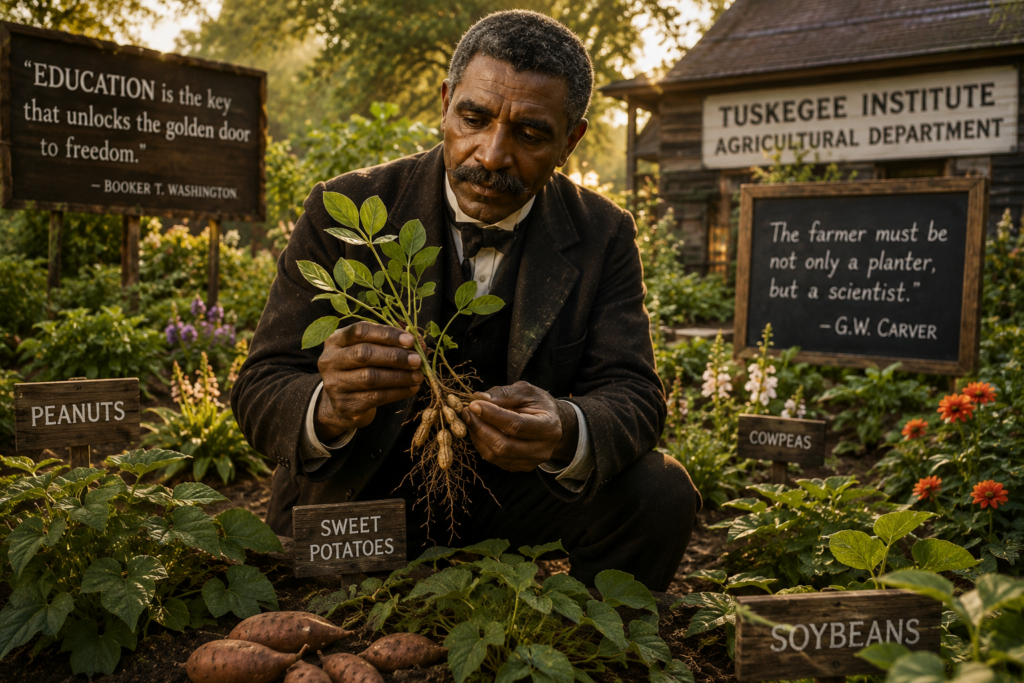
His persistence eventually led him to Iowa State Agricultural College, where his brilliance quickly attracted attention. Carver became the institution’s first Black faculty member, earning respect for his research in botany and plant pathology. His groundbreaking work soon caught the attention of Booker T. Washington, founder of the Tuskegee Institute in Alabama. Recognizing Carver’s extraordinary talent, Washington invited him to lead Tuskegee’s agricultural department in 1896.
At the time, Southern agriculture faced a crisis. For decades, farmers had planted cotton on the same land year after year, stripping the soil of vital nutrients. Harvests declined, farms struggled, and poverty spread across rural communities. Many believed the solution required expensive fertilizers that struggling farmers simply could not afford.
George Washington Carver saw another path.
Drawing upon his extensive knowledge of soil science, Carver encouraged farmers to rotate their crops instead of planting cotton continuously. He recommended growing peanuts, sweet potatoes, soybeans, cowpeas, and other nitrogen-fixing plants that naturally restored nutrients to depleted soil. His advice not only revived exhausted farmland but also gave struggling farmers new crops they could sell for additional income.
Yet Carver understood that convincing farmers to grow peanuts or sweet potatoes meant creating markets for those crops. If no one wanted to buy them, farmers would simply return to cotton. Rather than accepting that limitation, Carver dedicated years to discovering new commercial uses for agricultural products many people overlooked.
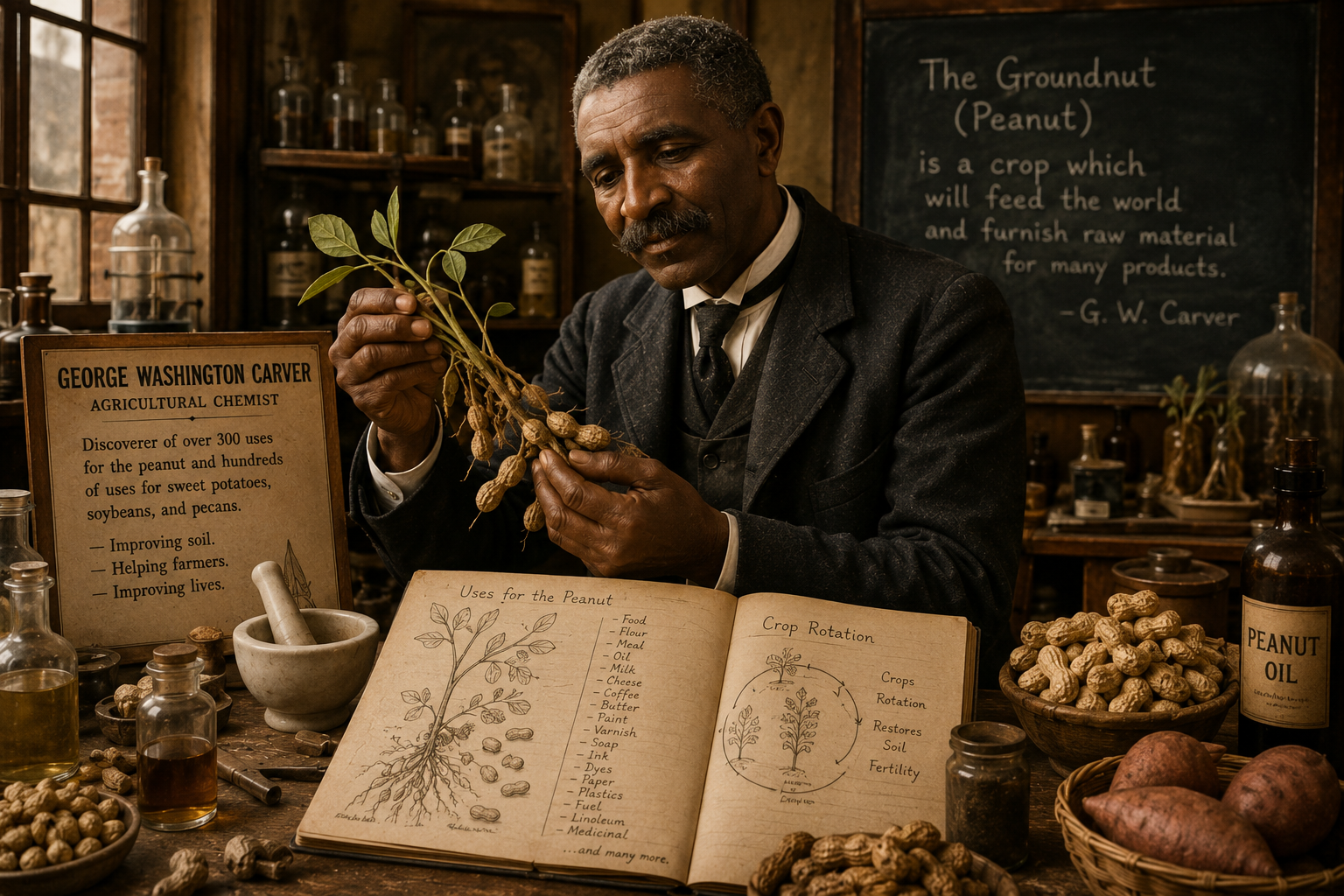
Inside his laboratory at Tuskegee, surrounded by simple equipment and driven by endless curiosity, Carver developed hundreds of practical applications for peanuts, sweet potatoes, pecans, soybeans, and other crops. His research explored products ranging from cooking oils, soaps, dyes, paints, inks, cosmetics, paper, adhesives, livestock feed, insulating materials, and industrial compounds. His goal was never fame or fortune. Instead, he wanted rural families to prosper by creating demand for crops that restored the land while providing new economic opportunities.
His discoveries soon attracted national attention. In 1921, Carver appeared before the United States Congress to speak about the importance of the peanut industry. Initially granted only a few minutes to present his findings, lawmakers became so captivated by his demonstrations that they extended his presentation. By the end of his testimony, the scientist from Tuskegee had earned the admiration of politicians, agricultural leaders, and manufacturers alike, further establishing his reputation as one of America’s foremost innovators.
Despite receiving offers from major corporations that promised enormous wealth, George Washington Carver remained at Tuskegee Institute for the rest of his life. He believed his greatest contribution was not accumulating personal riches but educating future generations and helping ordinary people improve their lives through knowledge. His laboratory became a place where science met compassion, proving that innovation could serve communities rather than simply generate profits.
Today, many of Carver’s ideas remain foundational to sustainable agriculture. Crop rotation, soil conservation, environmental stewardship, and agricultural diversification are now considered essential farming practices around the world. His work anticipated modern conversations about sustainability decades before those ideas became mainstream.
George Washington Carver’s legacy extends far beyond peanuts. He demonstrated that scientific curiosity, perseverance, and a commitment to serving others could transform entire industries and improve countless lives. His story reminds us that true innovation often begins by asking simple questions, seeing possibilities where others see limitations, and using knowledge to create lasting change.
For Black Dollar & Culture, Carver’s life also represents a powerful lesson in ownership of knowledge. He showed that education, innovation, and practical problem-solving are forms of wealth that can outlive any fortune. More than a century later, his contributions continue to nourish farms, inspire scientists, and remind us that some of history’s greatest builders cultivated prosperity not with factories or skyscrapers, but with the soil beneath our feet.
Focus Keyphrase: George Washington Carver
Slug: george-washington-carver-history
Meta Description: Learn how George Washington Carver transformed American agriculture through scientific innovation, crop rotation, and practical discoveries that continue to influence farming and sustainability today.