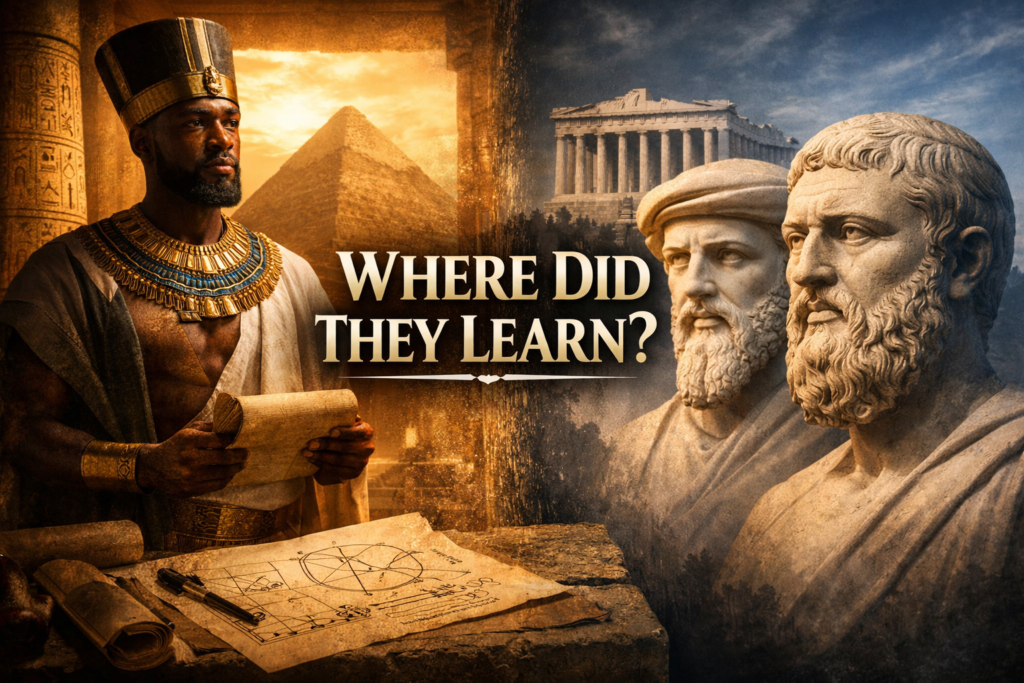

There was a time before marble statues. Before Athens debated democracy. Before the names Plato and Pythagoras echoed through lecture halls. Before the Parthenon crowned the Acropolis.
There was Kemet.
Along the Nile River, thousands of years before classical Greece reached its height, an advanced civilization flourished. The people of Kemet — what we now call ancient Egypt — developed complex systems of mathematics, astronomy, architecture, medicine, governance, and spiritual philosophy. The pyramids were already ancient when Greece was still forming its identity. Massive temple complexes stood as living universities carved in stone. Knowledge was preserved in priestly schools, inscribed on papyrus, and structured around Ma’at — the principle of truth, balance, order, and justice.
The question that echoes through history is powerful and layered: Did ancient Greece learn from Kemet?
This is not about mythology. It is about contact, documentation, intellectual exchange, and historical testimony.
Several Greek thinkers wrote about Egypt with deep respect.
Pythagoras is widely said in classical sources to have studied in Egypt for years before developing the mathematical theories that bear his name. Plato referenced Egyptian priests and their ancient wisdom in his dialogues, describing Egypt as a civilization of deep antiquity and preserved knowledge. Herodotus, often called the “Father of History,” openly stated that many Greek customs were derived from Egypt and expressed admiration for Egyptian institutions and religious traditions.
Cultural exchange across the Mediterranean is historically documented. Trade routes connected North Africa, the Levant, and Southern Europe. Sailors, scholars, merchants, and initiates traveled between civilizations. Knowledge traveled with them.
Consider architecture. Monumental Egyptian columns lined temple complexes centuries before Greece developed its Doric, Ionic, and Corinthian styles. Consider geometry. The Nile’s annual flooding required land measurement techniques long before Greece formalized geometric proof. Consider medicine. Egyptian medical papyri documented surgical procedures and diagnoses that predate many classical Greek texts.
None of this diminishes Greek achievement. Greece made extraordinary contributions to philosophy, governance, drama, art, and science. But history becomes more complete when we acknowledge that civilizations do not rise in isolation. They build upon what came before. They absorb, refine, reinterpret, and transmit knowledge.
And before Greece, there was Kemet.
In the 20th century, scholarly debate intensified around the depth of African influence on Greek civilization. Some historians argue Greece developed largely independently, influenced by multiple regions including Mesopotamia and the Near East. Others argue that Egypt played a foundational intellectual role. What remains undeniable is that Greek writers themselves acknowledged Egypt’s antiquity and described journeys there for study.
Why does this matter?
Because narratives shape identity.
For generations, Western education often presented Greece as the beginning of “civilization” — the birthplace of philosophy, democracy, science, and reason. Rarely did textbooks explore what influenced Greece. Rarely did they present Africa as a center of early intellectual life.
But the Nile does not disappear because a chapter was shortened.
When we study Kemet, we see advanced statecraft, massive engineering, sacred cosmology, ethical philosophy, mathematical precision, and astronomical alignment. We see a civilization that endured for more than 3,000 years. We see Black civilization shaping the ancient world long before colonialism distorted global perceptions of Africa.
This conversation is not about superiority. It is about restoration.
Restoration of historical complexity. Restoration of interconnectedness. Restoration of intellectual dignity.
Civilizations borrow. Civilizations trade. Civilizations learn.
The Mediterranean world was a crossroads, not a vacuum.
Imagine a young Greek scholar standing inside a towering Egyptian temple, surrounded by hieroglyphs describing cosmic law and divine order. Imagine witnessing engineering feats requiring mathematical mastery centuries ahead of their time. Imagine returning home inspired — not copying, but translating knowledge into a new cultural framework.
That is how civilizations evolve.
Knowledge moves. Ideas migrate. Truth survives.
When we explore whether Black civilizations taught ancient Greece, the answer is not a simple yes or no. The answer is layered. There was exchange. There was admiration. There was study. There was influence. Greece, in turn, became a transmitter of ideas to Rome and eventually to Europe.
The story of civilization is not linear. It is braided.
Africa is not a footnote in that braid.
It is one of its earliest strands.
Reclaiming that understanding is not about rewriting history recklessly. It is about widening the lens. It is about acknowledging Africa’s role in shaping global intellectual development. It is about recognizing that long before colonial narratives diminished the continent, Africa stood as a beacon of scholarship and statecraft.
Before Athens debated justice, Kemet spoke of Ma’at.
Before marble columns crowned Greece, sandstone pillars lined the Nile.
Before philosophy had a Greek name, wisdom had already been practiced for millennia.
History is deeper than we were taught.
And when we dig, we do not divide — we discover.
Because truth does not weaken civilization.
It strengthens it.
❤️ Support Independent Black Media
Black Dollar & Culture is 100% reader-powered — no corporate sponsors, just truth, history, and the pursuit of generational wealth.
Every article you read helps keep these stories alive — stories they tried to erase and lessons they never wanted us to learn.
Focus Keyphrase: Did Black Civilizations Teach Ancient Greece
Slug: did-black-civilizations-teach-ancient-greece
Meta Description: Explore the historical debate about whether ancient Kemet (Egypt) influenced Greek civilization. Discover the documented cultural exchange and intellectual connections between Africa and ancient Greece.