You’re driving down a long, quiet road in 1940s America.
The sun is starting to drop… and your heart starts to beat a little faster.
Not because you’re lost.
Not because you’re tired.
But because in this America… being on the road after dark could cost you everything.
You can’t stop at just any gas station.
You can’t pull into just any hotel.
You can’t walk into just any restaurant.
And one wrong stop… could turn into a situation you can’t get out of.
So before Black families even turned the key in the ignition, they made sure of one thing…
They had a book.
A small, green book.
A book that didn’t promise comfort…
It promised survival.
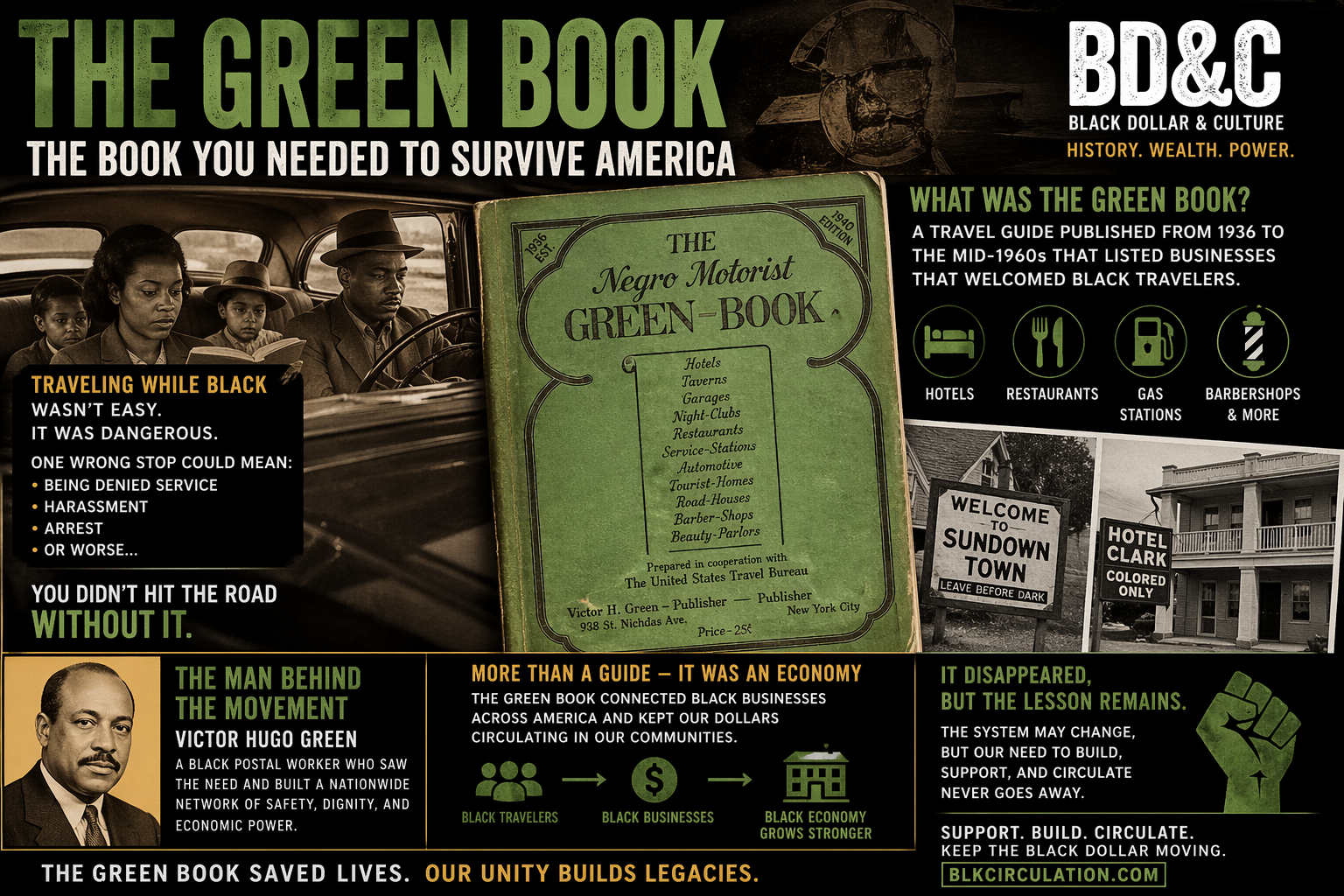
This was The Negro Motorist Green Book.
Created in 1936 by Victor Hugo Green, a Black postal worker who saw a problem that most of America ignored.
Black people were traveling more—buying cars, taking road trips, visiting family, building lives beyond the limits society tried to place on them.
But the road wasn’t safe.
Not for them.
So Victor Hugo Green did something powerful…
He built a solution.
At its core, the Green Book was simple.
It listed places where Black travelers were welcome.
Places where they wouldn’t be turned away.
Places where they wouldn’t be humiliated.
Places where they could exist… without fear.
Hotels.
Restaurants.
Gas stations.
Barbershops.
Tourist homes.
Each listing was more than a business…
It was a safe haven.
Because during segregation, America wasn’t just divided…
It was unpredictable.
There were towns known as sundown towns—places where Black people were expected to be gone before nightfall.
No warnings. No second chances.
Just an understanding… enforced by fear.
Imagine driving with your family.
Your children are in the back seat, asking when you’re going to stop.
They’re hungry.
They’re tired.
And you’re passing place after place that looks normal… but you know better.
You keep driving.
Because you can’t afford to be wrong.
So you reach for the Green Book.
Flip through its pages.
Search for a name… a location… a place that says, “You’re safe here.”
And when you find it…
That feeling isn’t luxury.
It’s relief.
But here’s what most people miss about the Green Book…
It didn’t just help Black people survive.
It helped Black people build.
Because inside those pages was something deeper than safety.
It was a network.
A system.
An economy.
Black-owned hotels.
Black-owned restaurants.
Black-owned service stations.
All connected.
All supporting each other.
All keeping the dollar moving within the community.
Every time a traveler used the Green Book…
They weren’t just spending money.
They were strengthening a system built for them… by them.
This is what we call today…
circulation.
And this is where the real lesson begins.
Because the Green Book wasn’t just a response to oppression…
It was a blueprint for power.
It showed what happens when people decide:
“If we can’t rely on the system… we’ll build our own.”
For decades, the Green Book expanded across the country.
It became known as the “Bible of Black travel.”
You didn’t leave home without it.
Because without it…
You were guessing.
And guessing could get you hurt.
Then, in 1964, everything shifted.
The Civil Rights Act was passed.
Segregation was outlawed.
Public spaces were no longer allowed to discriminate—at least by law.
And slowly…
The Green Book began to fade.
By 1967…
It was gone.
On the surface, that made sense.
If access is equal…
You don’t need a separate guide.
But here’s the question we don’t ask enough:
What else disappeared with it?
Because while the Green Book was born out of necessity…
It created something powerful.
Unity.
Ownership.
Intentional support.
It created a system where Black people knew where to go…
And who to support.
Today, we have more access than ever before.
We can go anywhere.
Buy from anyone.
Travel freely.
But access doesn’t always mean ownership.
And convenience doesn’t always mean circulation.
So now the question becomes…
Are we still building systems like they did?
Are we still supporting each other with intention?
Are we still thinking about where our dollar goes…
After we spend it?
Because the Green Book wasn’t just about travel.
It was about trust.
It was about strategy.
It was about survival turning into structure.
And if you really understand that…
You understand this:
We’ve already done this before.
We’ve already built networks.
We’ve already circulated our dollars.
We’ve already created systems that worked for us…
Even in the worst conditions.
So imagine what we can build now.
❤️ Support Independent Black Media
Black Dollar & Culture is 100% reader-powered — no corporate sponsors, just truth, history, and the pursuit of generational wealth.
📘 Start Building Your Family Bank Today
https://stan.store/blackdollarandculture/p/the-family-bank-starter-system
🏦 Protect & Pass Down Wealth the Right Way (ILIT Blueprint)
https://stan.store/blackdollarandculture/p/get-your-family-wealth-trust-blueprint-now
📖 The First World Before Erasure (Black History They Hid)
https://stan.store/blackdollarandculture/p/the-first-world-before-erasure
💬 The Green Book wasn’t just a guide…
It was a message.
A quiet reminder passed from one generation to the next:
If they don’t build it for you…
Build it yourself.
And once you do…
Support it.
Grow it.
Protect it.
Because that’s how you survive.
And more importantly…
That’s how you build legacy. 🔥
#GreenBook #BlackHistory #TravelingWhileBlack #JimCrow #BlackWealth #GenerationalWealth #BlackDollar #BlackEconomics #SupportBlackBusiness #HiddenHistory #FinancialFreedom #WealthBuilding #Ownership #BLKCirculation #EconomicPower