January 12, 1942 did not arrive with parades, speeches, or national celebration, but history often moves quietly before it roars. On this winter day, in a nation still shackled by segregation and racial mythology, the United States Army Air Forces authorized a program that would challenge one of America’s most deeply held lies: the belief that Black men lacked the intelligence, discipline, and courage to fly military aircraft. From this authorization emerged the men later known as the Tuskegee Airmen—a group whose excellence in the skies would force the nation to confront its contradictions.
❤️ Support Independent Black Media
Black Dollar & Culture is 100% reader-powered — no corporate sponsors, just truth, history, and the pursuit of generational wealth.
Every article you read helps keep these stories alive — stories they tried to erase and lessons they never wanted us to learn.
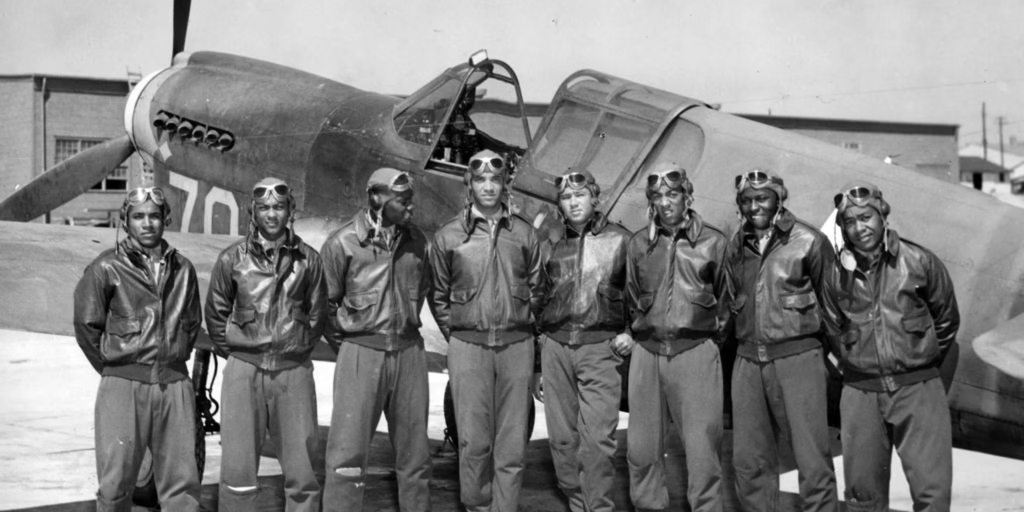
The establishment of the Tuskegee program did not come from sudden enlightenment. It was the result of pressure, protest, and necessity. Black leaders, civil rights organizations, and newspapers had long challenged the military’s refusal to allow Black pilots, pointing out the hypocrisy of fighting for democracy abroad while denying it at home. World War II, with its demand for manpower, created a crack in the wall. The government conceded, but only partially, and under tightly controlled conditions designed less to empower Black airmen than to test them under a microscope.
Training took place at Tuskegee Army Air Field in Alabama, a segregated base in a segregated state. The pilots were trained separately from white counterparts, often with inferior resources, outdated equipment, and instructors who expected failure. Every mistake by a Black cadet was magnified, recorded, and used as supposed proof of racial inferiority. No white unit trained under such pressure. These men were not simply learning to fly; they were fighting an unspoken trial in which the future of Black military aviation hung on every maneuver.
Despite these conditions, the men excelled. They mastered navigation, aerial combat, engineering, and leadership. Many already held college degrees at a time when higher education was still largely denied to Black Americans. Their discipline was not accidental—it was forged from the understanding that mediocrity would not be tolerated. Excellence was the minimum requirement for survival, dignity, and progress.
When the Tuskegee Airmen were finally deployed overseas, they were assigned to escort Allied bombers deep into enemy territory. This was among the most dangerous missions of the war. Bomber crews depended on fighter escorts to protect them from German aircraft; failure meant death. The Tuskegee Airmen, later known as the “Red Tails” for the distinctive markings on their planes, built a reputation for precision and loyalty. They stayed with the bombers. They did not abandon their posts for personal glory. As a result, they achieved one of the lowest bomber-loss rates of any fighter group in the war.
This success directly contradicted decades of pseudoscience and propaganda used to justify segregation. The myth that Black men lacked the mental acuity for complex machinery collapsed under the weight of facts written in combat reports and survival statistics. The myth that Black men lacked courage evaporated in the skies over Europe. What remained was an uncomfortable truth: the barrier had never been ability—it had been racism.
Yet recognition did not come easily. While white pilots were celebrated in newsreels and headlines, the Tuskegee Airmen returned home to a country still governed by Jim Crow. They could defeat fascism abroad but not segregation at home. Many were denied jobs in commercial aviation. Some were refused service in restaurants while still wearing their uniforms. The nation had used their skill but hesitated to honor their humanity.
Still, history has a long memory, even when institutions try to forget. The success of the Tuskegee Airmen became impossible to ignore. Their record played a crucial role in the 1948 decision by President Harry S. Truman to desegregate the U.S. military, a move that reshaped American armed forces and set a precedent for broader civil rights reforms. Though Truman signed the order, it was the Airmen who earned it with their lives and discipline.
The legacy of the Tuskegee Airmen is not confined to military history. It is a lesson in how systems preserve themselves through lies, and how those lies collapse when confronted by undeniable excellence. It is also a reminder that progress in America has rarely been gifted; it has been extracted through pressure, performance, and sacrifice. These men did not simply ask to be included—they proved that exclusion was irrational.
Today, when their story is told accurately, it reframes how we understand Black history. It challenges narratives that portray Black advancement as sudden or accidental. The Tuskegee Airmen were scholars, engineers, tacticians, and leaders operating under extreme constraints. Their success was not a fluke; it was the continuation of a long tradition of Black mastery systematically obscured from public memory.
January 12 should be remembered not merely as a date, but as a turning point where the lie began to crack. On that day, the United States unknowingly authorized the dismantling of one of its own racist doctrines. The men who trained at Tuskegee did more than learn to fly. They redefined what the nation could no longer deny. They turned the sky into a courtroom, and every successful mission became a verdict.
Their story is not just about airplanes or war. It is about truth. And once truth takes flight, it is very hard to bring back down.
Focus Keyphrase: Tuskegee Airmen Black History
Meta Description: Explore the true story of the Tuskegee Airmen, the Black pilots who shattered racist myths during World War II and reshaped American military history.
Slug: tuskegee-airmen-black-history