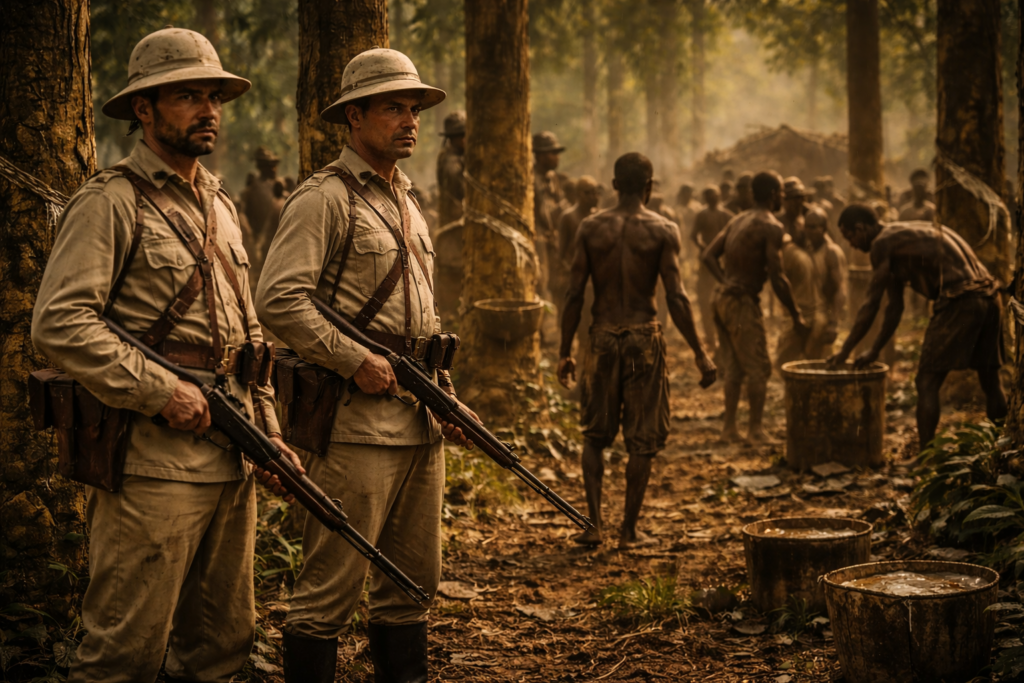
Europe’s modern rise did not begin in factories, parliaments, or banks. It began in the forests of Central Africa, where rubber vines wrapped around trees and human suffering wrapped around an entire civilization. Long before automobiles rolled across paved streets and before electricity lit European cities, the Congo was being drained—slowly, violently, and deliberately—to fuel an empire that the world would later call “progress.”

In the late 1800s, as Europe raced into the Industrial Age, rubber became one of the most valuable resources on Earth. It powered bicycle tires, automobile wheels, electrical insulation, machinery belts, and military equipment. Demand exploded almost overnight, and with it came a question that Europe was determined to answer at any cost: where would the rubber come from?
The answer was the Congo.
What made the Congo especially vulnerable was not just its natural abundance, but its political erasure. At the Berlin Conference of 1884–85, European powers carved Africa into territories without African consent or presence. In one of history’s most grotesque land grabs, the Congo did not even become a Belgian colony at first—it became the personal property of King Leopold II of Belgium. A single man claimed control over a landmass nearly the size of Western Europe and renamed it the Congo Free State, though nothing about it was free.
Leopold never set foot in the Congo. He did not need to. He ruled through violence, quotas, and terror, building a system that turned African lives into units of production. Villages were ordered to meet rubber quotas extracted from wild vines deep in the jungle. Failure was punished brutally. Hands were severed to prove bullets had not been wasted. Families were taken hostage. Entire communities were burned. Fear became policy. Violence became management.
The rubber that arrived in Europe carried no visible bloodstains, but it was soaked in them. Each shipment represented countless hours of forced labor, starvation, mutilation, and death. Historians estimate that between 10 and 15 million Congolese people perished during Leopold’s rule—through execution, exhaustion, famine, and disease. This was not accidental. It was the cost of doing business.
Meanwhile, Europe flourished.
Belgium transformed. Infrastructure expanded. Wealth accumulated. Banks grew stronger. Industries advanced. Rubber profits poured into European development while Congo villages collapsed into silence. Roads and railways were built, not to connect African communities, but to remove resources faster. The Congo was never meant to be developed—only emptied.
What made the system especially insidious was how it was marketed. Leopold presented himself to the world as a humanitarian, claiming to bring civilization, Christianity, and order to Africa. European newspapers repeated the lie. Investors believed it. Governments tolerated it. The suffering of African people was buried beneath propaganda and distance, hidden behind the language of “trade” and “progress.”
But the truth could not stay hidden forever.
Missionaries, journalists, and whistleblowers began documenting the atrocities. Photographs of mutilated Congolese men, women, and children leaked into the global consciousness. Testimonies described villages erased for missing quotas. International outrage grew. Eventually, pressure mounted enough that Belgium stripped Leopold of his personal control in 1908, officially turning the Congo into a Belgian colony.
Yet the system did not disappear—it evolved.
Forced labor continued under different names. Resource extraction persisted. Wealth still flowed outward, never inward. The rubber economy faded only when Southeast Asia began producing rubber more cheaply, not because African lives had suddenly gained value, but because exploitation found a more efficient location.
Europe’s industrial foundations, however, were already laid.
The bicycles, cars, machines, and infrastructure that symbolized modernity were built on African suffering that history textbooks rarely emphasize. Rubber was not just a material—it was a transfer of wealth, power, and future. The Congo lost generations. Europe gained centuries.
Today, when people speak of Africa’s “underdevelopment,” they rarely mention how development was removed. They ask why nations struggle without acknowledging that their wealth was exported at gunpoint. The Congo was not poor—it was plundered. Its people were not unproductive—they were enslaved. Its land was not empty—it was emptied.
And rubber was only the beginning.
The same patterns would repeat with minerals, oil, gold, diamonds, and now the materials powering modern technology. The Congo continues to supply the world while remaining among the poorest nations on Earth, trapped in cycles designed long before independence.
To understand Europe’s rise without understanding Congo’s suffering is to accept a lie. Progress did not happen in isolation. It happened through extraction, violence, and silence. The rubber that cushioned Europe’s journey into modernity crushed African lives beneath it.
History remembers the factories. It remembers the kings. It remembers the empires.
But it must also remember the blood-soaked vines in the Congo forests—where Africa bled so the modern world could move.