
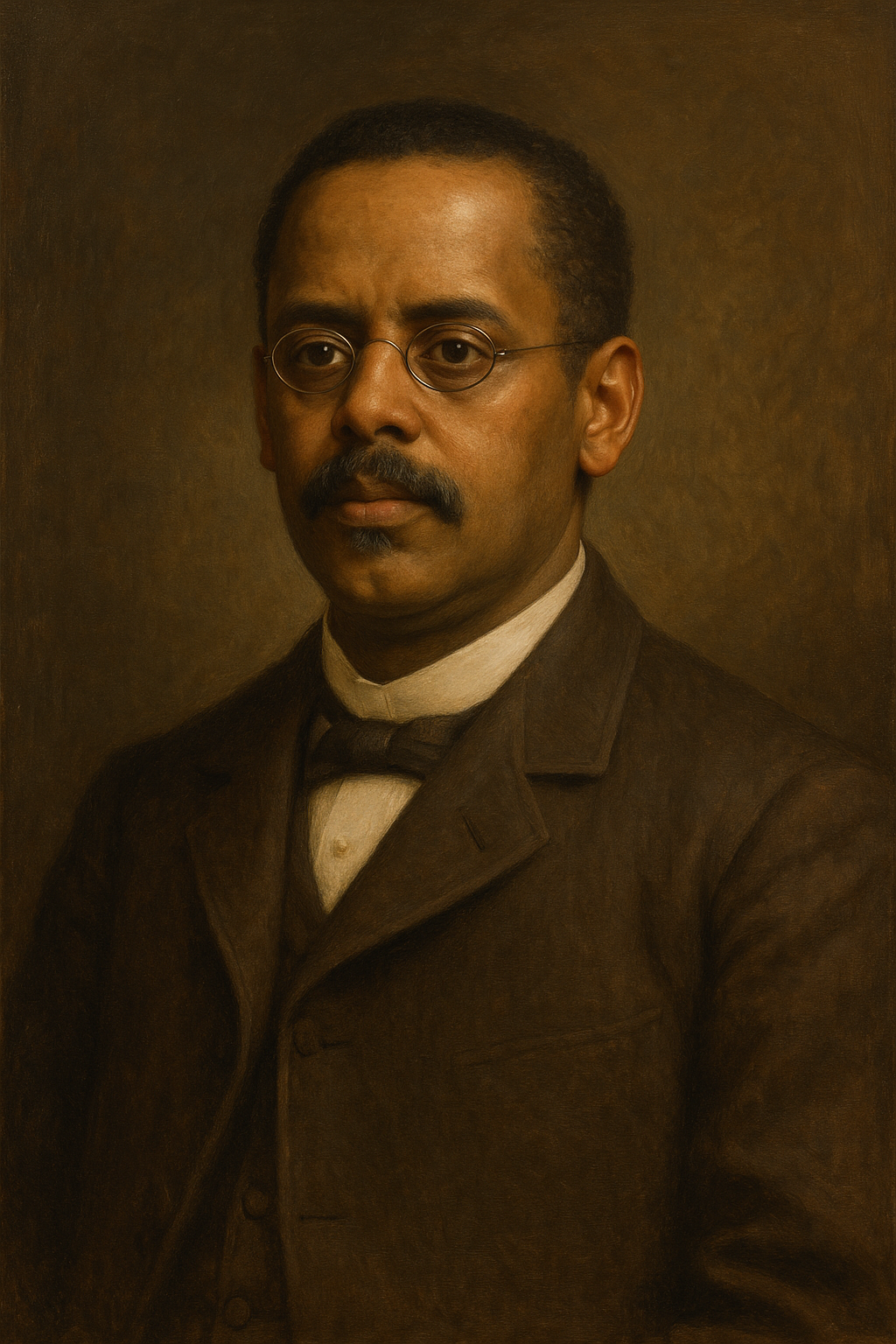
Before America ever glowed with electric light, before cities pulsed with brightness after sunset, and long before Thomas Edison became a household name, a quiet Black genius was doing the work that made it all possible. His name was Lewis Howard Latimer, and the light that fills our world today carries his fingerprints even if most history books pretend otherwise.
Picture America in the late 1800s — a country reborn from the Civil War, racing into an industrial future, but still deeply infected with racism, segregation, and a belief that Black minds were not meant to innovate. Into this world was born a man whose brilliance could not be dimmed. Latimer was the son of formerly enslaved parents who escaped bondage and fought for freedom in a world determined to silence them. They raised a boy who would one day illuminate the world — literally.
As a teenager, Lewis Latimer had no pathway to success laid out for him. No scholarships. No apprenticeships. No elite schools waiting to welcome him. Instead, he lied about his age just to get a job as an office boy at a patent law firm. Most would have stayed in that position forever. But Latimer watched. He studied. He learned the language of invention in silence, absorbing everything from gears to wiring to mechanical diagrams. And then, with nothing but determination and a sharpened pencil, he taught himself the most advanced skill of the era: mechanical drafting.
Within months, he was crafting diagrams so precise, so clean, so ahead of his time that the attorneys promoted him from an office boy to the firm’s top draftsman. Not because they wanted to — but because his talent was undeniable.
And that talent put him in the room with giants.
When Alexander Graham Bell rushed to file his patent for the telephone before a competitor beat him to it, it was Lewis Latimer — not Bell — who created the official drawings that secured the patent and changed telecommunications forever. When companies were scrambling to harness the power of electricity, it was Latimer who understood how to make light not just flicker… but last.
This is where the truth takes a turn.
Edison gets the credit for inventing the lightbulb because history is often written for convenience — and comfort. But Edison’s early bulbs burned out in minutes. They were too fragile, too expensive, too unstable to be used by everyday people. The “lightbulb” that Edison showcased was closer to a prototype than a practical invention. And every inventor knew the same truth: unless someone figured out a way to make carbon filaments stronger, longer-lasting, and cheaper to produce, the electric light would never leave the laboratory.
That “someone” was Lewis Latimer.
He developed a new, revolutionary process for creating carbon filaments — the tiny internal threads that determine whether a bulb glows for a moment or glows for hours. Latimer’s method made bulbs durable, affordable, and commercially viable. With his innovation, electricity spread into homes, factories, and entire cities.
Without Lewis Latimer, the modern lightbulb as we know it would not exist. Edison’s fame, Edison’s empire, Edison’s legacy — all of it sat on top of Latimer’s work.
Yet Latimer was not just an inventor of things; he was an architect of systems. He traveled the country installing electric lighting, training engineers, and designing cities for the electrical age. He wrote one of the earliest books on electric lighting, educating an entire generation of electricians. He worked for the Edison Electric Light Company as one of the only Black engineers in a field that barely allowed Black people to enter the front door.
Imagine the courage it took to walk into rooms filled with men who doubted your intelligence before you even spoke. Imagine the pressure of carrying a nation’s future in your inventions while knowing that credit might never come your way. Imagine being the reason the world lights up every night — and still being omitted from the chapter.
But Latimer never chased fame. He chased excellence. He chased solutions. He chased a vision of a world powered by innovation — innovation he helped create.
And that is the story they tried to bury. Because acknowledging Latimer means confronting a truth America has avoided for generations:
Black brilliance built this country — not just with labor, but with ideas, with genius, with innovation that shaped the modern world.
In the shadows of history where textbooks refused to shine a light, Lewis Latimer held the match.
His life is proof that Black excellence didn’t begin with the Civil Rights Movement and it didn’t begin with integration. It has always existed — in spite of chains, in spite of laws, in spite of systems designed to keep it hidden. Latimer’s legacy is not just about invention; it’s about recognition. It’s a reminder that erasing a name does not erase its impact.
Every time a streetlamp flickers on…
Every time a building glows at night…
Every time a child asks how a lightbulb works…
Lewis Latimer stands there, quietly illuminating the world he helped brighten.
His fingerprint is in the glow.
His contribution is in the current.
His genius is in the light.
And today, we bring his name out of the shadows and into the spotlight — where it always deserved to be.




Thank you for sharing, I shall do the same!