
Why W-2 Workers Pay More Taxes (And How the System Was Designed That Way)

There’s a truth most people don’t realize until it’s too late: The more you follow the traditional path—get a job, earn a steady paycheck, work your way up—the more exposed you are to taxation. W-2 workers don’t just pay taxes.They pay the most consistent, unavoidable taxes in the system. And the people who understand this don’t rely on that structure alone. The Hidden Structure of W-2 Income When you earn income as a W-2 employee, your earnings are fully visible and automatically taxed. Before you receive your paycheck, multiple deductions have already been applied: You are taxed before you have the opportunity to allocate or structure your money. There is no control over timing.There is little control over deductions.There is no flexibility in how income is reported. How Wealth Is Taxed Differently Higher-net-worth individuals rarely rely on W-2 income as their primary source of earnings. Instead, income is structured through: This creates a different flow: Earn → Allocate → Deduct → Tax what remains Compared to: Earn → Taxed → Spend The difference is not income level alone.It is structure. The Advantage of Deductions and Control W-2 earners have limited access to meaningful deductions. Business owners and investors, on the other hand, can: Two individuals earning the same amount can end up with significantly different tax outcomes based solely on how their income is structured. The System Rewards Ownership This is often misunderstood as unfair, but it is more accurate to say the system is designed with a specific incentive: Ownership is rewarded. Those who: are given tools to reduce taxable exposure. W-2 income provides stability, but it offers the least amount of strategic flexibility. The Shift From Income to Structure The objective is not necessarily to abandon employment immediately. The objective is to begin building outside of it. The goal is not simply to earn more.It is to gain control over how money is earned, taxed, and deployed. Where the Family Bank Fits In A family bank system introduces internal control over capital. Instead of relying entirely on external lenders and institutions, families can: This shifts the focus from income to control and circulation. Get The Family Bank Starter System:https://stan.store/blackdollarandculture/p/the-family-bank-starter-system Protecting the Structure With a Trust Building wealth without protecting it creates exposure. Trust structures allow families to: Get Your Family Wealth Trust Blueprint (ILIT):https://stan.store/blackdollarandculture/p/get-your-family-wealth-trust-blueprint-now The Core Difference W-2 Earners: Structured Wealth: FAQ Do W-2 workers always pay more taxes?They typically have fewer tools to reduce taxes, which often results in a higher effective tax burden compared to structured income earners. Is a business required to reduce taxes?Not required, but it is one of the most effective ways to gain flexibility and access to deductions. Are trusts only for wealthy families?No. Many middle-income families can benefit from basic trust structures for protection and planning. Final Thought The system does not primarily reward effort.It rewards structure. Once that becomes clear, the focus shifts from working harder to building smarter systems. #BlackDollarCulture #WealthBuilding #FinancialEducation #TaxStrategy #GenerationalWealth #FamilyBank #TrustFund #Ownership #FinancialFreedom #AssetBuilding Focus Keyphrase: Why W-2 Workers Pay More TaxesSlug: why-w2-workers-pay-more-taxesMeta Description: Learn why W-2 workers often pay more taxes and how structured income through businesses, investments, and trusts can reduce tax exposure and build long-term wealth.
Most Black Families Don’t Know What UBI Is… And That’s a Problem Because It’s Coming

The government starts sending checks. Every month. No application. No credit check. No approval process. Just money… deposited into your account. For many, it sounds like relief. But for Black families in America—this isn’t just about money. It’s about what happens next. Because history has already shown us something important: When money enters our communities without a system…it doesn’t stay. It flows right back out. The Promise of UBI Universal Basic Income (UBI) is being discussed as a solution to: On the surface, it looks like a reset. For Black families, who have historically faced: UBI could feel like long-overdue support. And in many ways… It is. Short-Term Relief: The Immediate Impact Let’s be real. For many households, UBI would: That alone could change lives. A family that’s constantly in survival mode finally gets breathing room. But relief is not the same as wealth. The Hidden Danger: Money Without Structure Here’s where the conversation shifts. If UBI becomes just another stream of income used for: Then nothing really changes. Because the system stays the same. Money comes in… And then leaves. Right back to: No ownership is created. No assets are built. No legacy is established. Inflation: The Silent Tax There’s another layer most people ignore. When more money enters the economy: So that $1,000 check? It may only feel like $400 in real value over time. And historically… Black communities feel inflation first and hardest. Two Paths: Dependency or Power UBI will create a fork in the road. Path 1: Dependency Path 2: Power Same money. Different outcome. The Family Bank Strategy This is where everything changes. Instead of each person spending their UBI individually… Families can organize. Let’s say: That’s: 👉 $5,000 per month👉 $60,000 per year Now imagine that money being used to: That’s not assistance. That’s capital formation. That’s a Family Bank. Why This Moment Matters UBI could be one of the biggest economic shifts of our lifetime. But it will not automatically close the wealth gap. Because wealth is not built from income alone. It’s built from: Without those… Even guaranteed income won’t change generational outcomes. The Real Question The question is not: “Will UBI help Black families?” The real question is: 👉 Will we use it to build… or just survive? ❤️ Support Independent Black Media Black Dollar & Culture is 100% reader-powered — no corporate sponsors, just truth, history, and the pursuit of generational wealth. Every article you read helps keep these stories alive — stories they tried to erase and lessons they never wanted us to learn. 📚 Build Your Family Bank Today If this message hit you, it’s time to move from awareness to action. 👉 The Family Bank Starter SystemLearn how to structure your family money, create internal lending systems, and build generational wealthhttps://stan.store/blackdollarandculture/p/the-family-bank-starter-system 👉 Get Your Family Wealth Trust Blueprint Now – ILITProtect your wealth, pass it down properly, and build a real legacy systemhttps://stan.store/blackdollarandculture/p/get-your-family-wealth-trust-blueprint-now They’re preparing to send money. But they’re not teaching what to do with it. And history has already shown us… money without strategy disappears. So when that first check hits… Will it pass through your hands… Or will it stay in your family? Start building your system now.Because the families that organize first… win. #BlackDollarAndCulture #FamilyBank #UBI #GenerationalWealth #BlackWealth #FinancialLiteracy #WealthBuilding #EconomicEmpowerment #Ownership #BlackEconomics #BuildTheSystem #FinancialFreedom #CommunityWealth #LegacyBuilding #BDCMovement Focus Keyphrase UBI and Black Families Slug ubi-and-black-families-wealth-or-dependence Meta Description Will Universal Basic Income help Black families build wealth or create dependency? Discover the truth and how to turn UBI into a family wealth-building system.
4 Ways to Pay Yourself First (And Build Real Wealth Before Bills Touch Your Money)

Most people get paid… and immediately start paying everyone else. Rent.Car note.Subscriptions.Debt. By the time they look up—there’s nothing left. That’s not an accident. That’s a system designed to keep you circulating money… instead of keeping it. Wealthy individuals don’t operate like that. They follow one simple rule: Pay yourself first. Before the world gets a dollar—you do. Here are 4 powerful ways to start doing that immediately. 1. Automatic Wealth Transfer (Before You See the Money) The easiest way to build wealth… is to remove emotion from the process. Set up an automatic transfer from your checking account to: The key is simple:You should never even see the money you’re saving. Because if you see it… you’ll spend it. Start with: This turns saving into a system—not a decision. 2. Pay Your Future Self Through Investments Saving money is good. But investing is what builds real wealth. Every time you get paid, allocate a portion to: This is how you move from:Working for money → Money working for you Even small amounts compound. Consistency beats intensity. 3. Build Your Family Bank First Most families:Go to the bank when they need money. Wealthy families:Are the bank. Instead of sending interest to outside institutions… You can: That means:Car loans, emergencies, business funding… All stay inside the family ecosystem. This is how wealth stops leaking. 4. Eliminate “Leftover Thinking” Most people save what’s left. Wealth builders invest first… and live on the rest. That mindset shift alone changes everything. Instead of saying:“I’ll save what I don’t spend…” Say:“I’ll spend what’s left after I build wealth.” That forces: The Real Shift Paying yourself first isn’t just about money. It’s about control. Control over: Because if you don’t prioritize yourself… The system will always prioritize itself. 💡 Final Thought You don’t build wealth by working harder. You build wealth by keeping more of what you earn—and putting it to work. 🚀 Call to Action If you’re serious about building something that lasts beyond you… 👉 Start your own financial system with my book:The Family Bank Starter Systemhttps://stan.store/blackdollarandculture/p/the-family-bank-starter-system 👉 And take it even further with asset protection and generational wealth strategy:Get Your Family Wealth Trust Blueprint Now – ILIThttps://stan.store/blackdollarandculture/p/get-your-family-wealth-trust-blueprint-now Focus Keyphrase Pay Yourself First Wealth Strategy Slug pay-yourself-first-wealth-strategy Meta Description Learn 4 powerful ways to pay yourself first and build real wealth before bills take your money. Discover strategies used by wealthy individuals to grow financial freedom.
How to Build Wealth Once You Hit 40
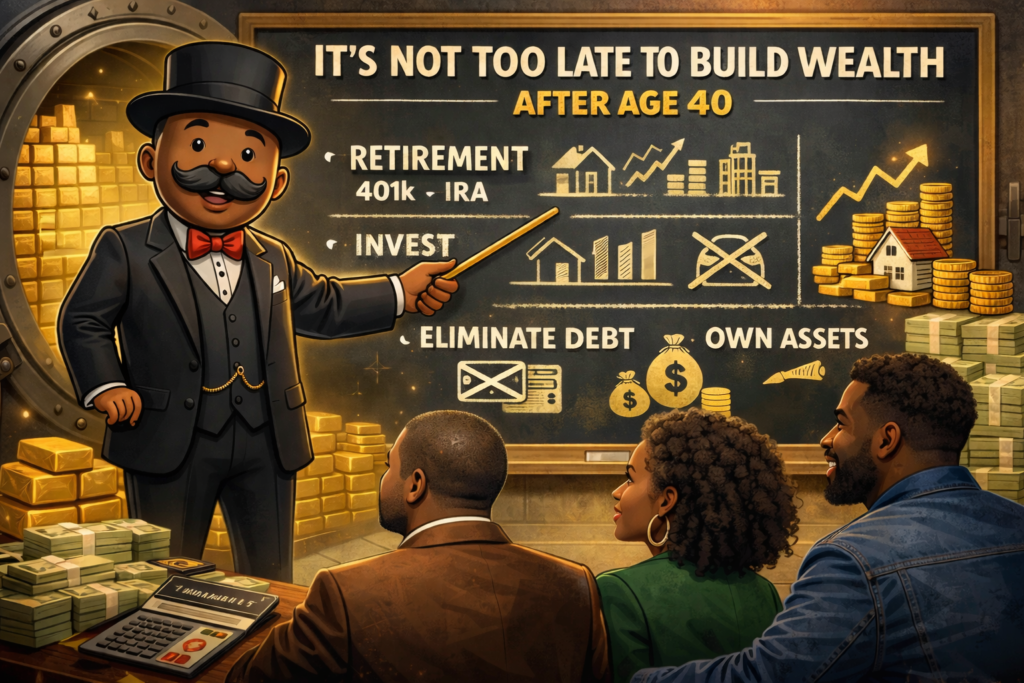
(Black Dollar & Culture Wealth Series) For many people, turning 40 feels like a financial wake-up call. You start realizing retirement isn’t some distant idea anymore. Kids may be getting older. Your career might be established — or you might feel like time is moving faster than expected. But here’s the truth most financial institutions never tell people: Your 40s can be one of the most powerful wealth-building decades of your life. Why? Because by this stage you likely have more income, more experience, and better decision-making ability than you did in your 20s. The key is shifting from earning money to building systems that produce wealth. Let’s break down the moves that matter most. 7 Wealth Moves You Must Make After Age 40 1. Maximize Your Retirement Accounts Your 40s are the time to aggressively fund retirement accounts. The power of compounding is still working in your favor, but you no longer have time to be passive. Focus on: • 401(k) contributions (especially if your employer offers a match)• Roth IRA or Traditional IRA• SEP IRA or Solo 401(k) if you’re self-employed Many wealthy individuals increase their contributions significantly in their 40s to make up for earlier years. Even an extra $500 per month invested for 20 years can grow into six figures. 2. Eliminate High-Interest Debt One of the biggest wealth killers after 40 is consumer debt. Credit cards charging 18%–30% interest quietly drain your future wealth. Every dollar spent on interest is a dollar not invested in assets. Focus on eliminating: • Credit card balances• Personal loans• High-interest car loans The goal is simple: Free up cash flow so your money can start working for you. 3. Invest Consistently in Assets Wealth is not built from income alone. It is built through ownership. By 40, your financial focus should shift toward accumulating assets like: • Dividend stocks• Index funds (S&P 500, ETFs)• Real estate• Private businesses• Ownership in companies Historically, the S&P 500 has averaged about 10% annually over the long term. Consistent investing over the next 20–25 years can transform your financial future. 4. Build a Family Bank System One strategy wealthy families have used for generations is circulating money within the family instead of constantly borrowing from banks. Instead of relying on outside lenders for every financial need, families can pool resources and create their own internal lending system. This allows families to: • Finance businesses• Help relatives purchase homes• Fund education• Keep interest circulating inside the family Learning how to structure this correctly can dramatically change how wealth flows through generations. 👉 Learn how to build your own system here:https://stan.store/blackdollarandculture/p/the-family-bank-starter-system 5. Protect Your Wealth With Proper Structures Building wealth is only half the equation. The other half is protecting it from taxes, lawsuits, and probate. Many wealthy families use legal structures such as trusts and insurance strategies to protect their assets. One powerful strategy is the Irrevocable Life Insurance Trust (ILIT), which allows families to transfer wealth to the next generation while reducing estate taxes and protecting assets. 👉 Learn how wealthy families use this strategy:https://stan.store/blackdollarandculture/p/get-your-family-wealth-trust-blueprint-now Support Independent Black Media ❤️ Support Independent Black Media Black Dollar & Culture is 100% reader-powered — no corporate sponsors, just truth, history, and the pursuit of generational wealth. Every article you read helps keep these stories alive — stories they tried to erase and lessons they never wanted us to learn. 6. Increase Your Income Streams By 40, relying on a single income source becomes risky. Many wealthy individuals focus on building multiple streams of income, such as: • Dividend income• Rental properties• Online businesses• Digital products• Consulting or coaching Even building two or three additional income streams can create financial security that a job alone cannot provide. 7. Start Thinking Generationally True wealth isn’t just about your retirement. It’s about what happens after you’re gone. At this stage in life, it’s important to start thinking about: • Estate planning• Teaching financial literacy to your children• Passing down assets instead of liabilities The goal is not simply to retire comfortably. The goal is to build something that lasts beyond your lifetime. Final Thoughts Your 40s are not too late. In fact, many successful entrepreneurs, investors, and business owners didn’t hit their financial stride until their 40s or even 50s. What matters now is intentional action. Reduce debt. Increase investments. Build ownership. Create systems that allow money to grow whether you’re working or not. Because the real goal isn’t just making money. It’s building a legacy. #BlackDollarCulture #GenerationalWealth #BlackWealth #FamilyBank #FinancialFreedom #WealthBuilding #InvestingForBeginners #OwnershipEconomy #BlackEntrepreneurs #BuildWealth Focus Keyphrase: How to Build Wealth Once You Hit 40 Slug: build-wealth-after-40 Meta Description:Learn how to build wealth after 40 with proven strategies including investing, eliminating debt, building a family bank system, and protecting assets for generational wealth.
How to Stop Living Paycheck to Paycheck

For millions of people, life follows the same exhausting cycle. Work.Wait for payday.Pay bills.Start over again. Two weeks later… the cycle repeats. For many families, especially in historically marginalized communities, this pattern didn’t start because of poor financial decisions. It started because wealth-building opportunities were limited for generations. Policies like redlining, employment discrimination, and unequal access to capital meant many families had to rely almost entirely on wages rather than ownership. And wages alone rarely build wealth. They build survival. Breaking the paycheck-to-paycheck cycle requires more than budgeting. It requires a shift in how money is viewed and used. Not just earning money. Directing where it flows. Because money behaves like water. If you don’t guide it intentionally, it will always flow somewhere else — usually into someone else’s pocket. The First Step: Understand the Real Problem Many people assume living paycheck to paycheck is simply caused by low income. Sometimes that’s true. But often the deeper issue is lack of ownership. When your entire financial life depends on a job, every expense becomes a risk. Rent.Car payments.Utilities.Groceries.Insurance. If the paycheck stops, everything becomes unstable. That’s because most people operate with only one financial engine — their labor. But wealth builders rely on multiple financial engines. The Second Step: Shift From Income to Cash Flow Employees are taught to focus on income. Owners focus on cash flow. Income requires time. Cash flow continues even when you’re not actively working. Examples of cash-flow assets include: • Dividend-paying stocks• Rental real estate• Businesses• Royalties from books or digital products• Ownership in companies When assets produce income, financial pressure begins to decrease. Instead of trading hours for money forever, money begins working on your behalf. The Third Step: Eliminate Financial Leakage One of the biggest hidden reasons people stay stuck financially is money leakage. These are small but constant expenses that quietly drain income. Examples include: • High-interest credit cards• Large car payments• Frequent convenience spending• Subscription services rarely used• Lifestyle purchases that produce no return Individually these expenses may seem harmless. But together they can consume thousands of dollars each year. Money that could have been used to build assets. The goal isn’t to remove joy from life. The goal is to make sure your money builds something before it disappears. The Fourth Step: Pay Yourself First Most households follow the same pattern. They pay everyone else first. The landlord.The bank.Credit card companies.Utility companies.Subscription services. By the time they think about saving or investing, the paycheck is already gone. Wealth builders reverse this order. They allocate money toward assets before anything else. Even if it starts small. Consistency matters more than size. Over time, those consistent investments compound into powerful financial growth. The Fifth Step: Build Internal Financial Systems Traditional banks make billions every year from interest payments. Every time a family borrows money, wealth flows out of that household and into the financial system. But some families operate differently. Instead of constantly borrowing from banks, they create internal lending systems within the family. Money circulates between relatives for: • Starting businesses• Purchasing homes• Funding education• Emergency needs• Investments Interest stays within the family rather than leaving it. This concept is known as family banking, and many wealthy families have quietly used versions of this strategy for generations. The Real Goal: Ownership Escaping the paycheck-to-paycheck cycle is not just about controlling spending. It is about building ownership. Ownership of businesses. Ownership of investments. Ownership of assets that generate income. Once assets begin producing money, something powerful happens. Bills are no longer paid only through labor. They begin to be paid through ownership income. And that is when financial stress finally begins to fade. Because your money is working for you. Not the other way around. Build Real Generational Wealth If you’re serious about breaking financial cycles and building lasting wealth for your family, these two resources can help you take the next step. The Family Bank Starter SystemLearn how families create their own internal banking system to keep money circulating inside the household instead of flowing to traditional banks.👉 https://stan.store/blackdollarandculture/p/the-family-bank-starter-system Family Wealth Trust Blueprint (ILIT Guide)Discover how wealthy families protect and transfer wealth using life insurance trusts and strategic estate planning.👉 https://stan.store/blackdollarandculture/p/get-your-family-wealth-trust-blueprint-now ❤️ Support Independent Black Media Black Dollar & Culture is 100% reader-powered — no corporate sponsors, just truth, history, and the pursuit of generational wealth. Every article you read helps keep these stories alive — stories they tried to erase and lessons they never wanted us to learn. FAQ Why do so many people live paycheck to paycheck?Many households depend on wages as their only income source while expenses continue rising. What is the fastest way to escape the paycheck-to-paycheck cycle?Increasing income while simultaneously investing in assets and reducing financial leakage. What is the biggest difference between wealthy families and struggling families?Wealthy families prioritize ownership and asset accumulation, while most households rely primarily on wages. #BlackDollarCulture #BlackWealth #GroupEconomics #FinancialLiteracy #GenerationalWealth #FamilyBank #OwnershipEconomy #WealthBuilding #EconomicEmpowerment #BlackFinance Focus Keyphrase: stop living paycheck to paycheckSlug: stop-living-paycheck-to-paycheckMeta Description: Learn how to stop living paycheck to paycheck by shifting from wage dependence to asset ownership, family banking strategies, and long-term wealth building.
7 Wealth Moves You Must Make After Age 30

Turning thirty is more than just a birthday milestone. For many people, it is the moment when financial reality becomes clear. Your twenties are often spent experimenting with careers, learning hard money lessons, and figuring out how the financial system actually works. But your thirties are different. This is the decade where wealth either begins to build… or the opportunity slowly slips away. The good news is that thirty is still early enough to let compound growth do most of the heavy lifting. Here are the wealth moves that matter most. 1. Shift From Income Thinking To Ownership Thinking • Most people spend their entire lives focused on earning income.• Wealthy people focus on owning assets that generate income.• The goal is to own things that continue producing money whether you work or not. Examples of ownership assets include: • Stocks• Businesses• Real estate• Intellectual property• Digital products Income pays bills. Ownership builds wealth. 2. Begin Investing Immediately • Time is the most powerful force in wealth creation.• Even small investments grow dramatically over decades.• Starting at age 30 gives compound interest enough time to work. Example: • $500 invested monthly with an average 8% return could grow to over $700,000 by age 60. Consistency matters more than trying to perfectly time the market. 3. Build Multiple Income Streams • One source of income is risky.• Wealthy individuals often have three to seven income streams. Examples include: • Salary or primary business• Dividend investments• Rental properties• Online content or media• Digital products and books Each additional income stream strengthens financial stability. 4. Avoid Lifestyle Inflation • One of the biggest wealth killers is lifestyle creep.• As income increases, spending often increases with it. Instead: • Increase investments before increasing lifestyle.• Maintain discipline as income grows. A useful rule is to invest 20–30 percent of all earnings. 5. Study Financial Systems • Wealthy individuals spend time understanding money itself.• Learning how financial systems operate can dramatically increase long-term wealth. Important topics include: • Investing strategies• Tax structures• Business ownership• Credit and leverage• Insurance and asset protection Financial education multiplies earning power. 6. Build Scalable Assets • Time is limited.• Assets that scale allow income to grow without equal increases in effort. Examples of scalable assets include: • Books and ebooks• Online courses• Software or apps• Blogs and media platforms• Intellectual property These assets can continue generating revenue long after they are created. 7. Think In Generations, Not Years • Wealth is rarely built quickly.• Most fortunes are built over 10–20 year cycles. A common pattern looks like this: • Age 30–40: Asset building• Age 40–50: Asset growth• Age 50–60: Financial independence Patience and discipline often outperform fast money strategies. Final Thought Throughout history, the families that built lasting wealth did not rely solely on income. They focused on ownership, invested consistently, and built systems that allowed money to circulate within their families. Your thirties represent the beginning of that opportunity. The earlier the shift from earning money to owning assets begins, the more powerful the results can become. Hashtags #BlackDollarCulture #GenerationalWealth #BlackWealth #FamilyBank #OwnershipEconomy #FinancialFreedom #BlackOwnership #EconomicEmpowerment #BuildTheBlock #LegacyBuilding Focus Keyphrase building wealth in your 30s Slug building-wealth-in-your-30s Meta Description Discover the most important wealth strategies to start in your 30s, including investing, ownership, and building multiple income streams for long-term financial freedom.
How to Think Like a Wealthy Person (Even Before You Have Money)

Most people think wealth starts in the bank account. It doesn’t. It starts in the mind. Before the portfolio.Before the business.Before the real estate. Wealth begins with a shift in how you see the world — and more importantly, how you see yourself inside it. Because poor thinking chases money. Wealthy thinking builds systems. And the difference between the two determines everything. 1. Wealthy People Think in Ownership, Not Income The average person asks: “How can I make more money?” The wealthy person asks: “How can I own something that makes money without me?” That shift alone separates employees from empires. A job is income.A system is leverage.Ownership is power. Look at figures like Warren Buffett. He didn’t become wealthy because of a salary. He became wealthy because he owned pieces of businesses. Ownership compounds.Income disappears. If you want to think wealthy, start asking daily: 2. Wealthy Thinking Is Long-Term Thinking Poor mindset: “I need it now.”Wealth mindset: “Where will this put me in 15 years?” Wealthy people think in decades, not days. They understand: They don’t panic when the economy dips.They position themselves. That’s why during downturns, some people lose everything — while others quietly accumulate. Patience is a wealth strategy. 3. Wealthy People Control Emotion Emotion is expensive. Impulse buying.Panic selling.Flexing to impress.Spending to feel validated. Wealthy people detach emotion from money decisions. They ask: Discipline beats hype. Every time. 4. They See Assets Where Others See Objects The average person sees: A wealthy thinker sees: It’s not about what something is. It’s about what something can produce. That’s the Family Bank mindset. Turn consumption into creation.Turn access into ownership.Turn platforms into pipelines. 5. Wealthy People Move Quietly Real wealth is quiet. It doesn’t scream.It doesn’t compete.It doesn’t explain itself. It studies.It accumulates.It protects. While some chase attention, others build infrastructure. That quiet separation is uncomfortable — but it’s necessary. Growth requires separation. 6. They Think in Systems, Not Hustles Hustle burns out. Systems scale. A wealthy thinker asks: Subscription businesses.Automated investing.Digital products.Trust structures.Content libraries. Build once.Collect repeatedly. That’s the difference between working hard and working strategically. 7. They Protect Capital Aggressively Building wealth is only half the game. Keeping it is the real discipline. Wealthy thinkers care about: They understand money must be defended. Capital is oxygen. Without it, nothing else matters. The Core Shift To think like a wealthy person, ask yourself daily: This isn’t about pretending to be rich. It’s about training your brain to operate at a higher level. Wealth is not an amount. It’s a perspective. And once your thinking shifts — your strategy follows. Then your behavior. Then your outcomes. ❤️ Support Independent Black Media Black Dollar & Culture is 100% reader-powered — no corporate sponsors, just truth, history, and the pursuit of generational wealth. Every article you read helps keep these stories alive — stories they tried to erase and lessons they never wanted us to learn. In a world drowning in debt, distraction, and dependence, wealthy thinking is an act of rebellion. Ownership is power. Discipline is protection. Systems are freedom. If this shifted your mindset, share it with someone building in silence — and step deeper into the BD&C movement. Focus Keyphrase: How to think like a wealthy personSlug: how-to-think-like-a-wealthy-personMeta Description: Learn how to think like a wealthy person by shifting from income to ownership, building systems, controlling emotion, and focusing on long-term asset growth.
How a Roth IRA Can Make Your Family Rich (Not Just Comfortable)

Most families chase income.Wealthy families build systems. A Roth IRA is one of the most powerful—and most misunderstood—systems available to everyday people. Used correctly, it doesn’t just help you retire comfortably. It can quietly turn your household into a multi-generation wealth engine. Let’s break down exactly how. 1. A Roth IRA Grows Tax-Free Forever • Contributions are made with after-tax dollars• Investments grow tax-free• Withdrawals in retirement are 100% tax-free This matters because taxes are the silent killer of wealth.Every dollar that avoids taxation compounds faster—and compounding is how families get rich slowly, then suddenly. 2. Time Turns Small Contributions Into Large Outcomes • $6,500 per year sounds small• 30–40 years of compounding is massive• Growth beats hustle when time is on your side A family that starts early doesn’t need luck, crypto bets, or viral income. Time does the heavy lifting. 3. Roth IRAs Protect You From Future Tax Increases • No one knows future tax rates• Governments historically raise taxes• Roth IRAs lock in today’s tax rate forever This is wealth defense.You pay taxes once—on your terms—and never again. 4. You Can Pass a Roth IRA to Your Children • Roth IRAs can be inherited• Heirs receive tax-free growth• Funds can stretch across years This is how wealthy families move money forward without erosion. Not through income—but through ownership structures. 5. Roth IRAs Work Perfectly With Family Banks & Trusts • Roth IRAs pair well with trusts• They fit inside Family Bank strategies• They protect wealth from mismanagement This is how money stays in the family longer than one generation. 6. You Can Invest the Roth IRA—It’s Not a Savings Account • Stocks• ETFs• Index funds• Dividend assets The Roth IRA is a container, not an investment.What you put inside determines how powerful it becomes. 7. The Real Secret: It Teaches Discipline, Not Just Returns • Automatic investing• Long-term thinking• Delayed gratification Families who win financially think decades ahead. A Roth IRA trains that mindset quietly, year after year. 8. This Is How Rich Families Think Rich families don’t ask: “How much can I make this year?” They ask: “How do I protect and multiply money for the next 40 years?” A Roth IRA answers that question. Final Thought You don’t need millions to start acting wealthy.You need structures, time, and discipline. A Roth IRA isn’t flashy.It’s not loud.But it’s one of the cleanest tools ever created for turning income into legacy. 📌 Focus Keyphrase How a Roth IRA can make your family rich 🔗 Slug how-a-roth-ira-can-make-your-family-rich 📝 Meta Description Learn how a Roth IRA can quietly build tax-free, generational wealth for your family using time, discipline, and smart investing strategies.
The Cheapest Way to Start Investing With Just $5 (Yes, Really)

Most people believe investing is something you do after you make money.That belief alone has kept millions of people permanently on the sidelines. The truth is uncomfortable for the system—but powerful for you: Investing doesn’t start with wealth.Wealth starts with investing. And today, that journey can begin with just $5. ❤️ Support Independent Black Media Black Dollar & Culture is 100% reader-powered — no corporate sponsors, just truth, history, and the pursuit of generational wealth. Every article you read helps keep these stories alive — stories they tried to erase and lessons they never wanted us to learn. 1. The Lie That Investing Is “Only for People With Money” For decades, investing was intentionally framed as something exclusive. You needed: This wasn’t accidental. When people believe investing is unreachable, they: The result?Generations trapped in a cycle where money passes through them, not works for them. But the rules quietly changed. Technology removed the gatekeepers—yet the old mindset remained. 2. What $5 Can Actually Buy You Today Thanks to fractional investing, you no longer need to buy an entire share of a company. You can buy a piece. That $5 can now purchase: This matters because ownership compounds, even in small amounts. While $5 in a savings account stays $5 (or loses value to inflation),$5 invested participates in growth. You’re no longer just holding money.You’re deploying it. 3. Why ETFs Are the Smartest Place to Start With $5 For beginners, the goal is not excitement.The goal is survival and consistency. That’s why Exchange-Traded Funds (ETFs) are ideal. ETFs: Instead of betting on one company, you’re betting on the system itself continuing to grow. This is not gambling.This is ownership. 4. The Real Power Isn’t the $5 — It’s the Habit Here’s what most people miss: The dollar amount matters far less than the behavior. When you invest $5: Small, repeated actions beat large, emotional decisions every time. Someone who invests $5 consistently will outperform someone who waits years for “the right time.” Because the market rewards time, not perfection. 5. A Simple $5 Investing Strategy That Actually Works This isn’t complicated. That’s the point. Step 1: Choose one broad-market ETFStep 2: Invest $5 weekly or bi-weeklyStep 3: Automate itStep 4: Ignore the noise No charts.No predictions.No panic. Over time, your money benefits from: You’re no longer guessing.You’re participating. 6. What NOT to Do With $5 Starting small doesn’t mean acting reckless. Avoid: Those strategies punish beginners and reward experience. $5 is not for chasing dopamine.It’s for building discipline and foundation. Wealth grows quietly before it grows loudly. 7. Why Waiting Is More Expensive Than Starting Small People often say:“I’ll invest when I make more.” But every year you wait: Time is the most expensive currency you own. Starting with $5 today beats starting with $500 five years from now. Because ownership rewards patience, not pride. 8. How This Connects to Generational Wealth Generational wealth doesn’t begin with inheritance.It begins with knowledge and repetition. When investing becomes normal: The amount grows later.The mindset must start now. This is how families quietly separate from the financial struggle most people accept as normal. 9. The Psychological Shift That Changes Everything Once you invest—even with $5—you cross a line. You stop asking:“How much does this cost?” And start asking:“What does this return?” That shift changes how you see: Ownership rewires thinking. And thinking shapes outcomes. 10. Final Truth Most People Never Hear You don’t start investing because you’re rich.You get rich because you start investing. The cheapest way to begin isn’t about money. It’s about deciding to own. Frequently Asked Questions Is investing $5 really worth it?Yes—because it builds habit, exposure, and discipline. The habit matters more than the amount. Is it better to save or invest $5?Emergency savings come first, but long-term growth requires investing. Saving alone does not build wealth. How often should I invest small amounts?Weekly or bi-weekly works best. Consistency beats timing. Can small investments really grow over time?Yes. Compound growth rewards time in the market, not size of the first deposit. Slug: cheapest-way-to-start-investing-with-5-dollarsMeta Description: Learn the cheapest way to start investing with just $5. Discover how small, consistent investing builds real wealth, ownership, and long-term financial freedom—even for beginners.
What Happens to the Black Community When Black Men Marry Outside the Race?

For decades, conversations around Black men dating or marrying outside the race have been framed emotionally — accusations, defensiveness, and surface-level debates about “preference.” But very little attention is paid to the structural impact of these choices on the Black community as a whole. This article isn’t about policing love.It’s about understanding how marriage functions as an economic and social institution — and what happens when participation in that institution becomes uneven. According to Pew Research Center, about 24% of Black male newlyweds married outside their race, compared to roughly 9% of Black female newlyweds. That imbalance alone creates long-term consequences that go far beyond individual relationships. Let’s break down what that actually means. Marriage in America is the primary mechanism through which wealth is pooled, protected, and passed down. Two incomes combine, assets are acquired jointly, homes are purchased, businesses are built, and children inherit both financial and social capital. When a Black man marries within the Black community, those economic benefits are statistically more likely to circulate within Black households, Black neighborhoods, and Black institutions. When a significant portion of Black men marry outside the race, a growing share of Black male income, assets, and future earnings becomes structurally anchored outside the Black community. This isn’t about intentions. It’s about where capital compounds over time. The effect multiplies across generations. Children are the carriers of legacy — not just DNA, but culture, identity, and economic direction. Research consistently shows that children spend more time in the primary custodial household, usually the mother’s. Cultural identity, social networks, and future relationship patterns tend to follow that environment. Over time, this leads to fewer Black-identified households, fewer Black family units, and weaker continuity in culture, economics, and community affiliation. The imbalance also directly affects Black women. Because Black men marry outside the race at nearly three times the rate of Black women, the available marriage pool shrinks. This contributes to lower marriage rates among Black women, delayed family formation, and a higher prevalence of single-parent households. That matters because two-parent households, regardless of race, statistically accumulate more wealth, experience less economic stress, and provide more stability for children. This isn’t a moral judgment — it’s a demographic reality. There’s also a political and economic dimension that often goes unspoken. Marriage influences where people live, which schools children attend, where families invest, how they vote, and which businesses they support. When high-earning Black men — especially athletes, entertainers, and executives — marry outside the race, their economic footprint, political influence, and philanthropy frequently become integrated into other communities rather than anchored in Black ones. That’s why the impact feels larger than the numbers suggest. While celebrities make up a small percentage of Black men, they represent an outsized share of visible Black wealth. When those resources exit the community, the loss is amplified — not symbolically, but materially. Still, it’s important to be precise: interracial marriage itself is not the problem. The real issue is a combination of low overall Black marriage rates, weak asset protection, and the absence of a coordinated strategy for retaining and compounding Black wealth. When out-marriage occurs alongside declining in-marriage and minimal financial planning, the community experiences capital leakage instead of circulation. If Black men married Black women at higher rates, protected assets through prenups and trusts, and intentionally reinvested in Black institutions, interracial marriage would not register as a crisis. It would simply be a personal choice within a strong, resilient system. The uncomfortable truth is this: marriage is not just about love. It is an economic contract, a wealth-building vehicle, and a power-transfer mechanism. When participation in that system becomes uneven, the effects are predictable — and they compound. Understanding that reality doesn’t require blame. It requires strategy. Focus Keyphrase: Black love and wealth Slug: black-men-interracial-marriage-impact-black-communityMeta Description: A data-driven look at how Black men marrying outside the race affects Black wealth, family formation, and long-term community power.