How Trusts Protect Assets From Lawsuits (And Why Most People Get It Wrong)

Most people believe that once assets are placed into a trust, they are automatically protected from lawsuits. That belief sounds comforting—but it’s often dangerously incomplete. Trusts can protect assets from lawsuits, but only when they are structured correctly, implemented early, and paired with the right legal principles. Otherwise, a trust may offer little more than a false sense of security. Asset protection is not about hiding money. It’s about changing ownership, limiting control, and placing legal distance between you and potential claims—before problems arise. To understand how trusts actually work in this context, we need to start with how lawsuits really take assets. When a lawsuit is filed and a judgment is entered, the opposing party is not looking for effort, intention, or fairness. They are looking for what you legally own and what you legally control. Bank accounts, real estate, investment accounts, business interests, and income streams are all evaluated through this lens. If an asset is considered yours—either because your name is on it or because you can freely access and control it—it may be reachable. This is where trusts come in, but not all trusts function the same way. A trust works by separating three roles: the person who creates the trust (the grantor), the person who manages the trust (the trustee), and the person who benefits from the trust (the beneficiary). Asset protection becomes possible when these roles are structured so that the grantor no longer has direct ownership or unrestricted control. In other words, protection comes from distance, not paperwork. One of the most common mistakes people make is assuming that a revocable living trust provides lawsuit protection. Revocable trusts are popular because they are flexible—you can change them, cancel them, and move assets in and out at will. However, from a lawsuit perspective, that flexibility is the problem. If you retain the power to revoke the trust or freely reclaim the assets, a court may still treat those assets as yours. In many cases, revocable trusts offer little to no protection from creditors. Irrevocable trusts operate differently. While “irrevocable” does not mean untouchable, it does mean that the grantor gives up certain rights and powers. That loss of control is precisely what can create asset protection. When structured properly, an irrevocable trust can place assets outside the grantor’s personal ownership, making it significantly more difficult for a creditor to reach them. Several mechanisms inside a trust determine whether it actually protects assets. One is legal ownership. If the trust, not the individual, owns the asset—and the individual cannot unilaterally reclaim it—that asset may be insulated from personal lawsuits. Another mechanism is the spendthrift provision, which can limit a beneficiary’s ability to transfer or pledge their interest and may restrict a creditor’s ability to force distributions. Trustee discretion also matters. When distributions are controlled by a trustee and not guaranteed on demand, creditors often face additional legal barriers. Timing is critical. Asset protection is strongest when trusts are established before there is any known claim, dispute, or legal threat. Moving assets into a trust after being sued—or after anticipating a lawsuit—can trigger fraudulent transfer laws. Courts have the power to reverse those transfers, effectively undoing the protection and potentially making the situation worse. This is why asset protection is about planning, not panic. Trusts are often used in combination with other protective tools. Real estate, for example, may be owned by an LLC to contain liability, with the ownership interest of that LLC held by a trust. Business interests may be structured so operational risk stays separate from personal wealth. Investment accounts can be titled in the name of a trust depending on the overall strategy. In each case, the trust is not the only line of defense—it is part of a layered system. The most common reason trusts fail in court is simple: too much control. When the same person is the grantor, trustee, and beneficiary—and can revoke the trust at any time—the legal separation collapses. Courts are not obligated to honor structures that exist in form but not in substance. Real protection usually requires real boundaries, sometimes including an independent trustee and clearly defined limits on access. From a BD&C perspective, trusts should be viewed as ownership tools, not magic shields. True protection comes from layering: reducing risk through smart behavior, transferring risk through insurance, containing risk through entities like LLCs, and then structuring ownership through trusts. Each layer reinforces the others. Trusts can protect assets from lawsuits—but only when they are built deliberately, early, and correctly. Wealth is not just about what you earn. It’s about what you can keep, control, and pass forward. Understanding how trusts really work is part of moving from income thinking to ownership thinking. This article is for educational purposes only and does not constitute legal advice. Asset protection strategies vary by jurisdiction, and qualified legal counsel should be consulted for individual circumstances. If you wait until risk shows up, it’s already too late. Asset protection only works before courts, creditors, or claims enter the picture. An Irrevocable Life Insurance Trust (ILIT) is one of the few tools that can legally remove life insurance from your estate and protect it from lawsuits — but only if it’s structured correctly. This guide breaks down exactly how ILITs work, when to set them up, and the mistakes that quietly expose families every day. Read the ILIT Guide now and secure the structure while you still control the outcome → Get Your Family Wealth Trust Blueprint Now Historically, the families who preserved wealth didn’t do it by reacting to threats—they built systems before threats ever appeared. Ownership structures, trusts, and layered protection weren’t accidents; they were deliberate moves. If you want to continue learning how real wealth is protected and transferred, explore more at Black Dollar & Culture and start building with intention, not urgency. Focus Keyphrase How trusts protect assets from lawsuits Meta Description Learn how trusts protect assets from lawsuits, why revocable trusts often fail, how irrevocable

How to Build a Business That Runs Without You

The Blueprint for True Freedom, Ownership, and Scale Most people say they want to own a business, but what they really end up building is a job with a logo. If the business collapses the moment you stop answering emails, posting content, or showing up every day, you don’t own a business—you own a dependency. True wealth comes from building systems that work whether you’re present or not. This is how the wealthy buy back their time, protect their energy, and scale beyond effort. Building a business that runs without you isn’t about laziness. It’s about design. It’s about removing yourself as the bottleneck and replacing hustle with structure, clarity, and automation. This guide breaks down exactly how to do that. 1. Start With the End in Mind (Owner vs Operator Thinking) The first shift is mental. You must decide early whether you’re building: An operator asks: What do I need to do today?An owner asks: What system needs to exist so this doesn’t require me? Every task you do manually today should be viewed as temporary. If you don’t design your business with replacement in mind, you’ll trap yourself inside it. Ask yourself: Those answers reveal exactly what must be systemized. 2. Choose a Business Model That Can Actually Scale Not every business is meant to run without you. Some models are naturally scalable, others fight you at every step. High-leverage models include: Low-leverage models include: If your income depends on your physical presence or constant customization, freedom will always be limited. The goal is repeatability, not perfection. 3. Document Everything You Do (Before You Delegate Anything) Most people try to hire help too early and fail because they never defined the work. Before you outsource or automate, you must document your processes: This can be as simple as: If someone can’t follow instructions to replace you, the system—not the worker—is the problem. 4. Turn Repetition Into Automation Anything repetitive should be automated before it’s delegated. Examples: Automation removes human error and emotional burnout. It also makes your business more valuable because systems don’t quit. Key areas to automate first: 5. Build a Team Around Roles, Not People A business that runs without you is built on roles, not personalities. Instead of saying: Say: This allows you to: Start with part-time or contract help: Your job is not to do the work—it’s to manage the system that produces the work. 6. Separate Ownership From Operations One of the most powerful moves you can make is separating: As the owner, your responsibilities should eventually shrink to: If you’re still stuck in daily execution years in, the business owns you. True freedom happens when: 7. Build Systems That Make Decisions Without You The highest level of leverage is decision automation. This includes: When your business has rules, it doesn’t need constant supervision. When everything requires your opinion, burnout is inevitable. Document your values and standards so your team and systems know how to act even when you’re absent. 8. Create Predictable Cash Flow First A business that runs without you must be financially stable. Focus on: Chaos in cash flow forces you back into survival mode, which kills system-thinking. Stability buys you space. Space allows structure. 9. Design the Exit Even If You Never Leave Every strong business is built as if it will be sold—even if you never sell it. That means: A business that can be sold is a business that can run without you. Even if you never exit, you gain leverage, freedom, and peace. 10. Measure Freedom, Not Just Revenue Revenue without freedom is a trap. Track: The real flex isn’t working nonstop—it’s earning while absent. Final Thought A business that runs without you is not built overnight. It’s built deliberately. Every system you create is a brick in the wall separating your income from your time. That separation is the foundation of generational wealth. Most people chase money. Owners design freedom. Build accordingly. Focus Keyphrase: build a business that runs without youMeta Description: Learn how to build a business that runs without you using systems, automation, and scalable models. A step-by-step blueprint for true freedom and ownership.Slug: build-a-business-that-runs-without-you

Black-Owned Businesses: Why Pouring Back Into the Community Is the Ultimate Power Move

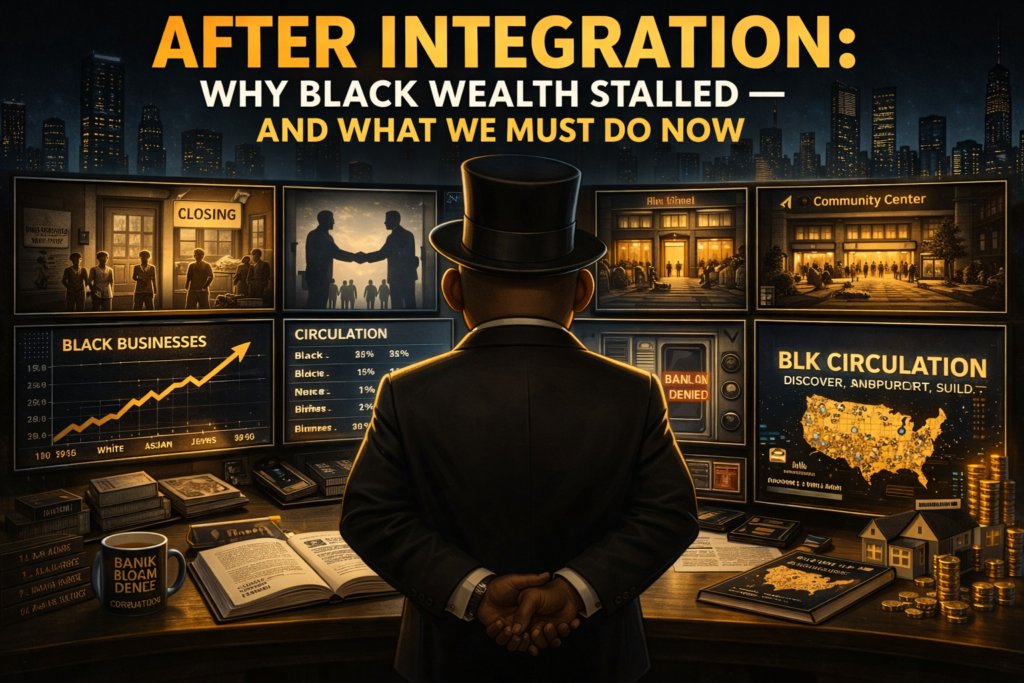
This isn’t about charity. It’s about strategy.When Black-owned businesses reinvest into the communities that support them, they aren’t giving money away — they’re locking in longevity, loyalty, and leverage. History proves it. Modern data confirms it. And the future demands it. Before desegregation, before outside corporations flooded our neighborhoods, Black communities circulated the dollar dozens of times before it ever left. That circulation built schools, banks, hospitals, newspapers, and generational wealth. The collapse didn’t happen because the model failed — it happened because the system was disrupted. Here’s why pouring back in is not optional, but essential. 1. Community Investment Multiplies Business Survival Money spent locally doesn’t disappear — it cycles.When a Black business hires locally, sources locally, or sponsors locally, the community becomes economically invested in that business’s survival. That’s how you create customers who don’t just buy once — they defend your brand. • Local Jobs create Stable customers• Local Vendors reduce Costs and dependencies• Local Loyalty increases Lifetime value A supported community protects its own. 2. Wealth Circulation Builds Economic Immunity Every dollar that leaves the community weakens it.Every dollar that stays strengthens it. When Black businesses reinvest — through scholarships, youth programs, apprenticeships, or community real estate — they reduce dependency on outside systems that were never designed to protect us. This isn’t emotional. It’s mathematical. 3. Reinvestment Creates the Next Generation of Owners Communities don’t rise by consumption alone — they rise by ownership transfer. When successful Black businesses mentor youth, fund internships, or teach financial literacy, they aren’t just helping — they’re creating future partners, suppliers, and successors. Ownership is taught. Power is modeled. 4. Trust Is the New Currency In a world of ads, algorithms, and distractions, trust beats marketing. A business that visibly pours back into the community earns:• Word-of-mouth growth• Free brand ambassadors• Crisis-proof support People support what supports them. 5. Economic Power Is Political Power (Without Politics) You don’t need permission when you control resources. Communities with strong local businesses:• Fund their own initiatives• Solve problems internally• Negotiate from strength Reinvestment turns neighborhoods into economic blocs, not begging grounds. 6. The Blueprint Already Exists We don’t need new ideas — we need discipline and execution. From Greenwood (Black Wall Street) to Durham’s Black banking class, history shows that community-centered business models work when we commit to them long-term. The goal isn’t to escape the community — it’s to elevate it with you. The Bottom Line Black-owned businesses that pour back into the community don’t shrink — they compound. This is how legacies are built.This is how ecosystems form.This is how wealth stops leaking and starts circulating. 👉 Read more stories like this — and learn how ownership really works. ❤️ Support Independent Black Media Black Dollar & Culture is 100% reader-powered — no corporate sponsors, just truth, history, and the pursuit of generational wealth. Every article you read helps keep these stories alive — stories they tried to erase and lessons they never wanted us to learn. #BlackOwnedBusiness #BlackWealth #EconomicPower #CommunityEconomics #BuyBlack #GenerationalWealth #BlackDollar #OwnershipMindset #BlackEntrepreneurs Focus Keyphrase: Black owned businesses community reinvestmentSlug: black-owned-businesses-community-reinvestmentMeta Description: Why Black-owned businesses pouring back into the community isn’t charity — it’s a proven strategy for wealth circulation, loyalty, and generational power.

Why Gold Protects Wealth When Markets Collapse

Markets don’t collapse overnight—they unravel quietly, then all at once. Long before the headlines turn red and panic becomes fashionable, confidence begins to erode beneath the surface. Liquidity tightens, assumptions fail, and investors realize—too late—that optimism was doing more work than fundamentals. When that confidence breaks, gold does what it has always done: it holds. Gold has never been an asset of excitement. It doesn’t trend on social media, it doesn’t promise outsized returns, and it doesn’t rely on narratives. It exists for moments of stress—when systems are questioned, currencies are diluted, and trust in leadership weakens. After surviving multiple market cycles, one lesson becomes unavoidable: markets reward growth, but wealth survives through protection. When stock markets collapse, it’s rarely because companies disappear overnight. It’s because valuations were built on fragile assumptions—cheap money, endless growth, stable geopolitics. Once those assumptions crack, repricing is swift and unforgiving. Gold doesn’t reprice on earnings calls or guidance forecasts. It responds to fear, uncertainty, and instability—the very conditions that define market collapses. Cash feels safe during chaos, but history exposes its weakness. Inflation quietly erodes purchasing power while governments respond to crises with stimulus, debt expansion, and money creation. Every collapse is met with liquidity, and liquidity always comes at a cost. Gold has no printing press. Its scarcity is real, which is why it preserves value when paper assets struggle to do the same. This is precisely why central banks hold gold. Not for tradition—but for credibility. When trust between nations weakens, gold becomes neutral ground. When debt loads grow uncomfortable, gold becomes reassurance. When currencies wobble, gold becomes stability. The same logic applies at the individual level. Another overlooked advantage of gold during market collapses is optionality. The most dangerous position an investor can be in during a downturn is forced selling. Gold provides liquidity without forcing the liquidation of productive assets at the worst possible moment. It buys time, and time is often the difference between recovery and permanent loss. Gold also behaves differently than most assets during crises. While correlations across markets tend to spike during panic, gold often diverges. It may not surge immediately, but it holds ground while others fall. That stability matters far more than aggressive upside when the goal is wealth preservation. The wealthy understand this distinction clearly. They don’t buy gold to outperform equities in bull markets. They hold it to survive bear markets. Gold is not designed to make headlines—it’s designed to protect capital when headlines turn ugly. History reinforces this lesson repeatedly. Empires rise and fall. Currencies are introduced, abused, and replaced. Financial systems evolve, break, and rebuild. Through every version of that cycle, gold remains relevant—not because it is old, but because it is independent. Gold does not replace businesses, real estate, or equities. It complements them. Think of it as structural support rather than decoration. You don’t admire it when times are calm, but without it, the foundation cracks under pressure. When markets collapse, emotions spread faster than facts. Gold does not react to emotion. It doesn’t panic, doesn’t promise, and doesn’t explain itself. It simply holds value while everything else explains why it can’t. That is why gold protects wealth—not through excitement, but through endurance. ❤️ Support Independent Black Media Black Dollar & Culture is 100% reader-powered — no corporate sponsors, just truth, history, and the pursuit of generational wealth. Every article you read helps keep these stories alive — stories they tried to erase and lessons they never wanted us to learn. Focus Keyphrase:gold protects wealth Slug:why-gold-protects-wealth-when-markets-collapse Meta Description:When markets collapse and confidence disappears, gold has historically protected wealth. Learn why gold remains a powerful hedge during economic uncertainty.

How a Roth IRA Can Make Your Family Rich (Not Just Comfortable)

Most families chase income.Wealthy families build systems. A Roth IRA is one of the most powerful—and most misunderstood—systems available to everyday people. Used correctly, it doesn’t just help you retire comfortably. It can quietly turn your household into a multi-generation wealth engine. Let’s break down exactly how. 1. A Roth IRA Grows Tax-Free Forever • Contributions are made with after-tax dollars• Investments grow tax-free• Withdrawals in retirement are 100% tax-free This matters because taxes are the silent killer of wealth.Every dollar that avoids taxation compounds faster—and compounding is how families get rich slowly, then suddenly. 2. Time Turns Small Contributions Into Large Outcomes • $6,500 per year sounds small• 30–40 years of compounding is massive• Growth beats hustle when time is on your side A family that starts early doesn’t need luck, crypto bets, or viral income. Time does the heavy lifting. 3. Roth IRAs Protect You From Future Tax Increases • No one knows future tax rates• Governments historically raise taxes• Roth IRAs lock in today’s tax rate forever This is wealth defense.You pay taxes once—on your terms—and never again. 4. You Can Pass a Roth IRA to Your Children • Roth IRAs can be inherited• Heirs receive tax-free growth• Funds can stretch across years This is how wealthy families move money forward without erosion. Not through income—but through ownership structures. 5. Roth IRAs Work Perfectly With Family Banks & Trusts • Roth IRAs pair well with trusts• They fit inside Family Bank strategies• They protect wealth from mismanagement This is how money stays in the family longer than one generation. 6. You Can Invest the Roth IRA—It’s Not a Savings Account • Stocks• ETFs• Index funds• Dividend assets The Roth IRA is a container, not an investment.What you put inside determines how powerful it becomes. 7. The Real Secret: It Teaches Discipline, Not Just Returns • Automatic investing• Long-term thinking• Delayed gratification Families who win financially think decades ahead. A Roth IRA trains that mindset quietly, year after year. 8. This Is How Rich Families Think Rich families don’t ask: “How much can I make this year?” They ask: “How do I protect and multiply money for the next 40 years?” A Roth IRA answers that question. Final Thought You don’t need millions to start acting wealthy.You need structures, time, and discipline. A Roth IRA isn’t flashy.It’s not loud.But it’s one of the cleanest tools ever created for turning income into legacy. 📌 Focus Keyphrase How a Roth IRA can make your family rich 🔗 Slug how-a-roth-ira-can-make-your-family-rich 📝 Meta Description Learn how a Roth IRA can quietly build tax-free, generational wealth for your family using time, discipline, and smart investing strategies.

Why the Media Won’t Talk About Black Economic Power

The silence is intentional. While headlines obsess over Black struggle, debt, and disparity, something far more disruptive is happening just beneath the surface: Black economic power is growing—quietly, strategically, and faster than the narrative allows. Not in the loud, flashy way the media prefers, but in a disciplined, ownership-focused way that doesn’t beg for validation. And that is precisely why it isn’t covered. For decades, Black progress has been framed through a narrow lens of hardship. The story rarely evolves. When it does, it is usually softened, minimized, or quickly redirected back to inequality. What is almost never explored is the shift from income to ownership, from consumption to control, from survival to strategy. Yet across the country, Black families are buying businesses instead of brands, assets instead of applause, and influence instead of attention. The media thrives on predictability. Struggle fits. Power complicates things. Economic power forces new questions—about systems, access, and who benefits when narratives change. It challenges advertisers who profit from insecurity. It disrupts political talking points that rely on dependency. And it undermines the long-standing myth that Black progress only happens when it is granted, approved, or overseen. Look closer and the shift becomes undeniable. Black entrepreneurship has surged, not just in numbers but in sophistication. We’re seeing acquisitions, not just startups. We’re seeing families pooling capital, not individuals chasing clout. We’re seeing a growing interest in trusts, private equity, insurance strategies, land, logistics, and digital infrastructure. These are not the moves of a community “catching up.” These are the moves of a community recalibrating how power actually works. What makes this moment especially dangerous to the old narrative is that it is decentralized. There is no single leader to discredit, no single movement to co-opt, no single celebrity to spotlight and exhaust. It is happening in households, group chats, private study circles, barbershops, church basements, Discord servers, and dinner tables. Quiet wealth is harder to attack because it does not announce itself. The media also struggles to report on things it doesn’t fully understand—or control. Ownership doesn’t trend the way outrage does. Long-term planning doesn’t generate clicks like controversy. A family buying a warehouse, a logistics route, or an insurance policy that funds future generations doesn’t make for dramatic television. But it reshapes reality far more than viral moments ever could. There is another reason for the silence, one that is rarely said out loud. Black economic power changes leverage. It changes how communities negotiate, where they live, what they tolerate, and what they walk away from. It changes voting behavior, schooling choices, healthcare decisions, and labor dynamics. A population with options is harder to manage. A population with assets is harder to pressure. A population that understands money is harder to mislead. This is why the focus remains on income gaps instead of asset gaps. Income can be taxed, inflated away, and capped. Assets endure. Assets appreciate. Assets talk back. When Black families begin to understand this distinction at scale, the entire economic conversation shifts. And that shift does not benefit institutions that profit from confusion. Even the language used tells the story. The media speaks endlessly about “spending power” but avoids “ownership power.” Spending power frames Black consumers as valuable only at the register. Ownership power frames Black people as stakeholders—people who collect, not just contribute. One narrative is safe. The other is transformative. What’s happening now didn’t come from nowhere. It is the result of hard lessons learned across generations. It is the response to watching wealth extracted, neighborhoods flipped, and labor undervalued. It is the realization that visibility without ownership is a trap, and representation without control is theater. So the strategy changed. Less talking. More building. And because it doesn’t fit the expected storyline, it’s easier for the media to pretend it isn’t happening. Silence becomes a form of denial. Omission becomes a way to preserve the illusion that nothing has fundamentally changed. But it has. The irony is that by ignoring Black economic power, the media is making it stronger. What grows quietly often grows sturdier. What isn’t spotlighted isn’t sabotaged as easily. While attention is elsewhere, foundations are being laid that don’t need applause to function. Black Dollar & Culture exists to document this shift—not as hype, not as fantasy, but as fact. The goal isn’t to convince skeptics. It’s to inform builders. To connect dots. To remind people that power doesn’t ask to be acknowledged. It simply moves. The media will talk about Black economic power when it becomes unavoidable. When it disrupts markets. When it alters politics. When it refuses to behave the way it’s “supposed” to. Until then, the silence tells you everything you need to know. What they don’t talk about is often what matters most. Slug: why-the-media-wont-talk-about-black-economic-powerMeta Description: Black economic power is growing faster than the media admits. Discover why ownership, assets, and quiet wealth-building are changing the narrative—and why it’s being ignored.

The Cheapest Way to Start Investing With Just $5 (Yes, Really)

Most people believe investing is something you do after you make money.That belief alone has kept millions of people permanently on the sidelines. The truth is uncomfortable for the system—but powerful for you: Investing doesn’t start with wealth.Wealth starts with investing. And today, that journey can begin with just $5. ❤️ Support Independent Black Media Black Dollar & Culture is 100% reader-powered — no corporate sponsors, just truth, history, and the pursuit of generational wealth. Every article you read helps keep these stories alive — stories they tried to erase and lessons they never wanted us to learn. 1. The Lie That Investing Is “Only for People With Money” For decades, investing was intentionally framed as something exclusive. You needed: This wasn’t accidental. When people believe investing is unreachable, they: The result?Generations trapped in a cycle where money passes through them, not works for them. But the rules quietly changed. Technology removed the gatekeepers—yet the old mindset remained. 2. What $5 Can Actually Buy You Today Thanks to fractional investing, you no longer need to buy an entire share of a company. You can buy a piece. That $5 can now purchase: This matters because ownership compounds, even in small amounts. While $5 in a savings account stays $5 (or loses value to inflation),$5 invested participates in growth. You’re no longer just holding money.You’re deploying it. 3. Why ETFs Are the Smartest Place to Start With $5 For beginners, the goal is not excitement.The goal is survival and consistency. That’s why Exchange-Traded Funds (ETFs) are ideal. ETFs: Instead of betting on one company, you’re betting on the system itself continuing to grow. This is not gambling.This is ownership. 4. The Real Power Isn’t the $5 — It’s the Habit Here’s what most people miss: The dollar amount matters far less than the behavior. When you invest $5: Small, repeated actions beat large, emotional decisions every time. Someone who invests $5 consistently will outperform someone who waits years for “the right time.” Because the market rewards time, not perfection. 5. A Simple $5 Investing Strategy That Actually Works This isn’t complicated. That’s the point. Step 1: Choose one broad-market ETFStep 2: Invest $5 weekly or bi-weeklyStep 3: Automate itStep 4: Ignore the noise No charts.No predictions.No panic. Over time, your money benefits from: You’re no longer guessing.You’re participating. 6. What NOT to Do With $5 Starting small doesn’t mean acting reckless. Avoid: Those strategies punish beginners and reward experience. $5 is not for chasing dopamine.It’s for building discipline and foundation. Wealth grows quietly before it grows loudly. 7. Why Waiting Is More Expensive Than Starting Small People often say:“I’ll invest when I make more.” But every year you wait: Time is the most expensive currency you own. Starting with $5 today beats starting with $500 five years from now. Because ownership rewards patience, not pride. 8. How This Connects to Generational Wealth Generational wealth doesn’t begin with inheritance.It begins with knowledge and repetition. When investing becomes normal: The amount grows later.The mindset must start now. This is how families quietly separate from the financial struggle most people accept as normal. 9. The Psychological Shift That Changes Everything Once you invest—even with $5—you cross a line. You stop asking:“How much does this cost?” And start asking:“What does this return?” That shift changes how you see: Ownership rewires thinking. And thinking shapes outcomes. 10. Final Truth Most People Never Hear You don’t start investing because you’re rich.You get rich because you start investing. The cheapest way to begin isn’t about money. It’s about deciding to own. Frequently Asked Questions Is investing $5 really worth it?Yes—because it builds habit, exposure, and discipline. The habit matters more than the amount. Is it better to save or invest $5?Emergency savings come first, but long-term growth requires investing. Saving alone does not build wealth. How often should I invest small amounts?Weekly or bi-weekly works best. Consistency beats timing. Can small investments really grow over time?Yes. Compound growth rewards time in the market, not size of the first deposit. Slug: cheapest-way-to-start-investing-with-5-dollarsMeta Description: Learn the cheapest way to start investing with just $5. Discover how small, consistent investing builds real wealth, ownership, and long-term financial freedom—even for beginners.

What Happens to the Black Community When Black Men Marry Outside the Race?

For decades, conversations around Black men dating or marrying outside the race have been framed emotionally — accusations, defensiveness, and surface-level debates about “preference.” But very little attention is paid to the structural impact of these choices on the Black community as a whole. This article isn’t about policing love.It’s about understanding how marriage functions as an economic and social institution — and what happens when participation in that institution becomes uneven. According to Pew Research Center, about 24% of Black male newlyweds married outside their race, compared to roughly 9% of Black female newlyweds. That imbalance alone creates long-term consequences that go far beyond individual relationships. Let’s break down what that actually means. Marriage in America is the primary mechanism through which wealth is pooled, protected, and passed down. Two incomes combine, assets are acquired jointly, homes are purchased, businesses are built, and children inherit both financial and social capital. When a Black man marries within the Black community, those economic benefits are statistically more likely to circulate within Black households, Black neighborhoods, and Black institutions. When a significant portion of Black men marry outside the race, a growing share of Black male income, assets, and future earnings becomes structurally anchored outside the Black community. This isn’t about intentions. It’s about where capital compounds over time. The effect multiplies across generations. Children are the carriers of legacy — not just DNA, but culture, identity, and economic direction. Research consistently shows that children spend more time in the primary custodial household, usually the mother’s. Cultural identity, social networks, and future relationship patterns tend to follow that environment. Over time, this leads to fewer Black-identified households, fewer Black family units, and weaker continuity in culture, economics, and community affiliation. The imbalance also directly affects Black women. Because Black men marry outside the race at nearly three times the rate of Black women, the available marriage pool shrinks. This contributes to lower marriage rates among Black women, delayed family formation, and a higher prevalence of single-parent households. That matters because two-parent households, regardless of race, statistically accumulate more wealth, experience less economic stress, and provide more stability for children. This isn’t a moral judgment — it’s a demographic reality. There’s also a political and economic dimension that often goes unspoken. Marriage influences where people live, which schools children attend, where families invest, how they vote, and which businesses they support. When high-earning Black men — especially athletes, entertainers, and executives — marry outside the race, their economic footprint, political influence, and philanthropy frequently become integrated into other communities rather than anchored in Black ones. That’s why the impact feels larger than the numbers suggest. While celebrities make up a small percentage of Black men, they represent an outsized share of visible Black wealth. When those resources exit the community, the loss is amplified — not symbolically, but materially. Still, it’s important to be precise: interracial marriage itself is not the problem. The real issue is a combination of low overall Black marriage rates, weak asset protection, and the absence of a coordinated strategy for retaining and compounding Black wealth. When out-marriage occurs alongside declining in-marriage and minimal financial planning, the community experiences capital leakage instead of circulation. If Black men married Black women at higher rates, protected assets through prenups and trusts, and intentionally reinvested in Black institutions, interracial marriage would not register as a crisis. It would simply be a personal choice within a strong, resilient system. The uncomfortable truth is this: marriage is not just about love. It is an economic contract, a wealth-building vehicle, and a power-transfer mechanism. When participation in that system becomes uneven, the effects are predictable — and they compound. Understanding that reality doesn’t require blame. It requires strategy. Focus Keyphrase: Black love and wealth Slug: black-men-interracial-marriage-impact-black-communityMeta Description: A data-driven look at how Black men marrying outside the race affects Black wealth, family formation, and long-term community power.

FHA vs Conventional Loans: Which Mortgage Is Better for First-Time Homebuyers?

Buying your first home isn’t just a milestone — it’s a financial fork in the road. Choose the right mortgage, and you build equity faster, save thousands in interest, and gain flexibility. Choose the wrong one, and you overpay for years without realizing why. Two options dominate the conversation for first-time buyers: FHA loans and conventional loans. Both can get you into a home. Only one may be right for your situation. Let’s break them down clearly. 1. What an FHA Loan Is (Plain English) An FHA loan is a mortgage backed by the Federal Housing Administration. It was designed to help buyers with lower credit scores or limited savings qualify for a home. Key traits: FHA loans are often marketed as the “starter” mortgage — and for some buyers, they are. 2. What a Conventional Loan Is A conventional loan is not backed by the government. It’s issued by private lenders and typically rewards borrowers with stronger credit and stable finances. Key traits: Conventional loans are often overlooked by first-time buyers who assume they don’t qualify — even when they do. 3. Down Payment Requirements Compared This is where most buyers focus first — sometimes too much. The difference is smaller than most people think. A lower down payment helps you get in the door, but it doesn’t tell the full cost story. 4. Credit Score Requirements This is where FHA loans shine — but with a tradeoff. If your credit is still recovering, FHA may be the bridge.If your credit is solid, conventional often wins long-term. 5. Mortgage Insurance: The Hidden Cost Most Buyers Miss This is the most important difference — and the one that costs people the most money. FHA Mortgage Insurance (MIP) Conventional Private Mortgage Insurance (PMI) Over time, FHA insurance can cost tens of thousands more than conventional PMI. 6. Monthly Payment Comparison Even with a similar home price: What looks cheaper upfront isn’t always cheaper long-term. 7. Long-Term Wealth Impact (This Is Where Strategy Matters) Homeownership isn’t just about getting approved — it’s about building equity efficiently. Conventional loans usually: FHA loans are better viewed as: Many smart buyers start FHA and later refinance into conventional — if they plan correctly. 8. Which Loan Is Better for First-Time Homebuyers? Here’s the honest answer: FHA May Be Better If: Conventional May Be Better If: The “best” loan isn’t universal.It’s situational. 9. The Biggest Mistake First-Time Buyers Make Most buyers ask: “Which loan gets me approved fastest?” Smarter buyers ask: “Which loan builds wealth with the least friction?” Approval is temporary.Mortgage costs are permanent. Final Thought FHA loans help people get in the game.Conventional loans help people win the game. The right move isn’t rushing into a mortgage — it’s choosing one that fits your credit today and your goals tomorrow. The difference can be tens of thousands of dollars — and years of progress. ❤️ Support Independent Black Media Black Dollar & Culture is 100% reader-powered — no corporate sponsors, just truth, history, and the pursuit of generational wealth. Every article you read helps keep these lessons alive — lessons they never wanted us to learn. Focus Keyphrase: FHA vs Conventional Loans for first-time homebuyersSlug: fha-vs-conventional-loans-first-time-homebuyersMeta Description: Compare FHA vs conventional loans to see which mortgage is better for first-time homebuyers, including down payments, credit requirements, mortgage insurance, and long-term costs.

How Black Americans Can Build Generational Wealth by Buying Assets During Economic Downturns

When the economy falls, most people freeze. The wealthy move. Every major fortune in American history was built during moments of fear—recessions, crashes, and downturns when prices were low and competition was scared. Economic downturns don’t destroy wealth. They transfer it. The question isn’t whether opportunity exists. The question is who is positioned to act. Assets don’t disappear in downturns. They get discounted. When markets fall: This is why the wealthy say, “Buy when there’s blood in the streets.” Not because they celebrate pain—but because pricing reflects emotion, not value. 2. The Assets That Matter Most During Downturns Not everything is worth buying just because it’s cheaper. Focus on assets that recover and compound. High-Priority Assets: Wealth is built by acquiring productive assets, not collectibles. 3. Cash Positioning Is the Real Advantage Downturns reward liquidity. Wealthy buyers prepare before crashes by: This allows them to act without panic. Cash doesn’t make you rich—but it lets you buy things that do. 4. Why Credit Access Separates Buyers From Spectators In downturns, banks tighten lending for most people— but extend favorable terms to strong borrowers. That’s why credit preparation matters: Credit is leverage. And leverage, used correctly, multiplies opportunity. 5. The Historical Pattern Black Families Must Understand History is clear: From land after the Civil War… to housing after 2008… to stocks after 2020… The tragedy wasn’t lack of opportunity. It was lack of access, preparation, and education. That’s changing now. 6. Ownership Beats Income Every Time Jobs pay bills. Ownership builds balance sheets. During downturns: This is why wealthy families prioritize what they own, not just what they earn. 7. What Stops Most People From Buying When It Matters The barriers are rarely financial. They’re psychological. Common blockers: The market doesn’t reward confidence. It rewards preparation. 8. A Simple Wealth-Building Playbook for Downturns You don’t need perfection. You need structure. Repeat this cycle across generations—not quarters. 9. Why This Moment Matters More Than Most America has entered a period of: These windows don’t stay open long. Those who move now build foundations. Those who hesitate pay premiums later. Final Thought The wealthy don’t wait for certainty. They wait for value. Economic downturns don’t signal the end of opportunity. They announce its arrival—quietly, briefly, and without warning. Those who understand this build legacies. Those who don’t fund them. ❤️ Support Independent Black Media Black Dollar & Culture is 100% reader-powered — no corporate sponsors, just truth, history, and the pursuit of generational wealth. Every article you read helps keep these lessons alive — lessons they never wanted us to learn. Focus Keyphrase: Black Americans build generational wealth during economic downturns Slug: how-black-americans-build-generational-wealth-economic-downturns Meta Description: Learn how Black Americans can build generational wealth by buying assets during economic downturns, when prices are lower and long-term opportunities are greatest.