Garrett Morgan Inventions That Changed the World Forever

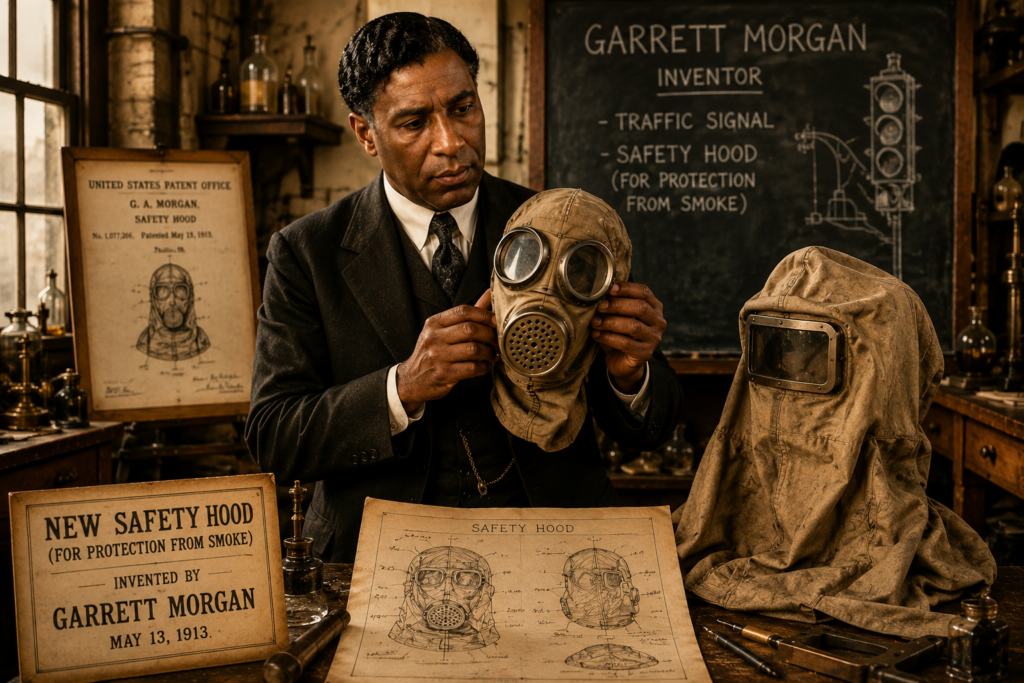
📖 Discover the History They Didn’t Teach If Garrett Morgan’s story inspired you, there’s an even deeper history waiting to be uncovered. The First World: Before Erasure explores ancient Black civilizations, forgotten kingdoms, pioneering innovators, and the rich global legacy that existed long before slavery. It’s a journey through history that challenges common narratives and highlights the achievements of Black people across the ancient world. Get your copy here: https://stan.store/blackdollarandculture/p/the-first-world-before-erasure Garrett Morgan was born in 1877 in Paris, Kentucky, only a little more than a decade after slavery ended in the United States. His parents had both been enslaved, and opportunities for Black Americans were extremely limited. Morgan received only an elementary education before leaving home as a teenager in search of a better future. Like many who dreamed of building something greater, he traveled north and eventually settled in Cleveland, Ohio, where he worked repairing sewing machines. Most people would have been satisfied earning a paycheck, but Garrett Morgan looked at every broken machine differently. He didn’t just see something that needed to be fixed—he saw an opportunity to understand how it worked and how it could be improved. As he repaired more machines, Morgan began making modifications that increased their efficiency. His reputation grew, and before long he owned his own repair business. Instead of depending on someone else to create opportunities for him, he created his own. That decision would become the foundation for everything that followed. Morgan understood something that many entrepreneurs still learn today: the more problems you solve, the more valuable you become. While experimenting with lubricants for sewing machines, Morgan accidentally discovered a formula that changed the texture of hair. Rather than dismissing the discovery, he turned it into a business. He founded the G. A. Morgan Hair Refining Company and began manufacturing and selling hair care products across the country. The company became highly successful, giving Morgan both financial independence and the capital to continue inventing. He wasn’t waiting for investors or government programs. He used one successful business to finance the next idea. Morgan constantly observed the world around him, looking for ways to make everyday life safer. During the early twentieth century, firefighters had little protection from smoke while battling fires. Once thick smoke filled a building, rescue workers often had only minutes before being overcome by toxic gases. Morgan believed there had to be a better way. After years of experimentation, he patented what became known as the Safety Hood in 1914. The device allowed its wearer to breathe cleaner air drawn from closer to the ground, where smoke was less concentrated. It was one of the earliest practical breathing devices and became the foundation for the modern gas mask used by firefighters, rescue teams, and eventually military personnel around the world. Just two years later, Morgan’s invention faced its greatest test. In 1916, an explosion rocked the Cleveland Waterworks Tunnel beneath Lake Erie. Toxic gas quickly filled the tunnel, trapping workers hundreds of feet below the surface. Several rescue attempts ended in tragedy as rescuers themselves collapsed from the poisonous air. Morgan arrived carrying his Safety Hood and entered the tunnel despite the extreme danger. Alongside his brother, he helped rescue trapped workers who otherwise may not have survived. Newspapers across the country reported on the dramatic rescue, although some initially failed to acknowledge that the man responsible was Black. Even in the face of discrimination, Morgan’s courage and invention could not be ignored. His device proved that innovation has the power to save lives regardless of who creates it. Morgan’s curiosity didn’t stop there. As automobiles became more common, city streets grew increasingly dangerous. One day, after witnessing a serious traffic accident at an intersection, he began thinking about how traffic could move more safely. At the time, traffic signals were simple and often confusing. Morgan designed a new three-position traffic signal that introduced a brief stop phase between traffic directions, allowing intersections to clear before vehicles continued moving. It was a simple idea with enormous consequences. In 1923, he patented the invention and later sold the rights for $40,000, a remarkable sum during that era. Although traffic lights have evolved with modern technology, the principle Morgan introduced remains part of traffic control systems used across the world today. Every time drivers safely pass through an intersection, they benefit from an idea that began with Garrett Morgan. Success never caused Morgan to forget his community. He invested in Black businesses, supported civic organizations, and used his platform to encourage economic progress. He believed inventions alone were not enough. Ownership mattered. Building businesses mattered. Creating jobs mattered. Passing opportunities to the next generation mattered. Long before conversations about generational wealth became popular, Garrett Morgan was living its principles by transforming knowledge into assets that could provide lasting value. His life reminds us that history is not only made by presidents, generals, and politicians. Sometimes history is shaped by an ordinary man who refuses to stop asking questions. Morgan wasn’t born wealthy. He didn’t have access to elite universities or unlimited resources. What he possessed was curiosity, persistence, and the willingness to solve problems that others overlooked. Those qualities turned him into one of America’s greatest inventors. Today, millions of people drive through intersections guided by traffic signals influenced by Morgan’s work. Firefighters and rescue personnel continue relying on breathing equipment inspired by his original Safety Hood. Countless lives have been protected because one inventor chose to improve the world instead of accepting it as it was. Garrett Morgan’s greatest invention may not have been a machine at all. It was the example he left behind. He proved that knowledge can become ownership, ownership can become wealth, and wealth can become a legacy that continues serving people long after we are gone. If we truly want to honor pioneers like Garrett Morgan, we shouldn’t stop at remembering their names. We should follow their example by learning valuable skills, solving meaningful problems, building businesses, and creating assets that our