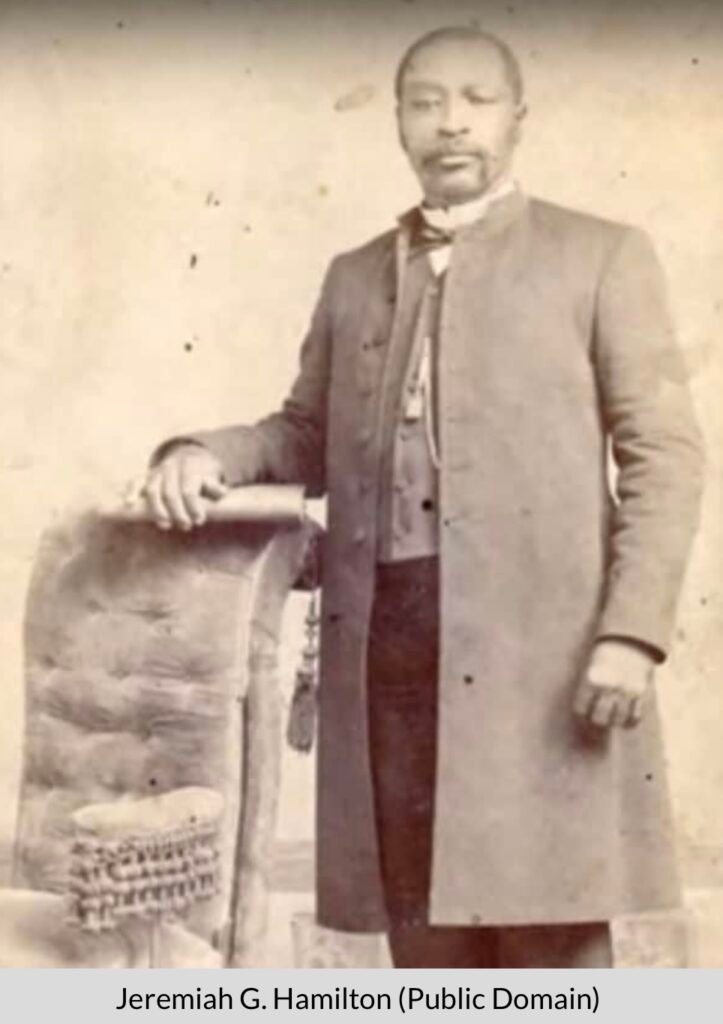
Jeremiah Hamilton: The Forgotten Black King of Wall Street
Long before Wall Street was a canyon of steel towers and billion-dollar firms, when lower Manhattan still smelled of seawater, coal smoke, and horse iron, a lone Black man walked its narrow, uneven streets with the confidence of someone who knew he didn’t belong there—yet refused to leave. His name was Jeremiah Hamilton, and during the mid-1800s, in the era of slavery, segregation, and violent racism, he did what no one believed possible: he became New York’s first Black millionaire, dominating a financial system that was never meant to include him. His story isn’t just rare.It is revolutionary.And it was nearly erased. Hamilton didn’t inherit generational wealth. He wasn’t protected by a powerful white family or backed by elite institutions. He built his empire inside a society structured to crush Black ambition at its roots. He played a game where the rules were written by his enemies—and still beat them at it. Even those who hated him confessed he was brilliant, fearless, calculating, and dangerous in the way only a man breaking racial boundaries can be. Born around 1806 in the Caribbean, Hamilton arrived in New York as a teenager. The city at the time was a paradox: a booming economic hub powered by global trade, yet still deeply entangled in slavery. Free Black people existed in a fragile, uncertain space—free, but not equal; present, but unwelcome. It was here that Hamilton carved out his identity. While most Black people were trapped in labor jobs or shut out of opportunities altogether, Hamilton pushed himself into commerce, international trade, and high-level negotiation—worlds dominated exclusively by wealthy white men. By his mid-20s, Hamilton had already developed a reputation for extraordinary intelligence and unbreakable nerve. Newspapers described him as “bold,” “audacious,” “daring,” and “dangerous.” These weren’t compliments—they were warnings. In a society where Black obedience was expected, Hamilton’s sharp mind and refusal to be intimidated were viewed as threats. His early rise came through an operation involving counterfeit coins, insurance loopholes, and trade violations. If a white merchant had done it, it would’ve been called “creative business tactics.” But Hamilton, as a Black man with ambition, was hunted. He was chased by mobs, nearly murdered, and forced to flee. Most men would have disappeared into the shadows. Hamilton came back stronger. When he returned to New York, he didn’t hide or play small. He stepped further into the belly of New York’s financial system—Wall Street—a place where no one wanted him and almost everyone wished he dead. Instead of breaking under the pressure, he studied the system, mastered it, and began beating men at their own game. He became so strategic, so calculating, that many wealthy businessmen had no choice but to partner with him or be destroyed by him. By the 1830s, Jeremiah Hamilton was a giant in the world of real estate speculation. He bought distressed properties, underwater mortgages, and land in neighborhoods where Black ownership was unheard of. He purchased parcels in Manhattan, Harlem, modern-day Tribeca, and beyond. He played chess while the city played checkers. Then came the Great Fire of 1835, one of the most devastating disasters in New York history. Flames consumed warehouses, docks, businesses, and some of the wealthiest commercial blocks in the country. While most businessmen wept over their losses, Hamilton saw opportunity. He used his cash reserves to buy fire-damaged properties at a fraction of their value. He loaned money at high interest to desperate merchants. He rebuilt, resold, and reinvested while the city was still smoking. That fire made him a multimillionaire in today’s money. By the 1840s, Hamilton controlled a financial network that stretched across real estate, insurance, trading, and lending. White elites despised him because they couldn’t control him. They couldn’t intimidate him. They couldn’t outsmart him. Newspapers, angry traders, and political enemies gave him the name meant to be an insult: “The Black Napoleon of Wall Street.” But the title exposed something else:Jeremiah Hamilton wasn’t just a wealthy Black man.He was a powerful one. Hamilton intimidated men who had never feared a Black person in their lives. He sued white businessmen and won. He walked into boardrooms where no Black person had ever stepped and left with deals sealed. He overcame racist laws, exclusionary banks, corrupt officials, and violent mobs—and still built an empire. Even his personal life defied the era’s norms. Hamilton lived in a wealthy white neighborhood, married a white woman, and raised mixed-race children during a time when interracial marriage was not only taboo, but often illegal. He owned a large mansion in New Jersey, complete with servants, groundskeepers, and luxuries unheard of for Black Americans at that time. Every day of his life was an act of rebellion. And yet, Hamilton was not someone who sought community approval. He didn’t involve himself in Black organizations, abolitionist circles, or social movements. Some say he avoided them because association made him a bigger target. Others say he didn’t trust the Black elite—he saw how quickly they distanced themselves from controversy, and Hamilton thrived in chaos. He chose to survive alone, on his own terms, in a world determined to destroy him. When he died in 1875, his estate was worth millions in today’s dollars. He left behind land, buildings, securities, and financial records that showed just how deep he’d carved his influence into New York’s economic landscape. Yet not a single Black newspaper published an obituary. Not a single major Black historian of the era claimed him. White newspapers only mentioned him to mock him or erase his accomplishments. His story faded from textbooks, archives, and public memory. For over a century, Jeremiah Hamilton became a ghost. But today, he rises again. Hamilton’s legacy is powerful not only because he was wealthy, but because of how he became wealthy—through intelligence, courage, and relentless determination in the face of racism so violent it’s hard to imagine today. His life proves that Black brilliance has always existed at the highest level of American finance, even when the world pretended