4 Ways to Pay Yourself First (And Build Real Wealth Before Bills Touch Your Money)

Most people get paid… and immediately start paying everyone else. Rent.Car note.Subscriptions.Debt. By the time they look up—there’s nothing left. That’s not an accident. That’s a system designed to keep you circulating money… instead of keeping it. Wealthy individuals don’t operate like that. They follow one simple rule: Pay yourself first. Before the world gets a dollar—you do. Here are 4 powerful ways to start doing that immediately. 1. Automatic Wealth Transfer (Before You See the Money) The easiest way to build wealth… is to remove emotion from the process. Set up an automatic transfer from your checking account to: The key is simple:You should never even see the money you’re saving. Because if you see it… you’ll spend it. Start with: This turns saving into a system—not a decision. 2. Pay Your Future Self Through Investments Saving money is good. But investing is what builds real wealth. Every time you get paid, allocate a portion to: This is how you move from:Working for money → Money working for you Even small amounts compound. Consistency beats intensity. 3. Build Your Family Bank First Most families:Go to the bank when they need money. Wealthy families:Are the bank. Instead of sending interest to outside institutions… You can: That means:Car loans, emergencies, business funding… All stay inside the family ecosystem. This is how wealth stops leaking. 4. Eliminate “Leftover Thinking” Most people save what’s left. Wealth builders invest first… and live on the rest. That mindset shift alone changes everything. Instead of saying:“I’ll save what I don’t spend…” Say:“I’ll spend what’s left after I build wealth.” That forces: The Real Shift Paying yourself first isn’t just about money. It’s about control. Control over: Because if you don’t prioritize yourself… The system will always prioritize itself. 💡 Final Thought You don’t build wealth by working harder. You build wealth by keeping more of what you earn—and putting it to work. 🚀 Call to Action If you’re serious about building something that lasts beyond you… 👉 Start your own financial system with my book:The Family Bank Starter Systemhttps://stan.store/blackdollarandculture/p/the-family-bank-starter-system 👉 And take it even further with asset protection and generational wealth strategy:Get Your Family Wealth Trust Blueprint Now – ILIThttps://stan.store/blackdollarandculture/p/get-your-family-wealth-trust-blueprint-now Focus Keyphrase Pay Yourself First Wealth Strategy Slug pay-yourself-first-wealth-strategy Meta Description Learn 4 powerful ways to pay yourself first and build real wealth before bills take your money. Discover strategies used by wealthy individuals to grow financial freedom.
The Black Inventor Who Created Dry Cleaning

Before dry cleaners existed on every corner of America… there was a Black tailor experimenting with stained fabric by candlelight. His name was Thomas Jennings. In the early 1800s, Jennings operated a tailoring business in New York City. His customers often brought him expensive coats, dresses, and garments made from delicate fabrics like wool and silk. But there was a problem. Once those clothes became stained, washing them with water often ruined the fabric. The garments would shrink, fade, or lose their shape. For many tailors, that would have been the end of the story. But Jennings refused to accept the problem as permanent. Late at night, after finishing his work for the day, he began experimenting with different cleaning techniques. He tested combinations of solutions, fabrics, and methods, trying to find a way to remove stains without damaging the clothing. After years of trial and error, he finally developed a process he called “dry scouring.” Instead of soaking clothes in water, his method used special cleaning agents that removed dirt and grease while protecting the fabric. It was revolutionary. In 1821, Thomas Jennings received a U.S. patent for his invention, becoming the first Black American in history to hold a patent in the United States. At a time when many Black Americans were still enslaved and denied basic rights, Jennings had legally secured ownership of his invention. His discovery laid the foundation for what we now know today as modern dry cleaning — an industry that exists in nearly every city around the world. But Jennings didn’t just build a successful business. He used the money from his invention to support the abolitionist movement, helping fund efforts that fought against slavery and pushed for freedom and civil rights. His success became more than personal wealth. It became a tool for progress and liberation. Thomas Jennings proved something powerful long before the modern era: Black innovation didn’t begin yesterday. Black entrepreneurship didn’t begin yesterday. Black excellence has always existed — even in the face of laws and systems designed to hold it back. His story is a reminder that many of the everyday things we use today were built on the ideas, courage, and determination of people whose names were rarely taught in school. And Thomas Jennings is one of those names. Call To Action Most people were never taught stories like this. Not in school.Not in textbooks.Not in the mainstream narrative. But the truth is… Black history is filled with inventors, innovators, and civilizations that shaped the modern world. If you want to explore more of these powerful stories, dive deeper with these two books from Black Dollar & Culture. 📚 Black BrillianceDiscover powerful stories of Black inventors, innovators, and pioneers who changed the course of history. 👉 https://stan.store/blackdollarandculture/p/get-my-black-brilliance-ebook-now 🌍 The First World: Before ErasureA deep exploration into ancient civilizations and global history that existed long before colonization rewrote the narrative. 👉 https://stan.store/blackdollarandculture/p/the-first-world-before-erasure Because when we understand the truth about our past… we unlock the power to build a stronger future. ✊🏾 Focus Keyphrase Thomas Jennings dry cleaning inventor Slug thomas-jennings-dry-cleaning-inventor Meta Description Thomas Jennings became the first Black American to receive a U.S. patent in 1821 after inventing the dry-cleaning process known as dry scouring. Discover the powerful story behind the invention that transformed clothing care.
How to Build Wealth Once You Hit 40

(Black Dollar & Culture Wealth Series) For many people, turning 40 feels like a financial wake-up call. You start realizing retirement isn’t some distant idea anymore. Kids may be getting older. Your career might be established — or you might feel like time is moving faster than expected. But here’s the truth most financial institutions never tell people: Your 40s can be one of the most powerful wealth-building decades of your life. Why? Because by this stage you likely have more income, more experience, and better decision-making ability than you did in your 20s. The key is shifting from earning money to building systems that produce wealth. Let’s break down the moves that matter most. 7 Wealth Moves You Must Make After Age 40 1. Maximize Your Retirement Accounts Your 40s are the time to aggressively fund retirement accounts. The power of compounding is still working in your favor, but you no longer have time to be passive. Focus on: • 401(k) contributions (especially if your employer offers a match)• Roth IRA or Traditional IRA• SEP IRA or Solo 401(k) if you’re self-employed Many wealthy individuals increase their contributions significantly in their 40s to make up for earlier years. Even an extra $500 per month invested for 20 years can grow into six figures. 2. Eliminate High-Interest Debt One of the biggest wealth killers after 40 is consumer debt. Credit cards charging 18%–30% interest quietly drain your future wealth. Every dollar spent on interest is a dollar not invested in assets. Focus on eliminating: • Credit card balances• Personal loans• High-interest car loans The goal is simple: Free up cash flow so your money can start working for you. 3. Invest Consistently in Assets Wealth is not built from income alone. It is built through ownership. By 40, your financial focus should shift toward accumulating assets like: • Dividend stocks• Index funds (S&P 500, ETFs)• Real estate• Private businesses• Ownership in companies Historically, the S&P 500 has averaged about 10% annually over the long term. Consistent investing over the next 20–25 years can transform your financial future. 4. Build a Family Bank System One strategy wealthy families have used for generations is circulating money within the family instead of constantly borrowing from banks. Instead of relying on outside lenders for every financial need, families can pool resources and create their own internal lending system. This allows families to: • Finance businesses• Help relatives purchase homes• Fund education• Keep interest circulating inside the family Learning how to structure this correctly can dramatically change how wealth flows through generations. 👉 Learn how to build your own system here:https://stan.store/blackdollarandculture/p/the-family-bank-starter-system 5. Protect Your Wealth With Proper Structures Building wealth is only half the equation. The other half is protecting it from taxes, lawsuits, and probate. Many wealthy families use legal structures such as trusts and insurance strategies to protect their assets. One powerful strategy is the Irrevocable Life Insurance Trust (ILIT), which allows families to transfer wealth to the next generation while reducing estate taxes and protecting assets. 👉 Learn how wealthy families use this strategy:https://stan.store/blackdollarandculture/p/get-your-family-wealth-trust-blueprint-now Support Independent Black Media ❤️ Support Independent Black Media Black Dollar & Culture is 100% reader-powered — no corporate sponsors, just truth, history, and the pursuit of generational wealth. Every article you read helps keep these stories alive — stories they tried to erase and lessons they never wanted us to learn. 6. Increase Your Income Streams By 40, relying on a single income source becomes risky. Many wealthy individuals focus on building multiple streams of income, such as: • Dividend income• Rental properties• Online businesses• Digital products• Consulting or coaching Even building two or three additional income streams can create financial security that a job alone cannot provide. 7. Start Thinking Generationally True wealth isn’t just about your retirement. It’s about what happens after you’re gone. At this stage in life, it’s important to start thinking about: • Estate planning• Teaching financial literacy to your children• Passing down assets instead of liabilities The goal is not simply to retire comfortably. The goal is to build something that lasts beyond your lifetime. Final Thoughts Your 40s are not too late. In fact, many successful entrepreneurs, investors, and business owners didn’t hit their financial stride until their 40s or even 50s. What matters now is intentional action. Reduce debt. Increase investments. Build ownership. Create systems that allow money to grow whether you’re working or not. Because the real goal isn’t just making money. It’s building a legacy. #BlackDollarCulture #GenerationalWealth #BlackWealth #FamilyBank #FinancialFreedom #WealthBuilding #InvestingForBeginners #OwnershipEconomy #BlackEntrepreneurs #BuildWealth Focus Keyphrase: How to Build Wealth Once You Hit 40 Slug: build-wealth-after-40 Meta Description:Learn how to build wealth after 40 with proven strategies including investing, eliminating debt, building a family bank system, and protecting assets for generational wealth.
How to Stop Living Paycheck to Paycheck

For millions of people, life follows the same exhausting cycle. Work.Wait for payday.Pay bills.Start over again. Two weeks later… the cycle repeats. For many families, especially in historically marginalized communities, this pattern didn’t start because of poor financial decisions. It started because wealth-building opportunities were limited for generations. Policies like redlining, employment discrimination, and unequal access to capital meant many families had to rely almost entirely on wages rather than ownership. And wages alone rarely build wealth. They build survival. Breaking the paycheck-to-paycheck cycle requires more than budgeting. It requires a shift in how money is viewed and used. Not just earning money. Directing where it flows. Because money behaves like water. If you don’t guide it intentionally, it will always flow somewhere else — usually into someone else’s pocket. The First Step: Understand the Real Problem Many people assume living paycheck to paycheck is simply caused by low income. Sometimes that’s true. But often the deeper issue is lack of ownership. When your entire financial life depends on a job, every expense becomes a risk. Rent.Car payments.Utilities.Groceries.Insurance. If the paycheck stops, everything becomes unstable. That’s because most people operate with only one financial engine — their labor. But wealth builders rely on multiple financial engines. The Second Step: Shift From Income to Cash Flow Employees are taught to focus on income. Owners focus on cash flow. Income requires time. Cash flow continues even when you’re not actively working. Examples of cash-flow assets include: • Dividend-paying stocks• Rental real estate• Businesses• Royalties from books or digital products• Ownership in companies When assets produce income, financial pressure begins to decrease. Instead of trading hours for money forever, money begins working on your behalf. The Third Step: Eliminate Financial Leakage One of the biggest hidden reasons people stay stuck financially is money leakage. These are small but constant expenses that quietly drain income. Examples include: • High-interest credit cards• Large car payments• Frequent convenience spending• Subscription services rarely used• Lifestyle purchases that produce no return Individually these expenses may seem harmless. But together they can consume thousands of dollars each year. Money that could have been used to build assets. The goal isn’t to remove joy from life. The goal is to make sure your money builds something before it disappears. The Fourth Step: Pay Yourself First Most households follow the same pattern. They pay everyone else first. The landlord.The bank.Credit card companies.Utility companies.Subscription services. By the time they think about saving or investing, the paycheck is already gone. Wealth builders reverse this order. They allocate money toward assets before anything else. Even if it starts small. Consistency matters more than size. Over time, those consistent investments compound into powerful financial growth. The Fifth Step: Build Internal Financial Systems Traditional banks make billions every year from interest payments. Every time a family borrows money, wealth flows out of that household and into the financial system. But some families operate differently. Instead of constantly borrowing from banks, they create internal lending systems within the family. Money circulates between relatives for: • Starting businesses• Purchasing homes• Funding education• Emergency needs• Investments Interest stays within the family rather than leaving it. This concept is known as family banking, and many wealthy families have quietly used versions of this strategy for generations. The Real Goal: Ownership Escaping the paycheck-to-paycheck cycle is not just about controlling spending. It is about building ownership. Ownership of businesses. Ownership of investments. Ownership of assets that generate income. Once assets begin producing money, something powerful happens. Bills are no longer paid only through labor. They begin to be paid through ownership income. And that is when financial stress finally begins to fade. Because your money is working for you. Not the other way around. Build Real Generational Wealth If you’re serious about breaking financial cycles and building lasting wealth for your family, these two resources can help you take the next step. The Family Bank Starter SystemLearn how families create their own internal banking system to keep money circulating inside the household instead of flowing to traditional banks.👉 https://stan.store/blackdollarandculture/p/the-family-bank-starter-system Family Wealth Trust Blueprint (ILIT Guide)Discover how wealthy families protect and transfer wealth using life insurance trusts and strategic estate planning.👉 https://stan.store/blackdollarandculture/p/get-your-family-wealth-trust-blueprint-now ❤️ Support Independent Black Media Black Dollar & Culture is 100% reader-powered — no corporate sponsors, just truth, history, and the pursuit of generational wealth. Every article you read helps keep these stories alive — stories they tried to erase and lessons they never wanted us to learn. FAQ Why do so many people live paycheck to paycheck?Many households depend on wages as their only income source while expenses continue rising. What is the fastest way to escape the paycheck-to-paycheck cycle?Increasing income while simultaneously investing in assets and reducing financial leakage. What is the biggest difference between wealthy families and struggling families?Wealthy families prioritize ownership and asset accumulation, while most households rely primarily on wages. #BlackDollarCulture #BlackWealth #GroupEconomics #FinancialLiteracy #GenerationalWealth #FamilyBank #OwnershipEconomy #WealthBuilding #EconomicEmpowerment #BlackFinance Focus Keyphrase: stop living paycheck to paycheckSlug: stop-living-paycheck-to-paycheckMeta Description: Learn how to stop living paycheck to paycheck by shifting from wage dependence to asset ownership, family banking strategies, and long-term wealth building.
7 Wealth Moves You Must Make After Age 30

Turning thirty is more than just a birthday milestone. For many people, it is the moment when financial reality becomes clear. Your twenties are often spent experimenting with careers, learning hard money lessons, and figuring out how the financial system actually works. But your thirties are different. This is the decade where wealth either begins to build… or the opportunity slowly slips away. The good news is that thirty is still early enough to let compound growth do most of the heavy lifting. Here are the wealth moves that matter most. 1. Shift From Income Thinking To Ownership Thinking • Most people spend their entire lives focused on earning income.• Wealthy people focus on owning assets that generate income.• The goal is to own things that continue producing money whether you work or not. Examples of ownership assets include: • Stocks• Businesses• Real estate• Intellectual property• Digital products Income pays bills. Ownership builds wealth. 2. Begin Investing Immediately • Time is the most powerful force in wealth creation.• Even small investments grow dramatically over decades.• Starting at age 30 gives compound interest enough time to work. Example: • $500 invested monthly with an average 8% return could grow to over $700,000 by age 60. Consistency matters more than trying to perfectly time the market. 3. Build Multiple Income Streams • One source of income is risky.• Wealthy individuals often have three to seven income streams. Examples include: • Salary or primary business• Dividend investments• Rental properties• Online content or media• Digital products and books Each additional income stream strengthens financial stability. 4. Avoid Lifestyle Inflation • One of the biggest wealth killers is lifestyle creep.• As income increases, spending often increases with it. Instead: • Increase investments before increasing lifestyle.• Maintain discipline as income grows. A useful rule is to invest 20–30 percent of all earnings. 5. Study Financial Systems • Wealthy individuals spend time understanding money itself.• Learning how financial systems operate can dramatically increase long-term wealth. Important topics include: • Investing strategies• Tax structures• Business ownership• Credit and leverage• Insurance and asset protection Financial education multiplies earning power. 6. Build Scalable Assets • Time is limited.• Assets that scale allow income to grow without equal increases in effort. Examples of scalable assets include: • Books and ebooks• Online courses• Software or apps• Blogs and media platforms• Intellectual property These assets can continue generating revenue long after they are created. 7. Think In Generations, Not Years • Wealth is rarely built quickly.• Most fortunes are built over 10–20 year cycles. A common pattern looks like this: • Age 30–40: Asset building• Age 40–50: Asset growth• Age 50–60: Financial independence Patience and discipline often outperform fast money strategies. Final Thought Throughout history, the families that built lasting wealth did not rely solely on income. They focused on ownership, invested consistently, and built systems that allowed money to circulate within their families. Your thirties represent the beginning of that opportunity. The earlier the shift from earning money to owning assets begins, the more powerful the results can become. Hashtags #BlackDollarCulture #GenerationalWealth #BlackWealth #FamilyBank #OwnershipEconomy #FinancialFreedom #BlackOwnership #EconomicEmpowerment #BuildTheBlock #LegacyBuilding Focus Keyphrase building wealth in your 30s Slug building-wealth-in-your-30s Meta Description Discover the most important wealth strategies to start in your 30s, including investing, ownership, and building multiple income streams for long-term financial freedom.
Joseph Bologne, Chevalier de Saint-Georges: The Revolutionary Virtuoso Europe Tried to Erase

In 1745, on the Caribbean island of Guadeloupe, a child was born into contradiction. His father was a wealthy French plantation owner. His mother, Nanon, was an enslaved African woman. The child’s name was Joseph Bologne. History would later know him as the Chevalier de Saint-Georges. From the beginning, his existence challenged the rigid hierarchies of the 18th century. He was taken to France as a boy and raised within elite circles. At a time when most men of African descent were denied status, education, and recognition, Joseph was trained like nobility. He studied literature. He studied music. And he trained in fencing with a discipline that bordered on obsession. By his teenage years, he had become one of the finest swordsmen in Europe. Crowds gathered to watch him duel. Newspapers praised his speed, his elegance, his precision. He defeated seasoned masters. His skill was so extraordinary that it forced even the prejudiced to acknowledge him. Steel could not be debated. Skill could not be denied. But the blade was only one part of his genius. Music was where he transcended. Joseph Bologne became a master violinist, not merely competent, not merely talented, but exceptional. He performed across France. He composed symphonies and violin concertos that displayed complexity, innovation, and emotional depth. He directed orchestras with authority and grace. He was not an outsider peering into Europe’s cultural elite. He was inside it. Paris embraced him — cautiously at first, then enthusiastically. He led one of the most prestigious orchestras in Europe, Le Concert des Amateurs. His compositions rivaled the most celebrated works of the era. His presence in royal circles was undeniable. And yet, even at the height of his brilliance, the boundaries of race lingered. When he was considered for a directorship at the Paris Opéra, several prominent singers petitioned the queen. They refused to be directed by a man of mixed heritage. Talent was not enough to shield him from prejudice. But Joseph did not retreat. Then the French Revolution erupted. While many artists remained safely within salons and theaters, Joseph stepped onto the battlefield. He became a colonel and led one of the first all-Black regiments in European history — the Légion Saint-Georges. These soldiers fought for revolutionary ideals of liberty and equality in a nation still struggling to practice both. He carried a sword not for sport now, but for principle. Yet revolutions are rarely clean. Political chaos consumed France. Joseph himself was imprisoned during the Reign of Terror, despite his service. Suspicion was indiscriminate. Loyalty meant little in an age of paranoia. He survived. But after his death in 1799, something quieter happened. Silence. His compositions gradually disappeared from concert halls. His name faded from textbooks. His legacy, once undeniable, was minimized. Europe remembered many of its great composers — but not him. History did not erase him in one dramatic act. It simply neglected him. And neglect can be just as powerful. For generations, his music gathered dust. His story was reduced to footnotes. His existence complicated the narrative many preferred — that genius in classical Europe had a singular image. But truth has endurance. In recent decades, historians and musicians have revived his work. His symphonies are performed again. Scholars study his life not as novelty, but as significance. Films and biographies have brought his name back into public consciousness. Joseph Bologne was not a side character in someone else’s era. He was a master fencer.A virtuoso violinist.A respected composer.A military colonel.A revolutionary. He embodied excellence in spaces that were not designed for him to thrive. And perhaps that is why his story matters so deeply now. Because legacy is not always destroyed by force. Sometimes it is buried by omission. Joseph Bologne, Chevalier de Saint-Georges, does not need comparison to stand tall. He stands on his own — blade in one hand, violin in the other — a reminder that brilliance has never been confined to the boundaries history tried to draw. He was not ahead of his time. He was greater than the limits placed upon it. ❤️ Support Independent Black Media Black Dollar & Culture is 100% reader-powered — no corporate sponsors, just truth, history, and the pursuit of generational wealth. Every article you read helps keep these stories alive — stories they tried to erase and lessons they never wanted us to learn. Focus Keyphrase Joseph Bologne Chevalier de Saint-Georges Meta Description Explore the extraordinary life of Joseph Bologne, Chevalier de Saint-Georges — master violinist, elite fencer, and revolutionary colonel whose brilliance in 18th-century France was nearly erased from history. Slug joseph-bologne-chevalier-de-saint-georges-revolutionary-virtuoso
What the Supreme Court’s Tariff Decision Means for Your Money

When the Supreme Court of the United States ruled against key tariffs put in place during the administration of Donald Trump, it wasn’t just political news. It was economic news. And whether you realize it or not — decisions like this directly affect: • Your grocery bill• The price of electronics• Small business profit margins• The stock market• Your investment portfolio Let’s break this down clearly. First: What Are Tariffs? A tariff is essentially a tax placed on imported goods. When tariffs go up: When tariffs are reduced or invalidated: This Supreme Court decision signals a shift in how trade policy may be handled going forward. What This Means for Consumer Prices In theory: If tariffs are removed → imported goods become cheaper → retail prices can ease. But here’s the reality: Prices don’t drop overnight. Retailers may: So while this could relieve pressure on inflation, don’t expect instant price cuts. What This Means for Small Businesses This is where it gets serious. Small businesses that rely on: Could see cost relief. For example:If you run an apparel brand (like many Shopify businesses), lower import duties = better profit margins. But… Domestic manufacturers who benefited from protectionist tariffs may face more competition now. What This Means for the Stock Market Markets hate uncertainty — but they love clarity. If trade tensions cool: Watch sectors like: This could be a quiet shift that investors pay attention to before the headlines catch up. What This Means for Investors If you’re investing: Pay attention to: Lower trade friction can improve earnings. But remember — markets move on expectations, not just policy. The Bigger Question Who controls trade power in America? The executive branch?Or the courts? This ruling reminds everyone that economic power isn’t unlimited — and the balance of power can directly affect markets. That’s why ownership matters. When you understand policy, you understand positioning. Final Thought Tariffs are political.But money is practical. Instead of reacting emotionally to headlines, smart investors ask: • Who benefits?• Who loses?• Where is capital flowing next? That’s how you stay ahead. Focus Keyphrase Supreme Court tariff decision impact on prices and small business Meta Description The Supreme Court invalidated most Trump-era tariffs. Here’s what the ruling means for consumer prices, small businesses, investors, and the stock market. Slug supreme-court-tariff-decision-impact-on-prices-and-small-business
How to Think Like a Wealthy Person (Even Before You Have Money)

Most people think wealth starts in the bank account. It doesn’t. It starts in the mind. Before the portfolio.Before the business.Before the real estate. Wealth begins with a shift in how you see the world — and more importantly, how you see yourself inside it. Because poor thinking chases money. Wealthy thinking builds systems. And the difference between the two determines everything. 1. Wealthy People Think in Ownership, Not Income The average person asks: “How can I make more money?” The wealthy person asks: “How can I own something that makes money without me?” That shift alone separates employees from empires. A job is income.A system is leverage.Ownership is power. Look at figures like Warren Buffett. He didn’t become wealthy because of a salary. He became wealthy because he owned pieces of businesses. Ownership compounds.Income disappears. If you want to think wealthy, start asking daily: 2. Wealthy Thinking Is Long-Term Thinking Poor mindset: “I need it now.”Wealth mindset: “Where will this put me in 15 years?” Wealthy people think in decades, not days. They understand: They don’t panic when the economy dips.They position themselves. That’s why during downturns, some people lose everything — while others quietly accumulate. Patience is a wealth strategy. 3. Wealthy People Control Emotion Emotion is expensive. Impulse buying.Panic selling.Flexing to impress.Spending to feel validated. Wealthy people detach emotion from money decisions. They ask: Discipline beats hype. Every time. 4. They See Assets Where Others See Objects The average person sees: A wealthy thinker sees: It’s not about what something is. It’s about what something can produce. That’s the Family Bank mindset. Turn consumption into creation.Turn access into ownership.Turn platforms into pipelines. 5. Wealthy People Move Quietly Real wealth is quiet. It doesn’t scream.It doesn’t compete.It doesn’t explain itself. It studies.It accumulates.It protects. While some chase attention, others build infrastructure. That quiet separation is uncomfortable — but it’s necessary. Growth requires separation. 6. They Think in Systems, Not Hustles Hustle burns out. Systems scale. A wealthy thinker asks: Subscription businesses.Automated investing.Digital products.Trust structures.Content libraries. Build once.Collect repeatedly. That’s the difference between working hard and working strategically. 7. They Protect Capital Aggressively Building wealth is only half the game. Keeping it is the real discipline. Wealthy thinkers care about: They understand money must be defended. Capital is oxygen. Without it, nothing else matters. The Core Shift To think like a wealthy person, ask yourself daily: This isn’t about pretending to be rich. It’s about training your brain to operate at a higher level. Wealth is not an amount. It’s a perspective. And once your thinking shifts — your strategy follows. Then your behavior. Then your outcomes. ❤️ Support Independent Black Media Black Dollar & Culture is 100% reader-powered — no corporate sponsors, just truth, history, and the pursuit of generational wealth. Every article you read helps keep these stories alive — stories they tried to erase and lessons they never wanted us to learn. In a world drowning in debt, distraction, and dependence, wealthy thinking is an act of rebellion. Ownership is power. Discipline is protection. Systems are freedom. If this shifted your mindset, share it with someone building in silence — and step deeper into the BD&C movement. Focus Keyphrase: How to think like a wealthy personSlug: how-to-think-like-a-wealthy-personMeta Description: Learn how to think like a wealthy person by shifting from income to ownership, building systems, controlling emotion, and focusing on long-term asset growth.
Why So Many People Feel Financially Stuck (And Don’t Know Why)
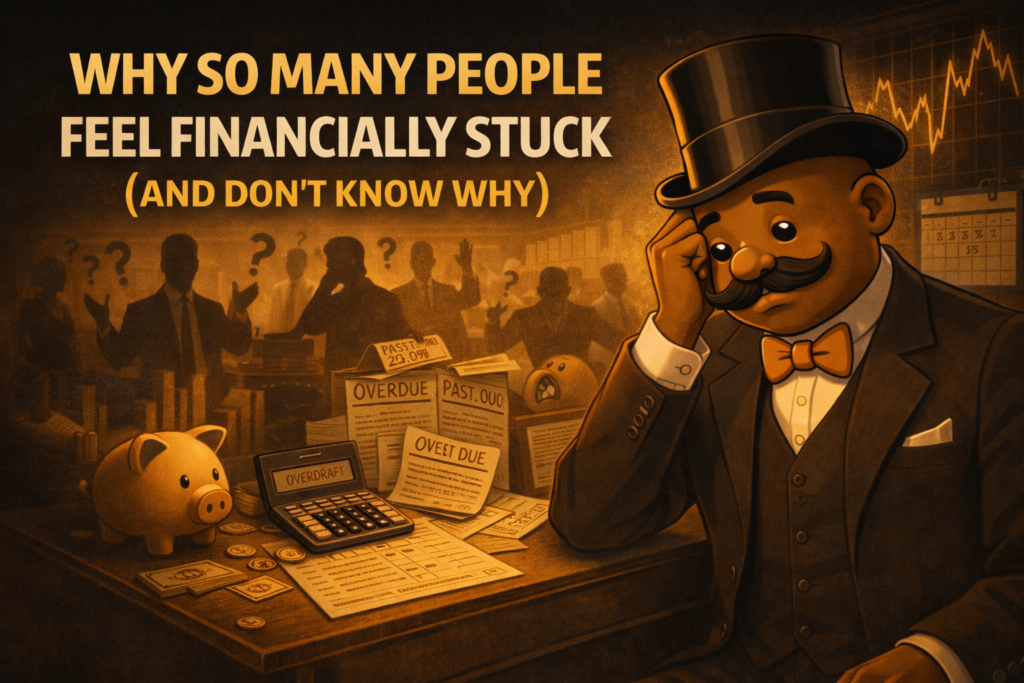
There’s a quiet frustration millions of people carry. You work.You earn.You pay bills.You repeat. And yet… nothing moves. No real wealth.No real leverage.No real freedom. You’re not lazy.You’re not irresponsible. You’re stuck inside a design you were never taught to question. Let’s break it down. 1. You Were Trained For Income — Not Ownership School teaches: Nobody teaches: Income feeds survival. Ownership builds freedom. If your money stops when you stop working, you’re in survival mode — even if your salary looks good. That gap is why many feel stuck. 2. Your Expenses Rise With Your Identity You don’t upgrade your wealth. You upgrade your lifestyle. Every raise becomes a new bill. So even when income increases, freedom doesn’t. That creates the illusion of progress — without actual progress. 3. You Were Never Shown How Money Actually Works Most people think wealth comes from: Wealth actually comes from: Nobody explained the difference between:Income vs AssetsCash flow vs Net worthConsumption vs Investment So people grind harder… inside the same cage. 4. You’re Surrounded By Other People in Survival Mode Environment shapes expectations. If everyone around you: Then “normal” becomes limitation. Growth requires separation. Not arrogance — alignment. 5. You Confuse Activity With Progress Being busy feels productive. But: If you’re building someone else’s system 40+ hours a week and not building your own at all… the math will always keep you stuck. 6. You Don’t Have a Wealth System — Only a Budget A budget controls spending. A wealth system multiplies money. Do you have: If not, you’re relying on hope. Hope doesn’t compound. Systems do. 7. You Think Freedom Requires Millions This one is psychological. People think:“I need to be rich to feel free.” No. You need: Optionality is power. Even modest leverage reduces that trapped feeling. 8. You’re Playing Defense — Not Offense Most people focus on: Wealth builders focus on: Different game. Different outcome. The Real Reason You Feel Stuck You were taught how to survive inside the system. You were never taught how to build above it. That tension — between effort and lack of ownership — creates the trapped feeling. And the scary part? Many people don’t even realize that’s what they’re experiencing. They think it’s inflation. Or bad luck. Or the economy. Sometimes it is. But most of the time? It’s structure. The Shift If you feel financially stuck, start here: You don’t escape financially by working harder. You escape by owning differently. Because the goal isn’t to look rich. It’s to stay free. ❤️ Support Independent Black Media Black Dollar & Culture is 100% reader-powered — no corporate sponsors, just truth, history, and the pursuit of generational wealth. Every article you read helps keep these lessons alive — lessons they never built the system to teach. Focus Keyphrase: Why So Many People Feel Financially StuckSlug: why-so-many-people-feel-financially-stuckMeta Description: Discover the real reasons why so many people feel financially stuck. Learn how income, lifestyle creep, and lack of ownership keep people trapped — and how to break free with a wealth system.
How to Start an Emergency Fund (Beginner Guide)

Most people don’t fall into financial trouble because they’re reckless.They fall because life happens. A tire blows out on the highway.Hours get cut at work.A child gets sick.Rent goes up.The car refuses to start on Monday morning. And suddenly a small inconvenience becomes a financial emergency. Here’s the truth many households discover too late: The problem isn’t the emergency.The problem is being unprepared for it. That’s where an emergency fund changes everything. It turns panic into inconvenience.It turns stress into strategy.It gives you breathing room while everyone else is gasping for air. Let’s build yours step by step. What Is An Emergency Fund? An emergency fund is money set aside ONLY for unexpected, necessary expenses. Not vacations.Not shoes.Not a concert. We’re talking about: If it’s not urgent and unexpected, it doesn’t qualify. This money is your financial shock absorber. Why Beginners Must Start Here First Before investing.Before flipping houses.Before crypto.Before options. You need stability. Without a cushion, every surprise gets put on a credit card…and debt quietly becomes the thief of your future wealth. An emergency fund protects your:✔ Credit score✔ Investments✔ Peace of mind✔ Ability to make calm decisions No drama. No desperation. Step 1: Your First Goal → $1,000 Forget six months of expenses for now. Your first mission is simple:stack your first $1,000 as fast as possible. Why? Because most small emergencies fall under that number. And once you hit it, something powerful happens… You start moving different.You feel in control.You breathe easier. Confidence is built through wins. Step 2: Where Should You Keep It? Your emergency money should be: ✅ Safe✅ Easy to access✅ Separate from daily spending Good places include: Not under the mattress.Not invested in stocks.Not tied up where it can lose value. This is protection money, not growth money. Step 3: How Much Do You Eventually Need? After you reach $1,000, level up to: 👉 3–6 months of living expenses. If your monthly bills are $3,000, your target becomes: This is the number that protects families from layoffs, illness, or major life disruptions. Step 4: How To Build It Faster Most people think they can’t save. But usually, money is leaking quietly. Try this: Speed matters. The faster you build it, the faster stress leaves your life. Step 5: Automate Your Discipline Willpower fades. Systems win. Set up automatic transfers every payday — even if it’s only $25 or $50. You’re not trying to be impressive.You’re trying to be protected. Small deposits create big security over time. What Happens When You Finally Have One Something amazing changes. You stop fearing the mail.You stop dreading unknown numbers calling.You stop living on edge. You gain power. Because emergencies no longer control you. You control them. The BD&C Truth About Wealth Most people chase visible wealth. Nice cars.Designer clothes.Status. But real wealth often starts invisibly. In quiet accounts.In boring savings.In preparation. Because when storms hit, the prepared keep moving forward while others start over. If nobody ever taught you this, now you know. Start small.Stay consistent.Protect your household. Your future self will thank you. #EmergencyFund #RainyDayMoney #FinancialSecurity #BlackWealth #GenerationalWealth #MoneyBasics #WealthBuilding #BDandC Focus Keyphrase: how to start an emergency fundSlug: how-to-start-an-emergency-fundMeta Description: Learn how to start an emergency fund step by step. A beginner-friendly guide to building financial security, avoiding debt, and protecting your future. They never told us that peace of mind has a price — and it’s usually saved a little at a time. An emergency fund is more than money; it’s dignity, choice, and the power to say “we’ll be okay.” Start yours today, build it brick by brick, and watch how differently you walk through the world tomorrow. Read more and take control at Black Dollar & Culture.