
Amenhotep III: The African Pharaoh Who Ruled Egypt at Its Absolute Peak
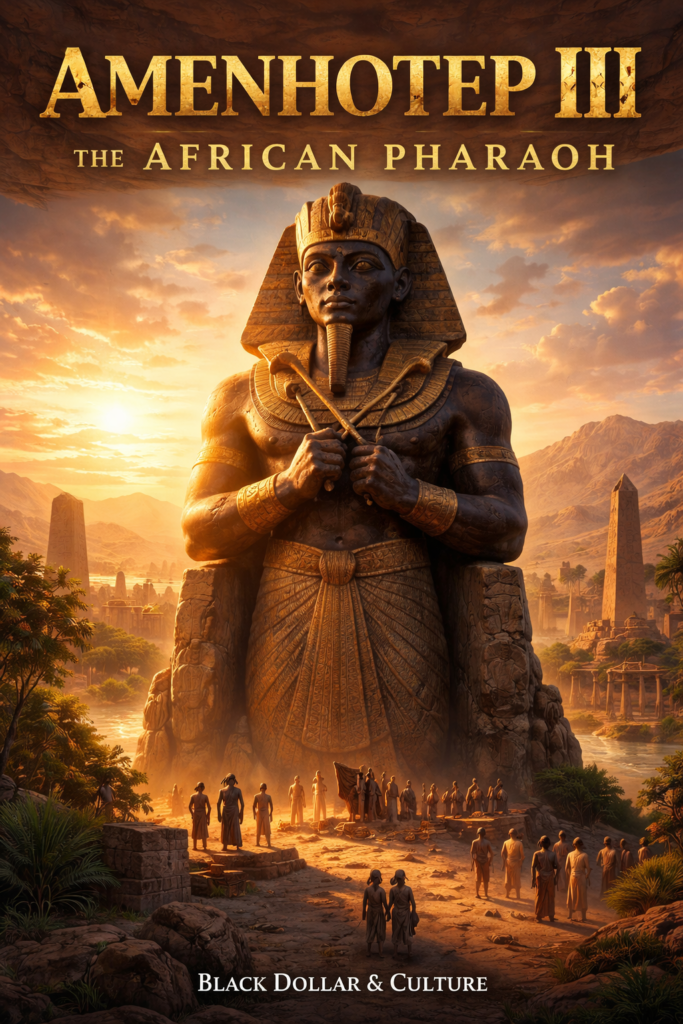
Long before decline, invasion, and distortion crept into the historical record, there was a moment when Egypt stood uncontested—politically, economically, culturally, and spiritually. That moment belonged to Amenhotep III. His reign was not built on constant warfare or desperate expansion, but on something far rarer in the ancient world: total dominance so complete that peace itself became a symbol of power. Under Amenhotep III, Egypt did not merely survive history—it defined it. He ascended the throne in the 14th century BCE, inheriting a kingdom already strong, but what he transformed it into was unprecedented. Egypt became the axis of the known world. Gold flowed through its cities like blood through arteries. Foreign kings did not challenge Egypt—they courted it. They sent tribute, daughters, luxury goods, and diplomatic letters not as equals, but as petitioners seeking favor from the African superpower seated along the Nile. This was not accidental. Amenhotep III ruled during a time when Nubian gold mines were fully operational, giving Egypt control over the most valuable resource of the Bronze Age. Gold was not symbolic—it was structural. It funded architecture on a scale never seen before, paid craftsmen whose skills bordered on divine, and allowed Egypt to project power without raising a sword. Where other empires conquered through fear, Egypt under Amenhotep III conquered through gravity. Everything was pulled toward it. The monuments tell the story even when the texts are ignored. Colossal statues rose from the earth not as propaganda, but as statements of reality. Temples were not hurried structures of defense but carefully planned expressions of eternity. The Colossi of Memnon—towering figures seated in silence—were not meant to intimidate enemies. They were meant to remind the world that Egypt, and its king, were permanent. These were not the works of a kingdom bracing for collapse, but of one utterly confident in its place atop human civilization. Amenhotep III did something few rulers in history ever achieved: he ruled so well that war became unnecessary. His foreign policy was built on diplomacy, marriage alliances, and economic leverage. The Amarna Letters—diplomatic correspondence between Egypt and other great powers—reveal foreign rulers openly begging for gold, addressing the pharaoh as a brother while knowing full well the imbalance between them. Babylon, Mitanni, Assyria—names that loom large in ancient history—all acknowledged Egypt’s supremacy during his reign. Inside Egypt, life reflected that stability. Art flourished, not as rigid symbolism but with softness, realism, and confidence. Faces gained individuality. Bodies showed movement and ease. This was the aesthetic of a society at peace with itself. Religion expanded as well, with Amenhotep III increasingly associated with divine attributes during his lifetime. He was not merely a king chosen by the gods—he was a living manifestation of cosmic order, Ma’at itself embodied in human form. It is no coincidence that his reign is remembered as the golden age. This was the apex—the point at which wealth, culture, spirituality, and global influence aligned perfectly. Everything before led to it. Everything after struggled to live up to it. Even his successors ruled in the long shadow he cast. His son, Akhenaten, would attempt to reshape religion entirely, not from weakness, but from the confidence inherited from a world already conquered by his father. Tutankhamun, whose name eclipsed Amenhotep III in modern popular culture, ruled a diminished echo of that greatness, remembered largely because the artifacts of his burial survived untouched. History, however, has a habit of obscuring African power when it becomes inconvenient. Amenhotep III is often reduced to a prelude, a name mentioned quickly before the so-called “interesting” period begins. But this framing is backwards. There is no later drama without his stability. There is no religious revolution without his wealth. There is no global Egypt without his diplomacy. He is not a footnote—he is the foundation. What makes Amenhotep III truly remarkable is not just what he built, but what he proved. He demonstrated that African civilization could dominate the world without perpetual violence. That wealth could be institutional, not extractive. That culture could be both sacred and luxurious. That leadership rooted in balance, not chaos, could sustain an empire at its absolute height. When Egypt is discussed as a mystery, as a marvel detached from Africa, Amenhotep III stands as a correction. His reign was unmistakably African in origin, power, and identity. The Nile was not a backdrop—it was the engine. The people were not passive laborers—they were participants in a civilization conscious of its greatness. This was not borrowed glory. It was built, refined, and ruled by Africans at the highest level humanity had yet seen. Amenhotep III did not rule during Egypt’s rise, nor its decline. He ruled at the peak—the summit where everything worked. And history has been trying to climb back there ever since. Slug: amenhotep-iii-african-pharaoh-egypt-absolute-peakMeta Description: Amenhotep III was the African pharaoh who ruled Egypt at its absolute peak of wealth, peace, diplomacy, and global power—an unmatched golden age in human history.