How to Invest in ETFs for Beginners (Step-by-Step)
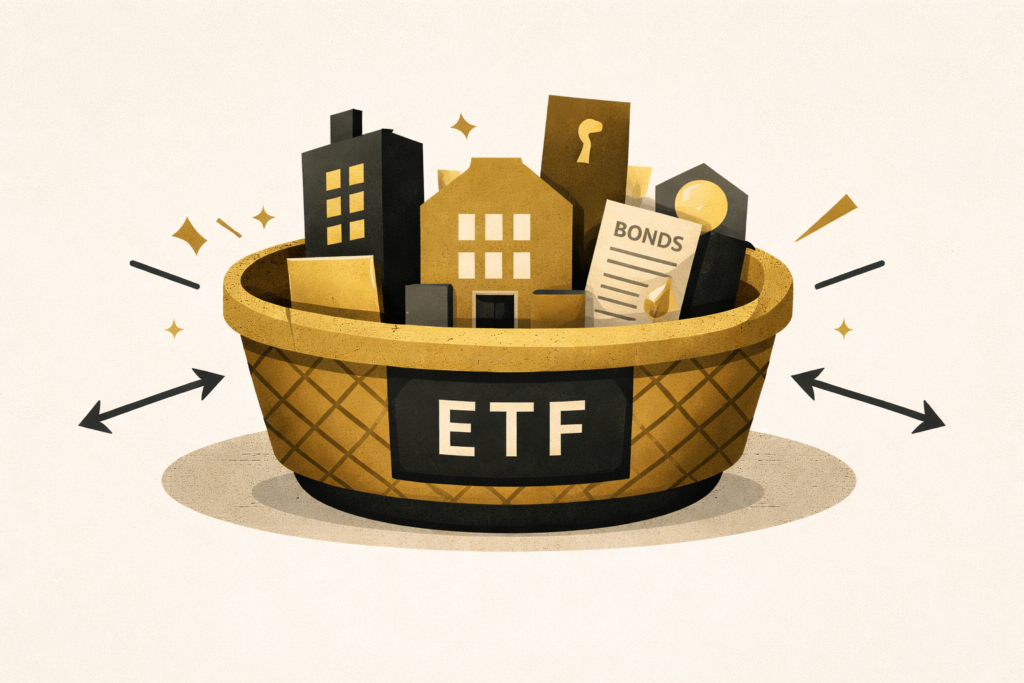
Most people don’t avoid investing because they’re lazy.They avoid it because Wall Street made it sound complicated on purpose. Charts, jargon, talking heads, and fear — all designed to make everyday people feel like investing is something other people do. People with suits, connections, or insider knowledge. The truth is much simpler. Exchange-traded funds — ETFs — were created so regular people could build wealth without needing to guess the next hot stock, time the market perfectly, or sit in front of screens all day. If you understand the basics and stay consistent, ETFs can quietly do the heavy lifting for you. This guide walks you through exactly how to invest in ETFs as a beginner, step by step. 1. What an ETF Actually Is (Plain English) An ETF (exchange-traded fund) is a collection of investments bundled together into one product that trades on the stock market. Instead of buying one company at a time, an ETF lets you buy small pieces of many companies at once. For example: When you buy an ETF, you’re not betting on one company — you’re betting on entire markets. That’s why ETFs are beginner-friendly: they reduce risk through diversification. 2. Why ETFs Are Ideal for Beginners ETFs solve many of the problems that stop people from investing in the first place. Low CostMost ETFs charge extremely low fees compared to traditional mutual funds. Over time, lower fees mean more money stays in your pocket. Instant DiversificationOne purchase can spread your money across dozens, hundreds, or even thousands of assets. Simple to UnderstandYou don’t need to analyze earnings reports or follow daily stock news. FlexibleETFs can be bought and sold just like stocks during market hours. For beginners, ETFs remove complexity without sacrificing growth. 3. Before You Invest: Set the Foundation Before buying any ETF, handle three basics first. Emergency CushionHave some cash set aside. Even $500–$1,000 helps prevent you from pulling investments out at the wrong time. High-Interest DebtCredit cards charging 20% interest will erase investment gains faster than the market can grow them. Clear GoalKnow why you’re investing. Retirement. Long-term wealth. Financial freedom. The goal determines how aggressive or conservative you should be. Investing works best when it supports your life — not when it creates stress. 4. Choose the Right Type of Account You don’t buy ETFs directly — you buy them through an account. The two main options: Taxable Brokerage AccountBest for flexibility. You can invest, withdraw, and add money anytime. You’ll pay taxes on gains. Retirement Accounts (IRA / Roth IRA / 401k)Designed for long-term wealth. Tax advantages make these powerful if you don’t need the money soon. If you’re unsure, many beginners start with a taxable brokerage and later add retirement accounts as income grows. 5. Understand Risk Without Fear Risk isn’t the enemy — misunderstanding it is. Stocks go up and down. That’s normal. ETFs smooth this volatility by spreading risk across many assets. As a beginner, your biggest risk is not investing at all. General rule: Time reduces risk. Panic increases it. 6. Beginner-Friendly ETF Categories You don’t need dozens of ETFs. Most beginners do well starting with just a few types. Total Market ETFsTrack the entire U.S. stock market. Broad, simple, effective. S&P 500 ETFsFocus on America’s largest companies. Historically strong long-term growth. International ETFsExpose you to markets outside the U.S. for global diversification. Bond ETFsProvide stability and income. Useful as your portfolio grows. Dividend ETFsFocus on companies that pay consistent dividends, offering income alongside growth. You don’t need everything — just balance. 7. How Much Money Do You Need to Start? There is no minimum “wealth level” to begin. Many ETFs allow: What matters is consistency, not size. A small amount invested regularly beats a large amount invested once and forgotten. 8. The Power of Dollar-Cost Averaging Dollar-cost averaging means investing the same amount on a schedule — regardless of market conditions. This approach: Markets reward patience, not prediction. 9. How to Place Your First ETF Trade The mechanics are simple. Once purchased, the real work is doing nothing. Overtrading hurts beginners more than market downturns. 10. How Often Should You Check Your Investments? Not often. Checking daily leads to emotional reactions. Long-term investing doesn’t require constant attention. A healthy rhythm: Wealth grows quietly — not through constant movement. 11. Common Beginner Mistakes to Avoid Chasing hypeIf everyone is talking about it, the opportunity is often already priced in. OvercomplicatingMore ETFs doesn’t mean better results. Selling during downturnsMarket drops are normal. Selling locks in losses. Ignoring feesSmall percentages compound over time — in either direction. Simplicity wins. 12. The Long View: Why ETFs Build Quiet Wealth ETFs don’t promise overnight riches. They promise something better: ownership, participation, and compounding over time. Many everyday investors built wealth not by brilliance, but by staying invested through recessions, booms, crashes, and recoveries. The market rewarded discipline, not drama. This is how wealth is built when no one is watching. Final Thought: Start Small, Stay Consistent You don’t need permission to invest.You don’t need perfect timing.You don’t need expert predictions. You need a plan, patience, and consistency. ETFs allow everyday people to participate in systems once reserved for institutions. Used correctly, they become quiet tools of freedom — growing in the background while you live your life. The best time to start was yesterday.The second best time is today. Focus Keyphrase how to invest in ETFs for beginners Slug how-to-invest-in-etfs-for-beginners Meta Description Learn how to invest in ETFs for beginners with this step-by-step guide from Black Dollar & Culture. Understand ETFs, reduce risk, and build long-term wealth with confidence.
How Banks Decide Who Gets Rich (And Who Stays Stuck)

Most people believe banks reward hard work, intelligence, or high income.They don’t. Banks reward behavior, predictability, and positioning inside the financial system. Long before wealth appears on the surface, banks have already classified individuals based on how they interact with money under pressure. This classification quietly determines who gets access, flexibility, and leverage — and who remains constrained. Let’s break it down step by step. 1. Banks Don’t See People — They See Risk Profiles Banks do not evaluate character, effort, or personal stories.They evaluate risk profiles. A risk profile is built from data: This data answers one core question:Is this person a liability or an asset? Someone can be intelligent, hardworking, and well-intentioned and still be labeled high risk if their profile shows inconsistency. Banks are not emotional. They respond to patterns. 2. Predictability Is More Valuable Than Income Income matters, but it is secondary. Predictability tells banks how someone behaves when money is tight. A person earning $60,000 who pays consistently, keeps balances low, and avoids volatility often receives better terms than someone earning $120,000 who lives at the edge of their limits. From a banking perspective: Banks lend other people’s money. Their goal is not generosity — it is certainty. 3. Credit Scores Measure Trust, Not Wealth A credit score is not a wealth indicator.It is a trust score. Banks use it to estimate: Every on-time payment slightly increases trust. Every missed payment tightens restrictions. Over time, these small signals accumulate into major differences in access. Trust compounds quietly. 4. Utilization Signals Dependence or Control How much credit someone uses compared to what they have available matters deeply. High utilization communicates one thing:Dependence on borrowed money. Low utilization communicates another:Access without desperation. Banks prefer borrowers who can borrow but don’t need to. This signals control, planning, and restraint — all qualities associated with lower default risk. 5. Banks Reward Good Behavior Indirectly Banks rarely announce when someone moves into a stronger category. Instead, the system responds subtly: People who stay stuck often think these advantages are reserved for others. In reality, they are responses to long-term behavioral patterns. Nothing dramatic happens.The rules simply loosen. 6. How Money Enters the System Changes Everything Earned income enters the financial system at a disadvantage. Taxes are removed immediately, and spending decisions are made with what remains. Ownership income enters differently. Businesses and asset holders touch money before expenses and taxes are finalized. This creates flexibility, write-offs, and control. From a bank’s perspective, control equals leverage. This is why two individuals earning the same amount can live entirely different financial lives. 7. Reactive Behavior Keeps People Stuck People who remain financially constrained often interact with banks reactively: This behavior keeps them visible as risks rather than participants. Banks do not punish this behavior.They simply do not reward it. 8. Strategic Positioning Changes Outcomes People who gain leverage interact with banks intentionally: They treat credit as a tool, not an emergency resource. Over time, this positioning shifts how the system responds to them. The system opens gradually — not suddenly. 9. Banks Don’t Decide Who Deserves Wealth This is where most people misunderstand the process. Banks do not decide who deserves to be wealthy. They decide who can handle leverage without collapsing under pressure. Their decisions are based on data, not judgment. Once this is understood, the goal changes: This shift is where access begins. 10. Wealth Is Authorized Before It Is Visible By the time wealth appears publicly, approval already happened quietly. Lower interest rates.Higher limits.Easier capital access.Room to recover from mistakes. These advantages are granted long before success is visible. Wealth is not random.It is authorized through behavior repeated over time. Final Word Banks do not create wealth.They gatekeep leverage. They decide who gets flexibility and who remains constrained based on predictable behavior, not effort or intention. Once you understand how banks think, the strategy becomes clear:position yourself as stable, disciplined, and low risk with long-term upside. That is how people stop being managed by the system and start operating within it. That is how people move from stuck to scalable. Focus Keyphrase How banks decide who gets rich Slug how-banks-decide-who-gets-rich-and-who-stays-stuck Meta Description Banks don’t reward hard work or income alone. This step-by-step breakdown explains how banks decide who gets access to leverage, lower rates, and wealth-building opportunities—and who stays financially stuck.
How Trusts Protect Assets From Lawsuits (And Why Most People Get It Wrong)

Most people believe that once assets are placed into a trust, they are automatically protected from lawsuits. That belief sounds comforting—but it’s often dangerously incomplete. Trusts can protect assets from lawsuits, but only when they are structured correctly, implemented early, and paired with the right legal principles. Otherwise, a trust may offer little more than a false sense of security. Asset protection is not about hiding money. It’s about changing ownership, limiting control, and placing legal distance between you and potential claims—before problems arise. To understand how trusts actually work in this context, we need to start with how lawsuits really take assets. When a lawsuit is filed and a judgment is entered, the opposing party is not looking for effort, intention, or fairness. They are looking for what you legally own and what you legally control. Bank accounts, real estate, investment accounts, business interests, and income streams are all evaluated through this lens. If an asset is considered yours—either because your name is on it or because you can freely access and control it—it may be reachable. This is where trusts come in, but not all trusts function the same way. A trust works by separating three roles: the person who creates the trust (the grantor), the person who manages the trust (the trustee), and the person who benefits from the trust (the beneficiary). Asset protection becomes possible when these roles are structured so that the grantor no longer has direct ownership or unrestricted control. In other words, protection comes from distance, not paperwork. One of the most common mistakes people make is assuming that a revocable living trust provides lawsuit protection. Revocable trusts are popular because they are flexible—you can change them, cancel them, and move assets in and out at will. However, from a lawsuit perspective, that flexibility is the problem. If you retain the power to revoke the trust or freely reclaim the assets, a court may still treat those assets as yours. In many cases, revocable trusts offer little to no protection from creditors. Irrevocable trusts operate differently. While “irrevocable” does not mean untouchable, it does mean that the grantor gives up certain rights and powers. That loss of control is precisely what can create asset protection. When structured properly, an irrevocable trust can place assets outside the grantor’s personal ownership, making it significantly more difficult for a creditor to reach them. Several mechanisms inside a trust determine whether it actually protects assets. One is legal ownership. If the trust, not the individual, owns the asset—and the individual cannot unilaterally reclaim it—that asset may be insulated from personal lawsuits. Another mechanism is the spendthrift provision, which can limit a beneficiary’s ability to transfer or pledge their interest and may restrict a creditor’s ability to force distributions. Trustee discretion also matters. When distributions are controlled by a trustee and not guaranteed on demand, creditors often face additional legal barriers. Timing is critical. Asset protection is strongest when trusts are established before there is any known claim, dispute, or legal threat. Moving assets into a trust after being sued—or after anticipating a lawsuit—can trigger fraudulent transfer laws. Courts have the power to reverse those transfers, effectively undoing the protection and potentially making the situation worse. This is why asset protection is about planning, not panic. Trusts are often used in combination with other protective tools. Real estate, for example, may be owned by an LLC to contain liability, with the ownership interest of that LLC held by a trust. Business interests may be structured so operational risk stays separate from personal wealth. Investment accounts can be titled in the name of a trust depending on the overall strategy. In each case, the trust is not the only line of defense—it is part of a layered system. The most common reason trusts fail in court is simple: too much control. When the same person is the grantor, trustee, and beneficiary—and can revoke the trust at any time—the legal separation collapses. Courts are not obligated to honor structures that exist in form but not in substance. Real protection usually requires real boundaries, sometimes including an independent trustee and clearly defined limits on access. From a BD&C perspective, trusts should be viewed as ownership tools, not magic shields. True protection comes from layering: reducing risk through smart behavior, transferring risk through insurance, containing risk through entities like LLCs, and then structuring ownership through trusts. Each layer reinforces the others. Trusts can protect assets from lawsuits—but only when they are built deliberately, early, and correctly. Wealth is not just about what you earn. It’s about what you can keep, control, and pass forward. Understanding how trusts really work is part of moving from income thinking to ownership thinking. This article is for educational purposes only and does not constitute legal advice. Asset protection strategies vary by jurisdiction, and qualified legal counsel should be consulted for individual circumstances. If you wait until risk shows up, it’s already too late. Asset protection only works before courts, creditors, or claims enter the picture. An Irrevocable Life Insurance Trust (ILIT) is one of the few tools that can legally remove life insurance from your estate and protect it from lawsuits — but only if it’s structured correctly. This guide breaks down exactly how ILITs work, when to set them up, and the mistakes that quietly expose families every day. Read the ILIT Guide now and secure the structure while you still control the outcome → Get Your Family Wealth Trust Blueprint Now Historically, the families who preserved wealth didn’t do it by reacting to threats—they built systems before threats ever appeared. Ownership structures, trusts, and layered protection weren’t accidents; they were deliberate moves. If you want to continue learning how real wealth is protected and transferred, explore more at Black Dollar & Culture and start building with intention, not urgency. Focus Keyphrase How trusts protect assets from lawsuits Meta Description Learn how trusts protect assets from lawsuits, why revocable trusts often fail, how irrevocable
Elijah McCoy: The Black Inventor Whose Genius Became the Standard for the World

Elijah McCoy was born into a nation that benefited from Black intelligence while refusing to honor it. The son of formerly enslaved parents, McCoy entered a world where freedom existed on paper, but opportunity did not. Yet even inside that reality, his mind operated on a level so advanced that the industrial world was forced to adapt to him—even while trying to erase his name. From an early age, McCoy displayed a rare mechanical brilliance. His parents, recognizing what they had, made an extraordinary sacrifice and sent him to Scotland to study mechanical engineering. At a time when most Black Americans were barred from formal education, McCoy became fully trained in the science of machinery, precision systems, and industrial mechanics. He returned to the United States prepared to work as an engineer—but America refused to let him be one. Instead, McCoy was hired as a railroad fireman and oiler, jobs far beneath his qualifications. But what appeared to be a demotion became an advantage. Inside the belly of the industrial machine, McCoy observed a problem no one else was equipped to solve. Steam engines powered the economy, but they were inefficient. They had to be stopped repeatedly so workers could manually lubricate moving parts. Every stop meant lost time, wasted money, and reduced productivity. McCoy saw the flaw clearly—and he fixed it. He designed an automatic lubrication system that allowed engines to oil themselves while running. Machines no longer needed to shut down. Railroads ran longer. Factories became more efficient. Heavy machinery gained endurance and reliability. His invention quietly transformed industry, setting a new standard for how machines should operate. The impact was immediate and undeniable. McCoy’s lubrication systems were so effective that inferior copies flooded the market. But engineers and buyers quickly learned the difference. They refused substitutes. When ordering equipment, they demanded only the authentic design. They wanted the real McCoy. That phrase—now used worldwide to describe authenticity and excellence—was born directly from the work of a Black inventor whose name history often omits when repeating it. Over his lifetime, Elijah McCoy secured more than 50 patents, many centered on lubrication systems, mechanical efficiency, and industrial improvement. Yet like so many Black innovators, he struggled to benefit financially from his own brilliance. Racism blocked access to investors, manufacturers, and ownership opportunities. Corporations and industries thrived using systems inspired by his ideas, while McCoy himself lived without the wealth his inventions generated. Still, his legacy could not be denied. Every modern engine designed for continuous operation carries his influence. Every industrial system built to reduce friction, prevent failure, and maximize efficiency reflects his thinking. McCoy did not simply invent devices—he defined reliability itself. His life exposes a larger truth: Black inventors were not behind progress. They were ahead of it. They built the backbone of modern industry while being denied credit, capital, and protection. Elijah McCoy’s genius was so undeniable that the world immortalized his name as a guarantee of quality—even while refusing to properly honor the man behind it. Elijah McCoy is not a footnote. He is a foundation. And understanding his story is not just about the past. It is about reclaiming the truth of who built the systems that still power the world today. 🔑 Focus Keyphrase Elijah McCoy Black Inventor 🔗 Slug elijah-mccoy-black-inventor-real-mccoy 🧾 Meta Description Elijah McCoy was a revolutionary Black inventor whose engineering genius transformed the Industrial Age and inspired the phrase “the real McCoy,” now a global symbol of authenticity and excellence.
Benjamin Banneker: The Man Who Measured the Stars and Helped Build America

Benjamin Banneker was born in 1731 in rural Maryland, at a time when knowledge was tightly controlled and opportunity was rationed by class, race, and access. He was born free, yet freedom in colonial America did not include schools, institutions, or formal pathways into science or public life. What Banneker possessed instead was an uncommon discipline of mind, a relentless curiosity, and the ability to teach himself in a world designed to exclude him. From an early age, Banneker demonstrated a deep attentiveness to patterns. He observed the movement of shadows, the rhythm of seasons, the cycles of the moon, and the quiet logic underlying numbers. These observations were not passive. They became the foundation of a rigorous self-education in mathematics, astronomy, mechanics, and natural philosophy. Without classrooms or instructors, he relied on borrowed books, correspondence, and repeated experimentation. Knowledge, for Banneker, was not inherited or granted — it was earned through persistence. One of his earliest achievements revealed the breadth of his mechanical intelligence. After examining a pocket watch, Banneker constructed a fully functional wooden clock entirely by hand. At a time when precision timekeeping was rare and highly specialized, his clock reportedly kept accurate time for decades. This was not novelty craftsmanship. It was applied engineering — a synthesis of measurement, geometry, and mechanical reasoning executed with remarkable precision. Banneker’s attention soon turned upward to the night sky. Astronomy in the eighteenth century demanded advanced mathematical ability, extended observation, and exact calculations. Without formal training, Banneker mastered celestial mechanics well enough to calculate planetary positions, track lunar cycles, and accurately predict eclipses. These were not theoretical exercises. They became published data used by others. Between 1791 and 1796, Banneker authored and published a series of almanacs containing astronomical calculations, weather forecasts, tide tables, and practical information essential for farmers, navigators, and merchants. Almanacs were critical tools in early American life, shaping agricultural planning and commerce. Banneker’s editions were valued for their accuracy and circulated widely throughout the Mid-Atlantic region. His work entered daily life quietly, efficiently, and without spectacle. It was this reputation for precision that brought Banneker into one of the most consequential projects of the young nation: the surveying of the federal district that would become Washington, D.C. In 1791, he was appointed as an assistant to the survey team responsible for mapping the boundaries of the future capital. Using astronomical observations and mathematical calculations, Banneker helped establish the layout of the city. According to historical accounts, when the original design plans were lost following the departure of the chief planner, Banneker reproduced the layout from memory — an extraordinary demonstration of spatial reasoning and intellectual command. At the same time, Banneker understood that knowledge carried moral responsibility. In 1791, he wrote a carefully reasoned letter to Thomas Jefferson, then Secretary of State, addressing the contradiction between Jefferson’s stated belief in liberty and his participation in slavery. Banneker did not rely on rhetoric alone. He appealed to logic, evidence, and shared Enlightenment principles. Enclosed with the letter was a copy of his almanac — not as a plea for validation, but as proof of intellectual equality grounded in demonstrable work. Jefferson responded respectfully and forwarded Banneker’s almanac to intellectual circles in Europe. Yet the system itself remained intact. Still, the exchange endures as one of the most direct intellectual challenges to slavery issued during the early republic — a reminder that resistance did not always take the form of protest, but often appeared as clarity, data, and moral precision. Banneker lived the remainder of his life quietly. He never married, never accumulated wealth, and never sought public acclaim. In 1806, after his death, much of his work was lost in a fire that consumed his home. What survived did so unevenly — scattered across letters, publications, and partial historical records. Over time, his role in the nation’s formation was minimized, simplified, or omitted altogether. Yet Benjamin Banneker cannot be reduced to a symbol or an exception. He was a builder of systems, a producer of usable knowledge, and a contributor to the physical and intellectual infrastructure of the United States. His life stands as evidence that disciplined thought does not require permission, and that nation-building has always depended on minds history later chose not to emphasize. To study Benjamin Banneker is to confront a deeper truth about America’s origins: that progress was shaped not only by those whose names dominate monuments, but by thinkers whose work spoke for itself long before recognition followed. His legacy is not confined to clocks, almanacs, or survey lines. It is the enduring reminder that knowledge, once proven, cannot be erased — only delayed. Focus Keyphrase:Benjamin Banneker Washington DC Slug:benjamin-banneker-washington-dc Meta Description:Discover the true story of Benjamin Banneker, the self-taught polymath whose astronomical calculations and surveying work helped shape Washington, D.C., and challenged the contradictions of America’s founding ideals.
Why Your Paycheck Is the Least Important Part of Your Financial Life

Most people believe the key to financial security is earning more money. A bigger paycheck. A raise. A promotion. Another side hustle. And while income matters, this belief hides a dangerous truth: A paycheck is not wealth. It’s just a tool. If your entire financial plan depends on a paycheck continuing forever, you don’t have stability—you have exposure. And the system understands this far better than most people do. This is why some households earn six figures and still struggle, while others earn less but quietly build lasting wealth. Let’s break down what really matters. 1. A Paycheck Is Temporary by Design A paycheck depends on factors you don’t fully control: No matter how good the job is, a paycheck only exists as long as someone else allows it. Wealth, on the other hand, is designed to function without your daily presence. That’s the first major distinction most people are never taught. 2. Banks Don’t Respect Income — They Respect Structure Here’s something the system doesn’t advertise: Banks don’t analyze you emotionally.They analyze you structurally. They look at: A high income with no structure is treated as fragile.A modest income with assets, reserves, and discipline is treated as stable. This is why two people earning the same amount can be treated completely differently by financial institutions. 3. Income Is Fuel — Not the Destination Think of your paycheck like gasoline. Gas is necessary, but nobody confuses gas with the vehicle. Your paycheck should be used to: If all of your income is consumed by lifestyle, bills, and survival, then your paycheck is doing exactly what the system expects it to do: keep you running, but never arriving. 4. Ownership Outlives Effort Here’s the uncomfortable truth: You can work hard forever and still pass down nothing. Ownership is what survives: This is why wealthy families talk about control, not just cash. Cash gets spent. Control compounds. When income stops, ownership continues. 5. The Real Risk Is Dependency, Not Low Income Low income can be improved.High dependency is dangerous. If missing two paychecks would collapse your life, the issue isn’t how much you earn—it’s how exposed your financial structure is. True financial growth focuses on: Wealth isn’t loud. It’s resilient. 6. A Simple Shift That Changes Everything Instead of asking: “How can I make more money?” Start asking: “How can I make my money less necessary?” That question changes how you: This is where real financial freedom begins—not with hustle, but with intention. Final Thought Your paycheck is important—but it was never meant to be the foundation of your financial life. It’s a tool.A bridge.A starting point. The goal isn’t to earn forever.The goal is to build something that no longer requires permission. And once you understand that, you stop chasing money—and start designing stability. 📣 Keep the Conversation Going If this perspective shifted how you think about money, share this with someone who’s grinding but not building. Then explore more wealth-building strategies at Black Dollar & Culture, where we focus on ownership, structure, and legacy—because no one is coming to save us, and we don’t need them to. #BlackDollarCulture #FinancialLiteracy #WealthMindset #OwnershipEconomy #GenerationalWealth #FinancialFreedom #BuildTheBlock #QuietWealth #MoneyEducation #EconomicEmpowerment Focus Keyphrase: why paycheck is not wealthMeta Description: Most people chase bigger paychecks while ignoring ownership, structure, and control. Learn why income is the least important part of real wealth.Slug: why-your-paycheck-is-not-wealth
Why One Missed Payment Changes How Banks See You (Most People Don’t Know This)

Most people think a missed payment is a small mistake. An accident. Something you can “catch up on next month.” But inside the financial system, a missed payment is not treated as an accident at all. It is treated as a signal. Not a loud signal. A quiet one. And quiet signals are often the most dangerous, because you don’t feel the damage immediately — but institutions adjust their behavior toward you long before you realize anything has changed. When a payment is missed, banks don’t ask why. Credit bureaus don’t care about context. Algorithms don’t measure intent. They measure behavior. One late payment tells the system something very specific: reliability has shifted. That shift doesn’t always show up as an immediate credit score collapse. In fact, that’s what makes it deceptive. Many people check their score after a missed payment and feel relieved. “It didn’t drop that much,” they say. But scores are only the surface layer. Beneath that number is a behavioral profile that lenders study far more closely than most people realize. Banks track patterns, not apologies. A missed payment introduces friction into your financial reputation. It changes how future decisions are made about you. Credit limits. Approval speed. Interest rates. Even which offers you’re allowed to see. You may never receive a rejection letter that says, “We noticed that one time you slipped.” Instead, you’ll experience something subtler: higher costs, slower approvals, fewer second chances. This is where people misunderstand the system. They believe recovery is immediate once the balance is paid. But trust, once dented, doesn’t snap back into place. It rebuilds slowly, over time, through consistency — not explanations. Financial institutions are not emotional. They are statistical. A single missed payment tells the system you are capable of disruption. And from a lender’s perspective, risk is not about how often something happens. It’s about whether it can happen again. That’s why two people with the same credit score can be treated very differently. One may have a clean behavioral record. The other may have a single late mark buried in their history. On paper, they look equal. In practice, they are not. This is also why missed payments matter more during certain windows. Early in a credit relationship, a missed payment weighs heavier. During periods of economic tightening, it weighs heavier. When interest rates are high and capital is cautious, lenders become less forgiving — not more. Timing amplifies consequences. The most dangerous part is that missed payments often happen during stress — illness, job changes, emergencies. Exactly when people are least equipped to absorb additional financial pressure. The system doesn’t pause during hardship. It documents it. That documentation follows you quietly. And while most people focus on “fixing” the missed payment, the more important move is preventing the next one. Systems reward predictability above all else. Autopay, buffers, conservative limits — these aren’t convenience tools. They’re defensive strategies. Wealthy households don’t rely on memory. They rely on systems. They assume life will interrupt. They assume distractions will happen. And they build financial structures that protect their reputation even when attention slips. Because they understand something most people are never taught: your financial reputation is more valuable than your money. Money can be replaced. Trust takes time. This is why a missed payment is not just a late fee. It’s not just interest. It’s a data point that lives in places you don’t see, influencing decisions you didn’t know were being made. The warning isn’t dramatic. It’s quiet. But it’s major. Understanding this changes how you move. It changes how you set up accounts. It changes how seriously you treat “small” delays. Because once you understand how the system thinks, you stop treating missed payments as minor mistakes — and start treating them as avoidable signals. Signals that decide how expensive your future becomes. Focus Keyphrase: missed payment financial warningSlug: missed-payment-major-warningMeta Description: A missed payment is more than a mistake—it’s a signal to banks and lenders. Learn how one late payment quietly changes your financial reputation and future costs.
Retirement Is a Scam: The System That Keeps You Working Until You Die

They sold us a picture—sunsets, cruises, rocking chairs, and finally “rest.” A promise that if you obeyed long enough, stayed loyal long enough, and worked hard enough, freedom would eventually arrive. But here’s the truth they never put in the brochure: retirement was never designed to free you. It was designed to manage you. From the moment you enter the workforce, the clock starts. Not the one on the wall—but the invisible one counting how long your labor can be extracted before your body slows down. You’re taught to trade the strongest years of your life for a future version of yourself that may never arrive. And if it does arrive, it often shows up tired, sick, underfunded, and still dependent. The system doesn’t ask whether you’ll live long enough to enjoy retirement. It only asks whether you’ll keep contributing. Pensions disappeared quietly. Social Security became “uncertain.” 401(k)s were sold as empowerment while shifting all the risk onto you. Markets go up, markets crash, inflation eats quietly, and fees drain consistently. Meanwhile, you’re told to “stay the course,” even as the goalposts move further away. Retire at 65. No, 67. Maybe 70. Work a little longer. Just a few more years. But here’s the part that exposes the scam completely: the wealthy don’t retire. They don’t stop owning. They don’t stop earning. They don’t wait for permission to rest. They build systems—assets that produce whether they wake up early or sleep in, whether the market is red or green, whether they’re present or absent. While workers are taught to save until the end, owners are taught to cash flow from the beginning. Retirement is a concept designed for people who don’t own anything. If your income stops when you stop working, you are not free—you are leased. And the retirement system simply extends that lease until your final years, hoping your savings outlast your breath. That’s not a plan. That’s a gamble. Inflation makes this even crueler. Every year, the dollar quietly loses strength. What you saved yesterday buys less tomorrow. So even if you “did everything right,” the finish line keeps drifting. Healthcare costs rise faster than savings. Housing becomes unstable. Food gets expensive. Energy costs surge. And suddenly the dream years become survival years. This is why so many retirees go back to work—not because they’re bored, but because the math no longer works. The truth is uncomfortable, but it’s liberating once you see it: the real goal was never retirement. The real goal was dependency. A population waiting on checks, fearful of market swings, hesitant to speak up, cautious not to disrupt the system they rely on. Ownership breaks that spell. When you own cash-flowing assets—businesses, real estate, royalties, equity—you don’t wait for retirement. You design your life in phases. You shift labor into leverage. You trade time-for-money income for money-that-produces-more-money. That’s the path they don’t emphasize, because it doesn’t keep you predictable. This doesn’t mean rest is wrong. It means postponing life until the end is a trap. Freedom isn’t an age. It’s a structure. And the earlier you build that structure, the less power the system has over you. You don’t need millions to start. You need clarity. You need a shift from “How do I save enough?” to “How do I own enough?” You need income streams that don’t expire at 65. You need education that focuses on assets, not just employment. Retirement is a scam—but exiting the scam is possible. The moment you stop chasing a finish line and start building a foundation, everything changes. You stop asking for permission. You stop waiting. You stop hoping the system keeps its promise. Because it never planned to. And that’s the quiet truth they never taught us—but the one that changes everything once you understand it. ❤️ Support Independent Black Media Black Dollar & Culture is 100% reader-powered — no corporate sponsors, just truth, history, and the pursuit of generational wealth. Every article you read helps keep these stories alive — stories they tried to erase and lessons they never wanted us to learn. This is why conversations like this matter. Not to scare you—but to wake you up. If this perspective shifted something in you, share it, bookmark it, and start asking different questions about money, ownership, and freedom. The exit from the trap doesn’t begin at retirement—it begins with what you build right now.👉 Read more and build with us at BlackDollarCulture.blog Hashtags#RetirementIsAScam #BlackDollarCulture #WealthEducation #FinancialFreedom #OwnershipMindset #GenerationalWealth #AssetsOverIncome #EscapeTheSystem #BuildTheBlock Focus Keyphrase: Retirement is a scamMeta Description: Retirement is a scam designed to keep workers dependent while owners build freedom. Learn why ownership—not retirement—is the real path to financial independence.Slug: retirement-is-a-scam
Money Rules the Rich Teach Their Kids (But Never Say Out Loud)

In certain households, money is never treated as a mystery. It’s not emotional, not dramatic, and not taboo. It’s discussed quietly, observed daily, and understood long before adulthood. Wealthy families rarely sit their children down and announce that they are about to teach them “the secrets of money.” Instead, they teach through behavior, structure, and repetition. By the time their children grow up, they don’t just earn money — they control it. One of the first unspoken lessons is that money is not the goal. In wealthy homes, money is framed as a tool. It exists to buy time, flexibility, and options. Children raised in these environments don’t chase money for validation. They learn that money is useful, but never emotional. This alone changes decision-making for life. When money loses its emotional charge, logic replaces impulse. Another quiet rule is that assets come before lifestyle. Wealthy parents do not rush to upgrade their lives every time income increases. Children grow up watching adults acquire businesses, equity, or income-producing assets before buying luxuries. The message isn’t spoken — it’s demonstrated. Lifestyle is something assets pay for, not something income is sacrificed to maintain. This creates patience and discipline that most people never develop. Jobs are also framed differently. In many households, a job is treated as the ultimate achievement. In wealthy families, a job is simply seed capital. Children hear conversations about using income to fund investments or ownership. Work is never positioned as identity. It’s positioned as leverage. As a result, wealthy children don’t grow up asking how to climb the ladder — they ask how to exit it. Ownership is the core principle behind everything. Cash is seen as temporary, while assets are permanent. Wealthy children grow up around deeds, shares, businesses, and partnerships. They understand early that ownership creates control, stability, and power. Saving money is respected, but hoarding cash is not glorified. Cash that isn’t deployed is seen as idle potential. Debt is another concept that’s handled with precision. In many families, debt is feared or misunderstood. In wealthy households, debt is treated like a tool that can either build or destroy depending on how it’s used. Children see debt used to acquire income-producing assets, never depreciating purchases meant for status. This distinction becomes second nature. Taxes are never framed emotionally either. Wealthy families don’t complain about taxes — they plan around them. Children overhear conversations about structure, strategy, and legal optimization. They learn early that taxes are not a punishment for success, but a penalty for ignorance. This understanding alone saves wealthy families millions over generations. One of the most powerful lessons is rarely spoken aloud: never sell an appreciating asset if you can borrow against it. Wealthy families hold onto assets and use loans for liquidity. This keeps ownership intact while allowing access to cash. Children raised with this mindset understand that selling stops compounding, while borrowing preserves it. Time is emphasized more than timing. Wealthy families teach patience by example. Children watch compounding happen slowly, then suddenly. They learn that starting early matters more than being perfect. Fast money loses its appeal when long-term growth proves unstoppable. Risk is not avoided — it’s managed. Wealthy parents don’t raise fearful children. They raise informed ones. Through diversification, insurance, and long-term planning, risk is reduced to something measurable rather than something terrifying. Children learn that avoiding risk entirely guarantees stagnation. Lifestyle inflation is quietly resisted. As income rises, expenses remain controlled. Children see adults live below their means while assets expand behind the scenes. This discipline protects future freedom and prevents wealth from leaking away unnoticed. Network is treated as an asset as well. Wealthy children grow up in environments where opportunity feels normal. Rooms matter. Conversations matter. Access changes outcomes faster than effort alone. This exposure shapes expectations for life. Perhaps the most important lesson is that wealth is taught at home. Schools are never relied upon to teach money. Children learn through participation, observation, and real-world involvement. Family discussions replace financial secrecy. Transparency replaces confusion. Finally, wealthy families value privacy. Quiet wealth is protected wealth. Flash is avoided. Attention is unnecessary. Power moves silently. Children learn that true wealth doesn’t need applause. By the time wealthy children become adults, the rules are already embedded. They don’t chase money. They deploy it. They don’t fear it. They control it. And that is the difference no one ever says out loud. Focus Keyphrase: money rules the rich teach their kids Meta Description: Explore the unspoken money rules wealthy families teach their children—covering assets, ownership, debt, taxes, discipline, and legacy thinking schools never explain. Slug: money-rules-the-rich-teach-their-kids
If Your Phone Is Making Money While You Sleep, You’ve Escaped the System

Most people go to sleep hoping tomorrow will be better. Sir Wealthington goes to sleep knowing tomorrow already paid him. That difference is everything. While the world teaches us to grind harder, wake up earlier, and trade more hours for dollars, the wealthy quietly build systems that work whether they’re awake or not. That’s why the image of Sir Wealthington sleeping peacefully while his phone lights up with money notifications isn’t fantasy — it’s a blueprint. Because real wealth doesn’t clock in. It compounds. For decades, Black communities have been taught survival instead of ownership. We were trained to hustle for checks instead of designing systems that generate them. The result? Exhaustion, burnout, and generations stuck restarting instead of scaling. Money that only pays you when you’re awake isn’t freedom. It’s dependency. The truth is simple but uncomfortable: if your income stops when you stop working, you don’t own your time — your job does. And no matter how good the salary looks on paper, time is the only asset you can’t refinance, renegotiate, or replace. This is where passive income gets misunderstood. It’s not about doing nothing. It’s about doing the right work once — then letting it pay you repeatedly. Sir Wealthington didn’t fall asleep rich. He engineered it. He built assets that notify him instead of supervisors. His phone doesn’t buzz with alarms — it buzzes with confirmations. Dividends clearing. Digital sales closing. Royalties posting. Interest compounding. Systems executing. That’s the goal. The wealthy don’t ask, “How much can I make this month?”They ask, “What can I build that pays me forever?” This mindset shift is critical. Because earned income has limits. There are only so many hours in a day. But ownership income has no ceiling. One asset can pay you a hundred times, a thousand times, or a million times over without asking for overtime. Think about it: music artists sleep while streams generate revenue. Authors sleep while books sell. Investors sleep while dividends hit accounts. Business owners sleep while systems operate. Workers sleep hoping their alarm doesn’t go off too early. That’s not accidental. That’s design. And design starts with understanding the difference between income and wealth. Income feeds you today. Wealth feeds generations. This is why wealthy families prioritize assets early. They buy cash-flowing tools before luxury toys. They reinvest before they reward themselves. They make money boring before they make it flashy. Sir Wealthington’s pajamas tell the story. Covered in dollar signs, but calm. No stress. No scramble. No panic. Because systems don’t panic — people do. Ownership brings peace. Systems bring sleep. Now let’s be clear: passive income is not lazy income. It requires discipline, patience, and delayed gratification. But unlike a job, the work is front-loaded. You build once, refine often, and collect continuously. That’s why many never reach it — they want immediate comfort instead of long-term leverage. Black wealth doesn’t disappear because we don’t work hard. It disappears because we were never taught to lock it in. To structure it. To protect it. To make it repeat. The system didn’t reward ownership education. It rewarded compliance. But the moment you understand how money works while you sleep, everything changes. You stop asking for raises and start building revenue streams. You stop chasing promotions and start acquiring positions. You stop worrying about layoffs because your income isn’t tied to someone else’s decisions. This is the real flex: peace. Imagine sleeping without anxiety because your bills are automated and your income is diversified. Imagine waking up without urgency because your assets already moved while you rested. That’s not luck. That’s leverage. Sir Wealthington doesn’t check his phone in the morning with fear. He checks it with confirmation. And this isn’t reserved for the elite. Digital assets, dividend investing, intellectual property, automated businesses, licensing, and ownership structures are more accessible today than ever before. The barrier isn’t access — it’s mindset. If you’re still trading hours for survival, you’re playing defense. Wealth requires offense. The goal isn’t to work less — it’s to work smarter, then let the work outlive the effort. Money that sleeps with you is loyal. Money that only pays when you show up is temporary. The real question isn’t whether you can build income streams.It’s whether you’re willing to stop being comfortable long enough to design them. Sir Wealthington didn’t escape the system by accident.He replaced it. And tonight, while most people sleep hoping,his phone will buzz again. ❤️ Support Independent Black Media Black Dollar & Culture is 100% reader-powered — no corporate sponsors, just truth, history, and the pursuit of generational wealth. Every article you read helps keep these stories alive — stories they tried to erase and lessons they never wanted us to learn. Focus Keyphrase: money working while you sleepSlug: money-working-while-you-sleepMeta Description: Discover why real wealth is built through systems that generate income while you sleep — and how ownership, not hustle, creates peace and generational power.